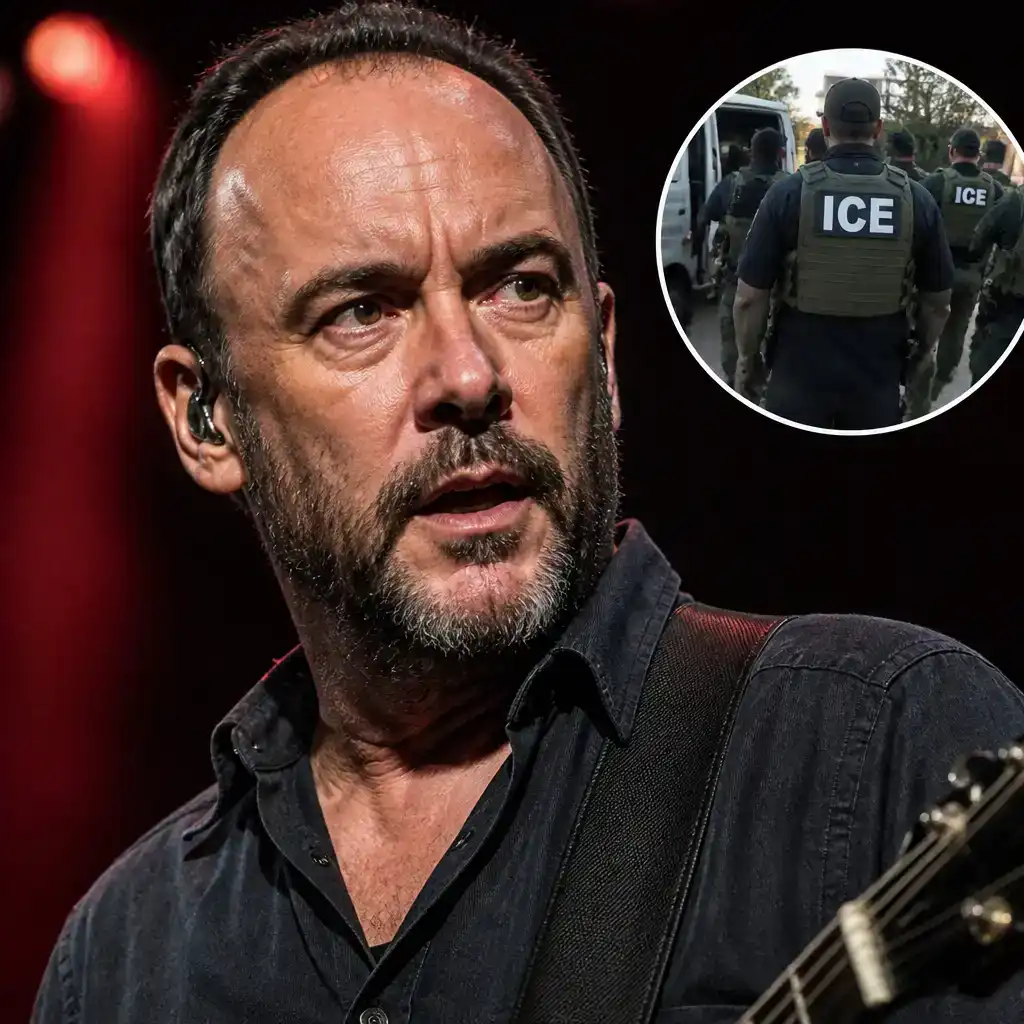
Dave Matthews has delivered a sharp rebuke of federal immigration enforcement, accusing Immigration and Customs Enforcement (ICE) agents of intimidating American communities and questioning why taxpayers should be funding their operations.
The Dave Matthews Band frontman made his position unmistakable in remarks quoted by Rolling Stone, taking aim at the federal agency amid a heated national debate over President Donald Trump's immigration policies.
“I don’t want my taxes to pay for ICE thugs to roam our streets and terrorize our communities,” Matthews said.
It is a strikingly direct statement from a musician whose career has largely been associated with sold-out concerts, sprawling live performances and a devoted fanbase. This time, however, Matthews is addressing a question far removed from the concert stage: what happens when Americans fundamentally disagree with how their government spends their money?
Dave Matthews takes direct aim at ICE enforcement
Matthews' criticism focuses on two closely connected issues: the conduct of federal immigration agents and the public money supporting their activities.
His choice of language leaves little room for ambiguity. By describing ICE personnel as “thugs” and accusing them of terrorizing communities, the singer is making a serious allegation about the agency's approach to enforcement.
Those descriptions reflect Matthews' assessment rather than independently established findings about particular operations. The remarks provided do not identify specific incidents, agents or enforcement actions that prompted his comments.
That distinction matters. Criticism of immigration enforcement can involve documented disputes over individual operations, broader objections to government policy or concerns about how federal authority is exercised. Matthews' statement expresses his opposition forcefully, but does not establish the details of any particular case.
What it does establish is that the musician does not regard immigration enforcement as simply another government function deserving unquestioned financial support.
Why taxpayer money is central to Matthews' criticism
The most revealing part of Matthews' statement may be his reference to taxes.
Rather than limiting his criticism to the behavior of immigration officers, he challenges the principle of using public funds to support enforcement practices he considers harmful.
ICE is a federal law enforcement agency responsible for immigration enforcement and other investigative functions. Its operations are supported by government funding, making decisions about its resources part of the wider political debate over federal spending and immigration priorities.
Matthews' objection effectively places ordinary taxpayers inside that debate. His argument is not simply that he dislikes what the agency is doing, but that he resents being financially connected to activities he believes are damaging communities.
There is, of course, an important difference between objecting to how tax revenue is spent and having the legal ability to withhold taxes from particular government programs. Individual taxpayers generally cannot choose which federal agencies receive their contributions.
Still, Matthews' language highlights a broader democratic question: how should elected officials respond when citizens believe government-funded enforcement is being carried out in ways that conflict with their values?
The wider battle over Trump's immigration policies
The comments arrive against the backdrop of continuing controversy surrounding the Trump administration's approach to immigration enforcement.
Federal immigration operations have become a prominent political flashpoint, particularly where questions arise about the relationship between national enforcement priorities, local authorities and the communities affected.
Supporters of stricter immigration enforcement generally argue that federal agencies must be able to carry out immigration laws and that enforcement is an essential responsibility of government.
Critics, meanwhile, question the methods used by enforcement agencies, the treatment of people targeted by operations and the consequences for communities where those operations take place.
Matthews has placed himself firmly within the critical camp.
His remarks do not set out a detailed alternative immigration policy, nor do they distinguish between different categories of enforcement activity. Instead, they deliver a moral and political objection to the conduct he associates with ICE.
That makes the statement easy to understand, even if the underlying policy questions are considerably more complicated.
Why Matthews' intervention matters beyond music
Dave Matthews is best known as the frontman of Dave Matthews Band, a group that built an enduring following through its distinctive blend of rock, jazz and improvisational performance.
His public criticism of immigration enforcement brings another recognizable cultural voice into a debate usually dominated by politicians, government officials, lawyers and activists.
Celebrity interventions do not automatically change public opinion or government policy. A famous musician's statement is not a substitute for evidence about how an agency operates.
But prominent artists can draw attention to questions that might otherwise remain confined to political reporting, particularly when they frame those questions in personal terms.
In my view, the strongest element of Matthews' criticism is his focus on public accountability rather than the insult directed at ICE agents. Calling officers “thugs” communicates anger, but it does little to establish what happened in any specific operation. Questioning how taxpayer money is used, by contrast, raises a legitimate issue that deserves scrutiny regardless of someone's position on immigration. His argument would be more persuasive with concrete examples, but the underlying demand for accountability is reasonable.
There is also a limit to what can be concluded from the remarks currently available. The supplied account does not establish whether Matthews intends to participate in organized campaigning, support particular legislative changes or expand on his comments.
Nor does it provide a response from ICE or the Trump administration to his specific statement.
What comes next after Matthews' outspoken remarks?
For now, Matthews' intervention is a public expression of opposition rather than an announced political initiative.
The more consequential questions concern the policies themselves: how federal immigration enforcement is conducted, what safeguards govern agents' behavior and how public officials justify the resources allocated to those operations.
Those questions cannot be resolved by a musician's condemnation alone. They require evidence, oversight and decisions from the institutions responsible for enforcing and reviewing federal law.
Matthews has nevertheless made his own position clear. He does not want his tax contributions supporting enforcement activities that, in his assessment, intimidate the communities they affect.
For an artist accustomed to commanding an audience, the message is unusually blunt. The harder question now belongs to the government: how does it demonstrate that the enforcement activities funded by the public are being carried out lawfully, proportionately and with appropriate accountability?