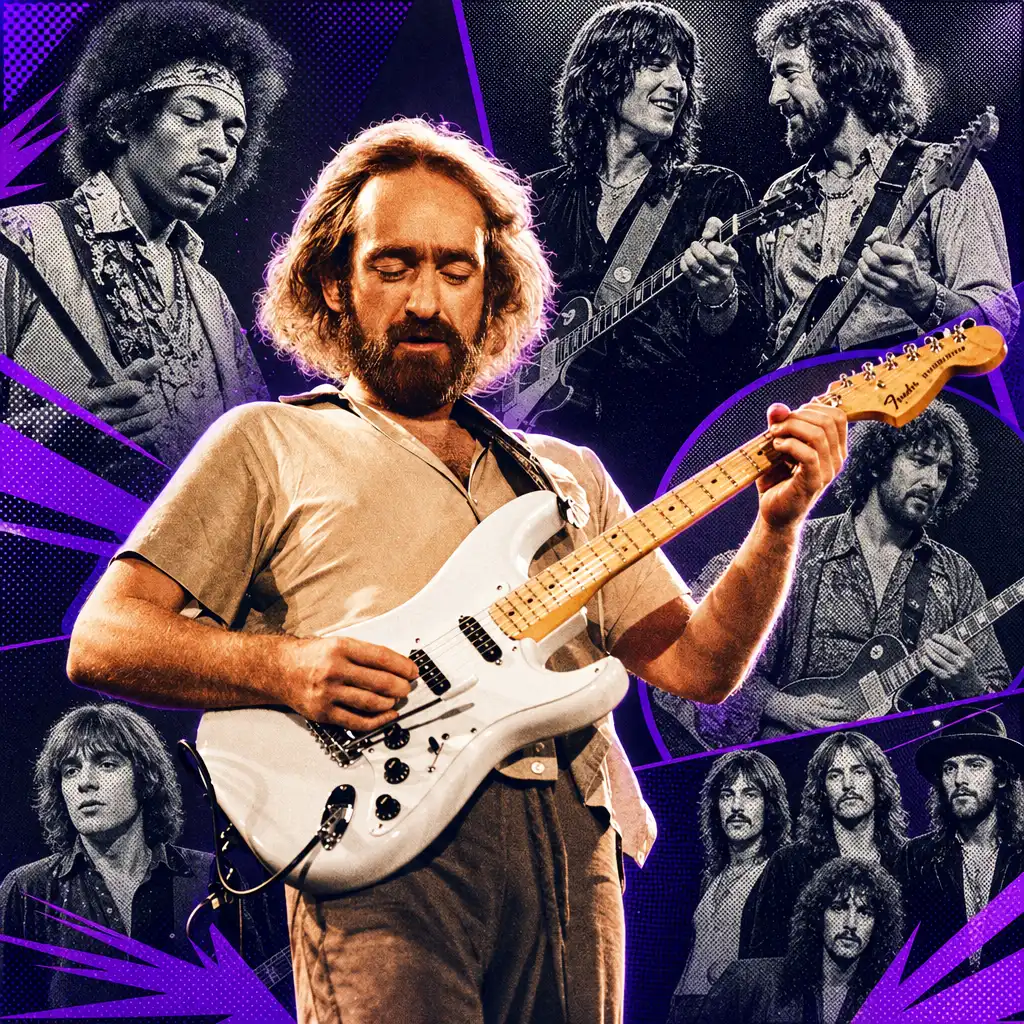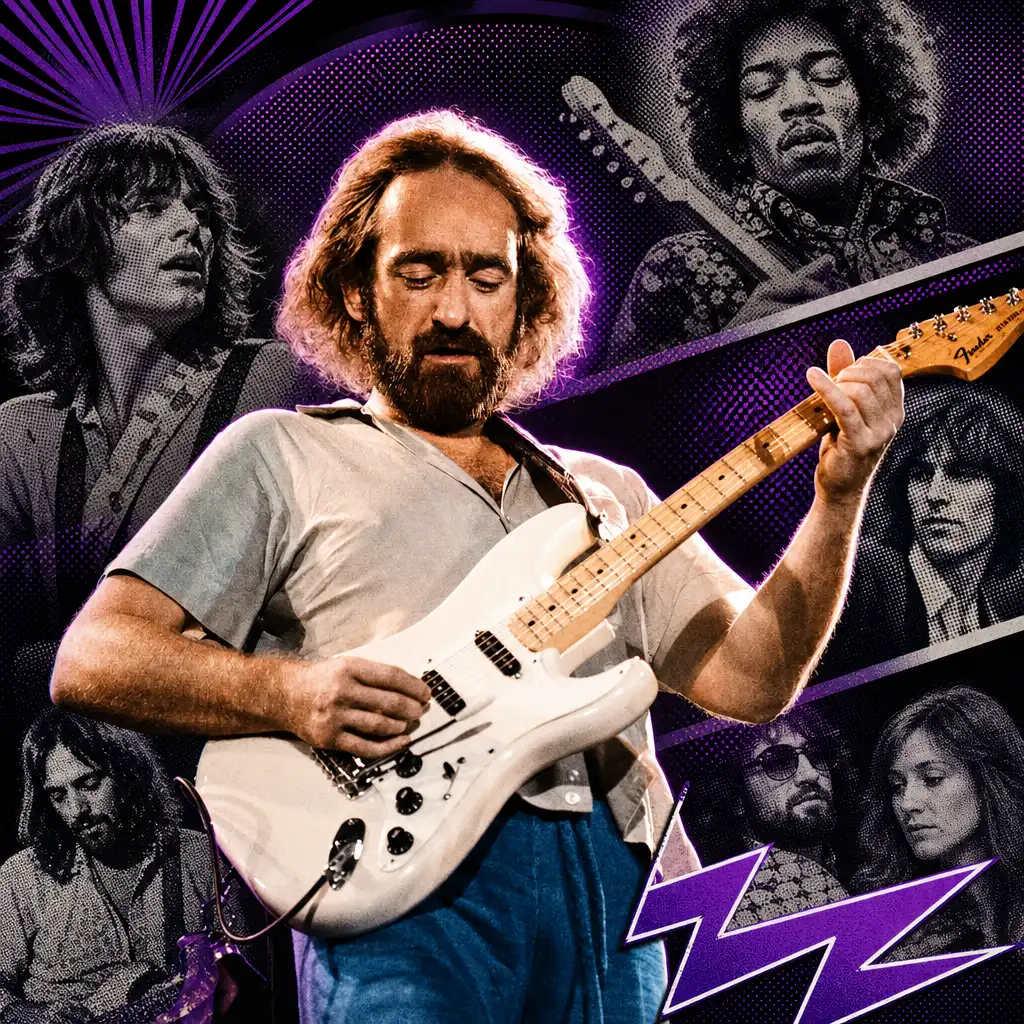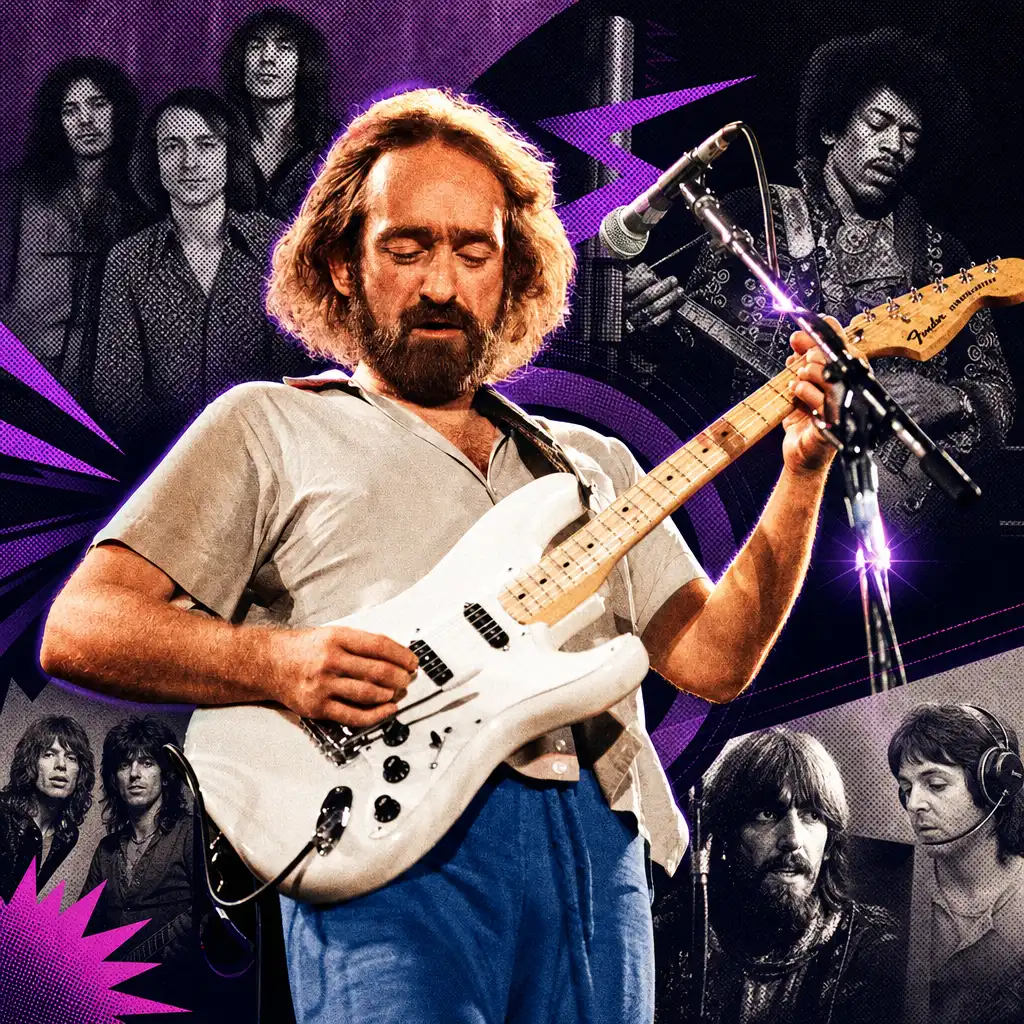
Dave Mason’s career was less a straight line than a map of late-1960s rock at full pressure: Traffic, Hendrix, the Stones, Harrison, Clapton, Delaney & Bonnie, Fleetwood Mac. He was often in the room when the room mattered.
Mason, the English guitarist, singer, and songwriter who co-founded Traffic and wrote the rock standard “Feelin’ Alright?,” died on Sunday. He was 79. A cause of death was not immediately available.
“On behalf of his family, it is with deep and profound sadness that we share the news of the passing of Dave Mason,” his publicist Melissa Dragich said in a statement. “Dave Mason lived a remarkable life devoted to the music and people he loved.”
Last fall, Mason announced that he was retiring from touring because of ongoing health problems. A statement posted to his social media said he was stepping back “a happy man with a heart full of gratitude to his band members, business colleagues, and especially his legions of fans who made his life one of deep satisfaction and fulfillment.” It added: “The immensity of his joy remains solid as he steps back from the stage.”
From Worcester to Traffic
David Thomas Mason was born May 10, 1946, in Worcester, England. He grew up in the Midlands, not far from the future Led Zeppelin axis of Robert Plant and John Bonham, and also near Jim Capaldi, who would become his bandmate in Traffic.
Mason sang in a school choir as a child, but rock and roll did the real damage, with Buddy Holly among the crucial early sparks. He picked up guitar at 16 and began playing professionally with the instrumental rock group the Jaguars. After the band released “Opus to Spring” in 1963, he left and teamed with Capaldi in the Hellions, who toured the U.K. and Germany in 1964 and 1965.
The Hellions released a handful of singles in 1965, starting with “Daydreaming of You,” written by Jackie De Shannon and produced by Kim Fowley. The records did not break through, and the group later worked as a support act for P.J. Proby. Mason drifted out, kept playing, and supplemented the work as a roadie for the Spencer Davis Group, the sharp R&B outfit featuring a teenage Steve Winwood on keyboards and guitar.
That job mattered. Mason became close enough to the Spencer Davis Group’s circle to sing backing vocals on some sessions. In 1967, Winwood left to form Traffic with Mason and Capaldi, with flautist and saxophonist Chris Wood completing the early lineup.
Traffic’s first working method was almost comically literal: they lived in a cottage and jammed until a sound appeared. What emerged mixed British psychedelia, folk textures, pop melody, and a willingness to let arrangements wander without losing the hook. In 1967, they quickly scored three U.K. Top 10 singles: “Paper Sun,” “Here We Go Round the Mulberry Bush,” and Mason’s “Hole in My Shoe,” which reached Number Two.
“Hole in My Shoe” gave Traffic their biggest British hit, but its success also unsettled Mason. He left soon afterward, a pattern that would repeat throughout his career. In 1968, he released the solo single “Little Woman” and produced Music in a Doll’s House, the debut album by the progressive rock band Family. Traffic then brought him back when the remaining members realized they needed more original material for their second album.
The song that outlived the band
Mason wrote half of Traffic’s 1968 self-titled album, including “Feelin’ Alright?,” its lone single. Traffic’s version was not a major hit, but the song had the kind of durable architecture that other singers could inhabit: a compact piano-driven groove, a plainspoken lyric, and enough open space for a vocalist to push or plead. Joe Cocker’s 1969 cover turned it into a standard.
Mason’s second stint in Traffic did not last. Shortly after Traffic came out in 1968, he was fired. In his 2024 memoir, Only You Know and I Know, Mason recalled Winwood telling him: “I don’t like the way you write. I don’t like the way you sing. I don’t like the way you play. And we don’t want you in the band any more.”
It was a brutal assessment. It also did not stop Mason from becoming one of rock’s most useful free agents.
By then, he was already a familiar presence in high-level sessions. He played the droning shehnai on the Rolling Stones’ “Street Fighting Man,” produced by Jimmy Miller, who also worked on Traffic’s early albums. Mason played 12-string acoustic guitar on Jimi Hendrix’s “All Along the Watchtower,” adding shimmer and pressure to one of Hendrix’s most exacting recordings. Hendrix even considered bringing Mason into the Experience, though it never happened.
Mason also spent time around Cream drummer Ginger Baker, appeared at sessions for George Harrison’s All Things Must Pass, and tried to reunite with Capaldi and Wood in Wooden Frog, a project that collapsed before it could become a real next chapter.
Years later, while promoting Only You Know and I Know, Mason joked to USA Today: “I’m kind of the Forrest Gump of rock.” It was funny because it was barely an exaggeration.
Los Angeles, Delaney & Bonnie, and a solo career
Mason moved to the United States, where Gram Parsons, whom he knew through the Rolling Stones, helped connect him to Los Angeles rock circles. He joined Delaney & Bonnie & Friends for U.S. and U.K. tours, playing alongside Eric Clapton.
On those tours, Mason sang “Only You Know and I Know,” the driving song that became the centerpiece of his 1970 solo debut, Alone Together, released on Blue Thumb Records. Recorded in Tulsa, Oklahoma, with musicians largely drawn from the Delaney & Bonnie world, the album remains one of Mason’s cleanest statements: tight playing, warm ensemble grooves, and songs that do not waste motion.
His solo momentum soon got complicated. In 1971, he released Dave Mason & Cass Elliot, a duet album with the former Mamas & the Papas singer. Around that time, he became caught in a contract dispute with Blue Thumb. The label issued Headkeeper in 1972 and Dave Mason Is Alive! without his approval.
During this unstable period, Mason accepted an invitation to join Clapton’s Derek & the Dominos, but he left after one gig. He later found the atmosphere around Clapton, then deep in drug use, draining rather than productive. Mason also returned to Traffic briefly, joining a tour documented on Welcome to the Canteen.
Once his Blue Thumb dispute was settled, Mason signed with Columbia and released It’s Like You Never Left in October 1973. Stevie Wonder played on “The Lonely One.” Mason followed with Dave Mason and Split Coconut, and continued building a serious audience through steady touring. The 1976 album Certified Live captured what his concerts were doing best: lean arrangements, unfussy guitar, and songs built for motion rather than display.
“We Just Disagree” and the soft-rock peak
Mason made another appearance on a superstar hit in 1975, playing guitar on Paul McCartney & Wings’ “Listen to What the Man Says.” Soon after, he had one of his own defining solo hits with “We Just Disagree,” a ballad written by his guitarist Jim Krueger.
The song anchored Mason’s 1977 album Let It Flow. It is not flashy, which is the point. Its strength is in the restraint: a measured vocal, a clean melodic line, and a chorus that lands without raising its voice. In the late 1970s, that kind of craft could still put a rock lifer on radio without demanding he reinvent himself as a logo.
Mason followed with another successful album, Mariposa de Oro, in 1978. He closed out his Columbia contract in 1980 with Old Crest on a New Wave. The title acknowledged the changing music business as new wave pushed many classic rock artists out of the charts. The album also carried a glimpse of the next decade through Michael Jackson, who duetted with Mason on “Save Me.” Jackson agreed because he had sung “Feelin’ Alright?” with Diana Ross on a television special when he was 12.
The 1980s were slower for Mason. He later said, “The latest flavor was something I didn’t want to be any part of. I didn’t fit into the business at that point.” While involved in a contractual dispute with Columbia Records, he toured as a duo with Krueger. In 1987, he released Two Hearts on MCA, his final major-label album.
Fleetwood Mac, Traffic tensions, and the final decades
Mason joined Fleetwood Mac in 1993 and appeared on the band’s 1995 album Time, the first Fleetwood Mac studio album in 20 years not to feature Stevie Nicks.
In 1998, Mason reunited with Jim Capaldi for a tour that produced Live: The 40,000 Headmen Tour. It would be the last period of real cordiality between them. Mason later wrote that his relationships with his former Traffic bandmates remained difficult. He had another dispute with Winwood around Traffic’s induction into the Rock & Roll Hall of Fame in 2003. In his memoir, Mason said Capaldi told Winwood on his deathbed in 2005 not to reform Traffic.
Mason kept recording. In 2008, he released 26 Letters and 12 Notes, his first album in 20 years. Future’s Past followed six years later. In 2020, he rerecorded Alone Together, revisiting the album that had given his solo career its first clear shape.
But in his later decades, the road became the center of his work. In 2024, he toured with a show called “Traffic Jam,” a late-career return to the catalog that first made him famous, even if fame itself never seemed to be his preferred instrument.
“I still don’t like standing up there in front of the spotlight. I feel very uncomfortable up there,” Mason told Rock Cellar in 2020. “I’m not a rock star, let’s put it that way. I never wanted to be. I just wanted to write great music, make some money and have fun. And when I was younger, meet girls.”
That candor fits the catalog. Mason’s best work did not chase grandeur. It relied on songcraft, feel, and the confidence to let a groove carry the room. He wrote one of rock’s most covered tunes, scored hits under his own name, and kept turning up on records where the guitar part mattered. That is not a footnote. That is a career.