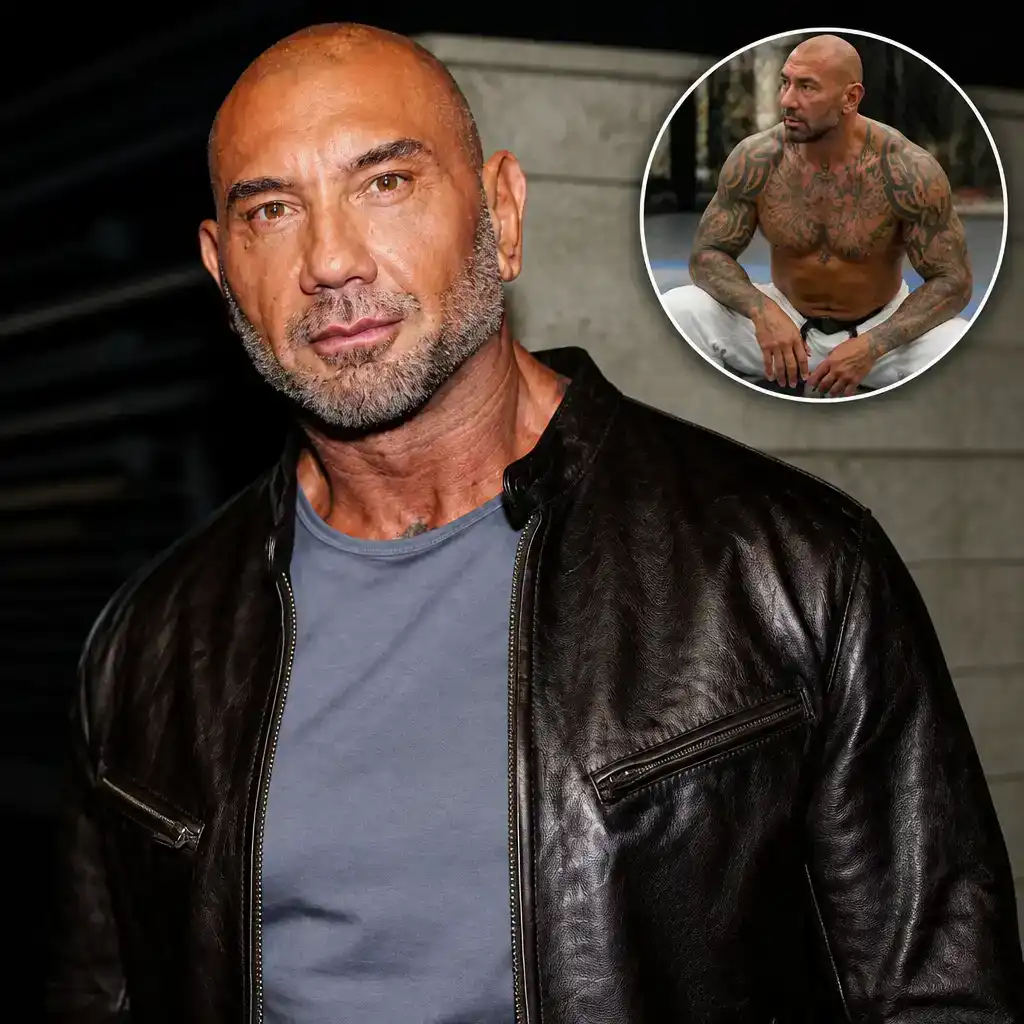
Dave Bautista’s weight loss began with a problem created for the screen: after pushing his weight beyond 300 lbs. for the 2023 thriller Knock at the Cabin, the actor found that getting back to a comfortable size was considerably harder than bulking up.
By September 2024, Bautista said he had lost 75 lbs., bringing his weight down to about 240 lbs. on his 6-foot-4 frame. The transformation cost him a substantial amount of muscle, but the former WWE champion said that was a trade he was willing to make.
“I’ve sacrificed a lot of muscle. But I’m okay with it, because I just feel more comfortable,” he said during a July 2024 appearance on Live with Kelly and Mark.
For an actor whose public image was built around being unusually large — first in professional wrestling and later as Drax in Marvel’s Guardians of the Galaxy films — slimming down also meant challenging what audiences expected him to look like.
Why Bautista decided he had become too big
Bautista deliberately gained weight to play Leonard, an imposing stranger at the centre of M. Night Shyamalan’s Knock at the Cabin. He later acknowledged that his approach may have gone further than the role required.
“I started slimming down because I ... was uncomfortably big. Now looking back at it, I probably overdid it,” he told the Insight with Chris Van Vliet podcast in September 2024.
The actor said pancakes and French fries helped him add the extra weight. His thinking at the time was straightforward: “I gotta get big, I gotta get big.”
That strategy worked, perhaps rather more efficiently than intended. Bautista told Kelly Ripa and Mark Consuelos that he reached “over 300 lbs.” for the film, leaving him uncomfortable and struggling to reverse the gain once production was over.
At around 240 lbs., Bautista said he felt more like himself again. The figure would hardly make him inconspicuous in an average room, but it represented a major change from the physique he had maintained for some of his most recognisable roles.
Jiu-jitsu became the engine of his 75-lb. transformation
When conventional efforts were not producing the results he wanted, Bautista turned to jiu-jitsu. While working in Budapest on Dune, he brought over his friend and trainer Jason Manly and began spending hours grappling.
“I was struggling to lose the weight, so I brought a trainer — my buddy Jason Manly — over to Budapest with me while I was filming Dune,” Bautista said on Live with Kelly and Mark.
“We did nothing but grapple for hours, and I started shedding the weight. I figured I’d stick with it and get my brown belt.”
The appeal extended beyond the number on the scale. Jiu-jitsu gave Bautista an intensive form of training with a technical goal attached, rather than reducing exercise to an endless attempt to burn calories.
He nevertheless said some parts of his body changed more slowly than others. “There were just certain spots that no matter how much weight I lost, I couldn’t get rid of it,” Bautista said, identifying his stomach, chest and face.
His comments offered a less polished account of a celebrity transformation than the familiar before-and-after narrative. The overall loss was substantial, but it was neither instant nor neatly distributed.
A balanced diet replaced the bulk-up mentality
Bautista paired his jiu-jitsu training with what he described as a balanced diet. The change represented a departure from the calorie-heavy approach he had used to prepare for Knock at the Cabin.
He has not presented the process as a secret formula or attached it to a single fashionable eating plan. Based on his public comments, the central shift was simpler: he stopped eating primarily to become larger and began training and eating in a way that made him feel comfortable.
The resulting 75-lb. loss inevitably reduced some of the muscle mass associated with his wrestling and Marvel years. Bautista has been unusually relaxed about that consequence, framing comfort and mobility as more important than preserving maximum size.
That distinction matters because his physique has often been treated as both his professional identity and his chief qualification. Bautista, meanwhile, has spent much of his acting career trying to demonstrate that he can do more than stand in a doorway and make it look structurally nervous.
Cardio now matters more than maintaining a bodybuilder image
By June 2025, Bautista said his training routine was still central to his life, but not for the reasons people often assumed. Speaking to Men’s Health U.K., he rejected the idea that his days revolved around lifting heavy weights to maintain a bodybuilder’s appearance.
“I think a lot of people think I’m just a meathead and that I live my life lifting weights. And I actually don’t,” he said.
“I do live my life training, but I think people think that I train because I want to look like a bodybuilder or a big muscle head. And it’s not at all the case.”
Bautista said he had increasingly embraced cardio-based activities including cycling and boxing. He also prefers working with trainers and changing his sessions regularly, an approach that helps keep him motivated.
“Me looking the way I do is really just kind of a by-product of that,” he said, adding that he would rather watch somebody else deadlift than pursue maximum lifts himself.
His changing physique reflects a changing career
Bautista’s transformation is particularly noticeable because size once defined his public persona. As a WWE star, physical dominance was part of the job description. As Drax, his muscular frame became one of the character’s immediate visual signatures.
His later film work has required greater flexibility, including gaining weight when a character demands it and accepting the difficult process of losing that weight afterwards. The experience of Knock at the Cabin appears to have clarified where his own preference lies.
Bautista continues to train extensively, but his stated priorities have moved away from becoming as large or as strong as possible. Jiu-jitsu, boxing and cycling now offer something that chasing a bodybuilder silhouette does not: variety, energy and a reason to return beyond appearance alone.
For a performer who spent years being paid to occupy as much physical space as possible, reaching 240 lbs. was not simply a smaller version of the same image. It was Bautista deciding that the body required by a role did not have to become the body he lived in afterwards.