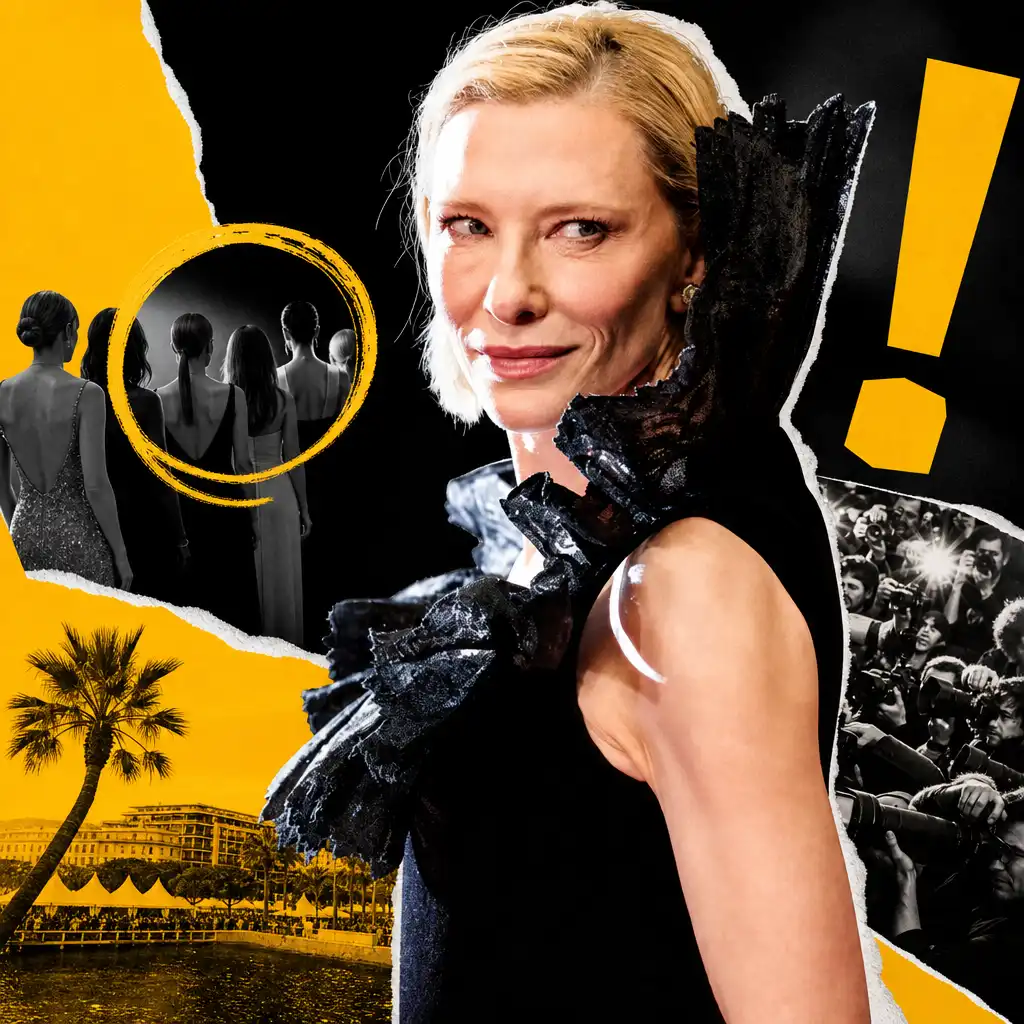
Cate Blanchett has said #MeToo was “killed very quickly,” arguing that the film industry remains stubbornly shaped by gender inequality, despite years of public reckoning. Speaking at the Cannes Film Festival on Sunday, she said she still finds herself counting the people around her on set: “there’s 10 women, and there’s 75 men every morning.” Not exactly a subtle data set.
What Blanchett said at Cannes
During a wide-ranging Cannes talk, Blanchett was asked about the legacy of the movement, which became a global rallying point against sexual abuse, assault and rape culture.
“Well, I mean, it got killed very quickly, which I think is very interesting,” she said.
The Oscar-winning Australian actor said the daily reality of film production still tells its own story. She explained that she does “the headcount every day” on sets and continues to see workplaces dominated by men.
“I love men, but what happens is the jokes become the same,” Blanchett said. “You just have to brace yourself slightly, and I’m used to that, but it just gets boring for everybody when you walk into a homogeneous workplace. I think it has an effect on the work.”
Her point was not that every set is the same, or that every man on one is the problem. It was simpler, and harder to dismiss: when one group overwhelmingly fills the room, the culture of the room changes.
How #MeToo became a global industry reckoning
The #MeToo movement began as a way for survivors to identify and speak about sexual abuse and harassment. It became a viral force after allegations against film producer Harvey Weinstein pushed longstanding industry abuses into public view.
American actress Alyssa Milano helped spread the phrase “Me Too” on social media, encouraging women to share their experiences to show the scale of the problem. High-profile figures including Gwyneth Paltrow, Jennifer Lawrence and Uma Thurman were among those whose stories drew major attention.
The campaign quickly expanded beyond Hollywood. Thousands of women, along with people from marginalised communities, used the moment to describe abuse, coercion and professional retaliation that had often been treated as private damage rather than public failure.
For a period, the movement dominated headlines and online conversation. Blanchett’s criticism is that attention and structural change are not the same thing, which is a useful distinction for an industry that enjoys a standing ovation almost as much as it enjoys not changing its hiring patterns.
Why she says silence protects the system
Blanchett also questioned why conversations about abuse and inequality are so often narrowed, managed or shut down after the first wave of outrage.
She pointed to the difference between celebrities “with platforms who are able to speak up with relative safety” and “the so-called average woman on the street.” Fame can offer protection, though not always enough. Most workers do not have publicists, lawyers or global name recognition when they challenge a workplace culture.
“Why does that get shut down?” she asked.
“All you’re saying is that what it revealed is a systemic layer of abuse, not only in this industry but in all industries, and if you don’t identify a problem, you can’t solve the problem.
“If you shut that conversation down, you can’t move on.”
That was the central warning in her remarks: treating #MeToo as a completed chapter makes it easier to avoid the less glamorous work of changing who is hired, who is protected and who gets believed.
Blanchett sees change in women supporting women
Blanchett did offer a more hopeful view when speaking about how women in the industry relate to one another now.
She said she grew up with a damaging narrative that “women are antagonistic and they don’t know about friendship.” In her view, that story has weakened as more actresses move into producing and directing, then use those positions to bring other women into the frame.
Blanchett praised women who are further along in their careers for “providing opportunities for actresses who don’t have as big a profile as they do.”
“My generation is very aware that we come from that toxic environment and not wanting to replicate that,” she said, adding that women in her position can “pave the way or help support the women who are coming up behind us.”
The emotional weight of that comment is not hard to locate. Blanchett is not only talking about representation as a statistic. She is talking about whether younger women enter a workplace expecting rivalry, silence and endurance, or whether they find enough support to stay.
Her history with Cannes activism
Blanchett has long been vocal about women’s rights and workplace protections. She has also drawn attention for gestures associated by supporters with Free Palestine advocacy, including a Cannes red carpet look two years ago that was widely read as a subtle nod to the Palestinian flag.
Her connection to Cannes activism is not new. In 2018, when the #MeToo movement was at the centre of the festival conversation, Blanchett served as Cannes jury president and helped lead a red carpet protest on the steps of the Palais des Festivals.
She walked alongside Kristen Stewart, Léa Seydoux, Ava DuVernay, Agnès Varda and others. The group held hands and remained silent, stopping halfway up the steps to symbolise the barriers women face when trying to climb the social and professional ladder.
After the protest, Blanchett read a group statement calling for safer working conditions for women and for equal pay laws to be upheld.
“Women are not a minority in the world, yet the current state of our industry says otherwise,” the statement said.
“As women, we all face our own unique challenges, but we stand together on these stairs today as a symbol of our determination and commitment to progress.”
Years later, Blanchett’s Cannes remarks suggest she believes that symbol still needs practical follow-through. The stairs were memorable. The headcount, apparently, still needs work.