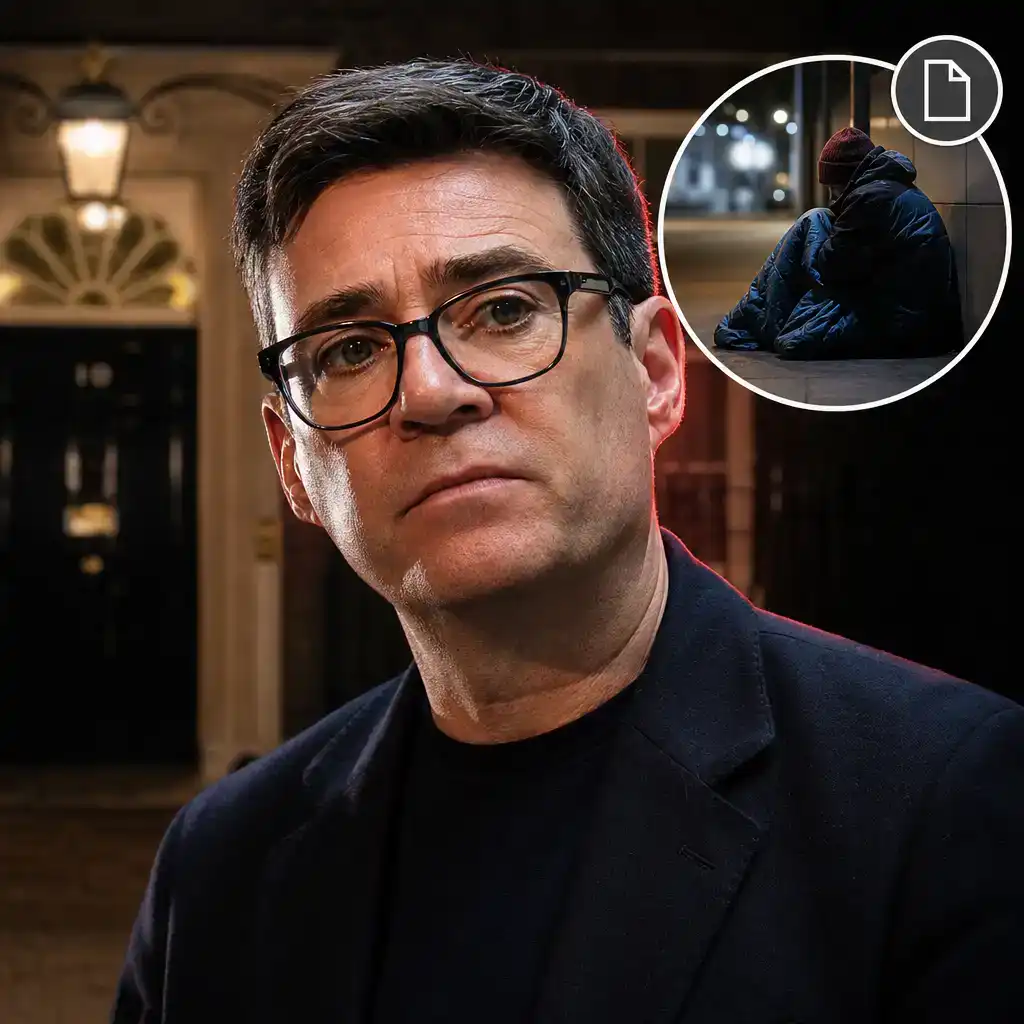
Andy Burnham has made a promise to end rough sleeping his first policy pledge as prime minister, using his opening Downing Street speech to frame the issue as both a moral failure and a costly policy choice. The government says it will put an extra £340m behind the plan, which is expected to fund 1,200 homes and provide “intensive support” for at least 3,000 people in England over five years.
Speaking outside Number 10, Burnham said he wanted a government that was “investing in people’s success rather than paying for failure”. It is a neat line, and a politically useful one, because rough sleeping is one of those crises everyone claims to oppose while the numbers keep doing their own grim admin.
What has Burnham promised on rough sleeping?
In a statement after his first speech as prime minister, Burnham said: “On my first day as prime minister, I’m announcing this government’s commitment to finally end long-term rough sleeping across the UK at the earliest opportunity.
“We’ll get to work immediately, bringing together national and local government with the investment needed to get it done.”
According to the government, the first phase will focus on people who have been sleeping rough for long periods, helping them move into secure housing. Ministers said the work will include the “acquisition of suitable homes”, alongside support services intended to help people stay housed.
The government is presenting the policy as a national effort, although the funding detail announced so far refers specifically to homes and support in England. That distinction may matter later, because constitutional geography has a habit of arriving just when a government would prefer a clean slogan.
The numbers Burnham inherits are bleak
The most recent annual national statistics, published by the government in February, estimated that 4,793 people were sleeping rough on a single night in autumn 2025 in England.
That was a new record high. It was also the fourth annual increase in a row.
Burnham enters Downing Street with his own record on the issue under immediate scrutiny. When he became mayor of Greater Manchester in 2017, he pledged to end rough sleeping in the city region by 2020. Figures later showed that rough sleeping had fallen compared with 2017, but had also begun rising again year on year.
Greater Manchester Combined Authority figures recorded:
- 268 people seen sleeping rough on a single night in 2017
- 149 in 2023
- 154 in autumn 2024
The Manchester Mill reported that the figure increased to 197 in 2025.
So yes, the direction of travel depends heavily on which year is doing the travelling.
His Manchester record is already under challenge
Conservative shadow housing secretary James Cleverly criticised Burnham’s announcement on X, writing: “Burnham’s rough sleeping pledge looking pretty shaky.
“His record in Manchester showed initial success, then failure once his focus shifted.”
Burnham has defended his record by pointing to the scale and limits of what a mayoral authority could do alone. His A Bed Every Night scheme, which he set up and donated 15% of his salary towards, now provides more than 600 beds each night for people who might otherwise be on the streets.
Greater Manchester also helped pioneer the government’s Housing First scheme, based on a Finnish model. The idea is fairly direct: a stable home is not a prize people earn after solving every other problem in their lives, but the starting point for tackling those problems.
Burnham said wider pressures beyond his control had made the situation harder. He cited the housing shortage, cost-of-living pressures, and refugees being evicted from hotels as factors keeping numbers high.
Burnham says local action was not enough
Before his Downing Street speech, Burnham visited homelessness charity The Passage in Victoria, London. Challenged by broadcasters about his Greater Manchester record, he said the “problem was down significantly” from when he first became mayor.
He said: “We ran a scheme every night, 600 beds, called ‘A Bed Every Night’ and we funded it through various different ways. But we were the only place that was doing it.
“And you won’t be able to get the numbers down if you’re the only place and other cities, people are coming to Manchester.
“So it taught me that the only way is to do this together.”
Burnham also referred to the Everyone In scheme during the Covid-19 pandemic, when thousands of people sleeping rough across England were helped into accommodation.
He said: “Everybody pulling in the same direction, everyone in, as we did in the pandemic, because we did bring people inside in the pandemic.
“And that’s what I’m saying as I go into government today.”
The pledge echoes earlier Labour promises
Burnham’s commitment has clear echoes of a pledge made by former Labour leader Jeremy Corbyn, who said he would provide 8,000 homes “immediately” for people with a history of rough sleeping if Labour won power.
The new £340m programme also follows work under former prime minister Sir Keir Starmer, whose government published a national plan to end homelessness in December. That plan was backed by £3.6bn.
Homelessness charity Crisis welcomed Burnham’s announcement. Its chief executive, Matt Downie, called the pledge “absolutely fantastic” and said it suggested a move away from “simply managing homelessness, which costs billions to the public purse”.
Downie said: “Rough sleeping is a moral stain on our country; a normalised emergency born out of years of chronic underinvestment in support services and a failure to build new social homes at anywhere close to the scale required.
“Andy Burnham now has the potential to rewrite the norms on tackling homelessness and end rough sleeping once and for all.”
The pledge is an ambitious one. The test, as ever, will be whether a government can turn a first-day promise into beds, homes, support, and falling numbers. Speeches are warm. Pavements are not.