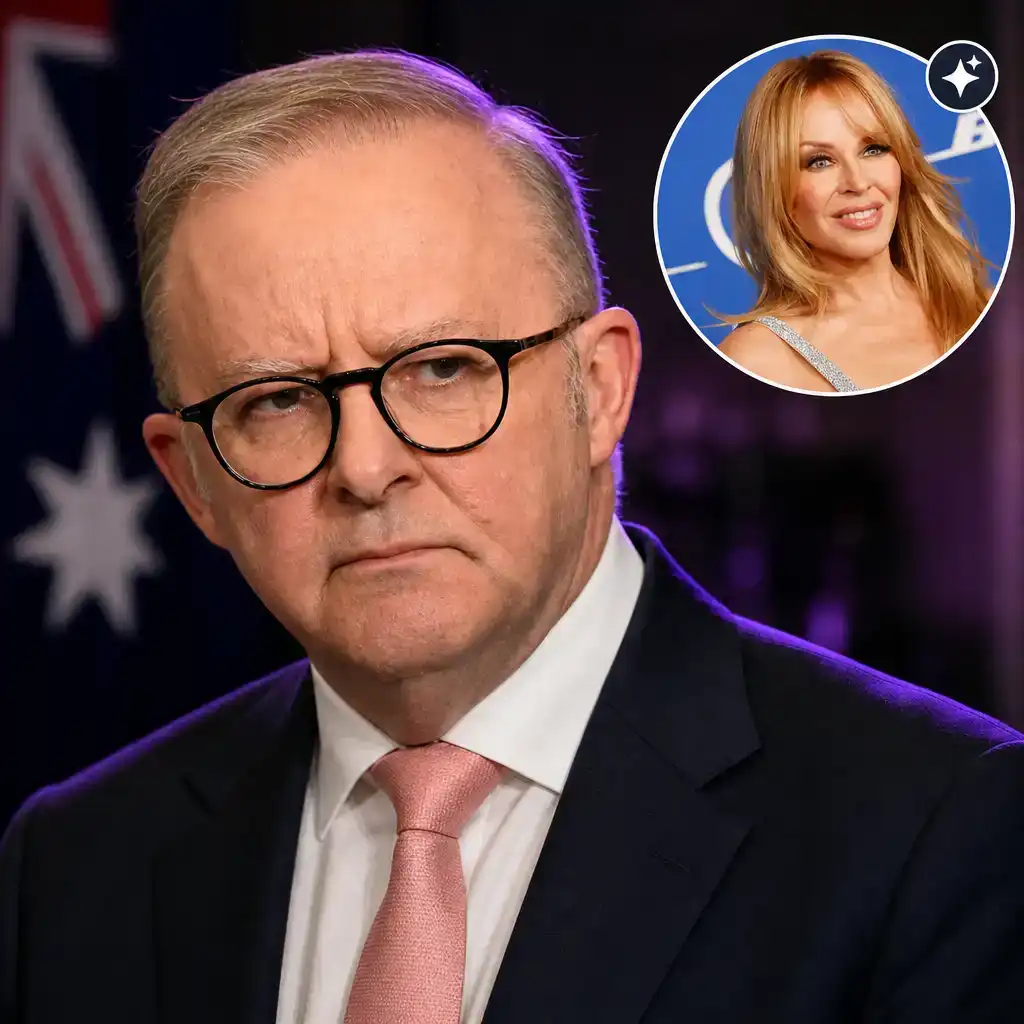
Australian Prime Minister Anthony Albanese has apologised over his Kylie Minogue remarks after a podcast appearance turned a supposedly playful quickfire question into a political headache. The issue was not whether the prime minister likes Minogue. Many people do. The issue was the wording, the setting, and the fact that he is the prime minister.
Albanese, 63, made the comments during an interview recorded last week at his official residence in Canberra. Comedian Nikki Osborne asked him a series of rapid questions, including a version of the game “shag, marry, date” involving Kylie Minogue, Nicole Kidman and Rhonda Burchmore.
Osborne introduced the segment by saying, “every guest gets asked these,” before asking him to choose between the three Australian entertainers.
Albanese initially appeared to recoil from the premise, putting a hand to his chest and saying: “I’ve just got married. I’m only six months in!”
When Osborne pressed, “But if it goes tits up, let’s just pretend…”, Albanese answered: “Oh, Kylie, clearly.”
Asked whether he would marry, sleep with and date Minogue, he replied: “All of the above.” He then added: “She’s terrific,” before the interview moved on.
What did Albanese say in his apology?
After criticism built over the weekend, Albanese issued a brief statement on Monday morning.
“I apologise unequivocally for the comments,” he said.
That was the full statement, and it at least avoided creating a second controversy by over-explaining.
The Labor leader married his partner, Jodie Haydon, 47, in November. His reference during the podcast to being newly married was one of the reasons the exchange drew extra attention, though most of the criticism focused on the way the remarks framed Minogue, Kidman and Burchmore.
Minogue, 58, has not publicly responded to the controversy. Representatives for the singer have been contacted for comment.
The podcast appearance had otherwise drawn praise from some YouTube viewers for its loose, informal style. But the same casual tone that can make politicians seem more human can also remind everyone that microphones are still recording. A relaxed interview does not make the consequences disappear.
Political opponents called the comments sexist
Community Strong MP Zali Steggall was among those who criticised Albanese, calling the remarks “entirely inappropriate.” She said he should not have taken part in the game at all.
“He needs to learn to push back, lead by example and call it out as sexist,” Steggall said.
Shadow communications minister Sarah Henderson was more blunt, describing the comments as “disrespectful to women, embarrassing to Australians, and [demeaning] the office of prime minister.”
“Mr Albanese’s crude locker-room talk makes a mockery of Labor’s claim to be champions of women,” Henderson said. “How low can this prime minister go? Australians deserve better than this.”
Liberal frontbencher Andrew Bragg also weighed in during an interview with Radio National, saying Albanese’s comment was “beneath his office” and “shouldn’t” have been made.
The criticism landed on familiar ground for Australian politics: questions about sexism, public leadership and whether politicians understand that “just banter” tends to age badly when replayed outside the room.
Labor figures defended his record on women
Not everyone in government treated the incident as a defining statement about Albanese’s views.
Labor minister Tanya Plibersek defended the prime minister’s broader record on gender equality, while trying to present the exchange as admiration for one of Australia’s most famous performers.
“If what the prime minister is saying is he’s a fan of Kylie Minogue, I guess that puts him in a group with millions of other Australians, including me,” Plibersek told Channel Seven viewers.
“I’m a big fan of Kylie’s as well,” she added.
Plibersek said that on women’s equality, “no government’s been better for it, and no prime minister’s been better for it.”
Acting Prime Minister Richard Marles also defended the government’s position, saying it remained “utterly committed” to elevating women in society.
“From time to time, we obviously do different interviews to the one we are doing now,” Marles said. He added that Albanese leads “the first [government] in history that has had equality in terms of the number of men and women in cabinet.”
Another exchange also drew attention
The Minogue comment was not the only podcast moment that raised eyebrows.
At another point, Albanese was asked about the worst gift he had received during an overseas business visit. He said Japanese Prime Minister Sanae Takaichi had once given him two melons, which he described as “strange” but “quite good.”
Osborne then asked: “She just came in looking like Pamela Anderson?”
Albanese responded by smiling and waving his hands in front of his chest.
The exchange added to the scrutiny around the interview, particularly because the criticism was not just about one answer but about the broader tone of the conversation. Politicians often seek out softer media formats to seem less managed. The trade-off is that unscripted moments can travel much further than the intended charm.
Why Kylie Minogue’s public image matters here
Minogue’s name matters here in a way a random celebrity mention would not. The “Padam Padam” singer and former Neighbours actor has long been viewed as a major figure in Australian pop culture and an inspiration to many women through both her career and public advocacy.
In 2014, when she became the only female coach on The Voice, Minogue addressed discussion about the show’s so-called “gender imbalance.”
“I have to say this is working for me,” she said at the time. “And I hope that I’m giving a voice to the women, the girls who look up to me or anyone like me in the business.”
More recently, while promoting her Netflix docuseries, Minogue reflected on the scrutiny and misogyny she has faced since becoming famous in the 1980s.
“There’s always a lot of talk about how much I’ve changed,” she said during a Q&A in London.
“I was famous before I knew what I was doing, so, you know, and there came a lot of the criticism and the hardship with that, but what’s illuminating to me is, in so many ways, I haven’t changed.”
Around the same period, Minogue said society had become more open-minded, but not enough to stop women in entertainment being asked questions men often avoid.
“It would be nice not to be asked about your age,” she said. “I’m still asked about it. I don’t know that Mick Jagger gets asked about it.
“I think as a whole we’re much more open-minded. But there’ll always be a way to go.”
That history helps explain why Albanese’s remarks travelled so quickly. For critics, the moment was not just a crude answer in a comedy format. It was another example of a powerful man reducing high-profile women to a sexualised game, then discovering, rather late, that the audience had also been invited to listen.