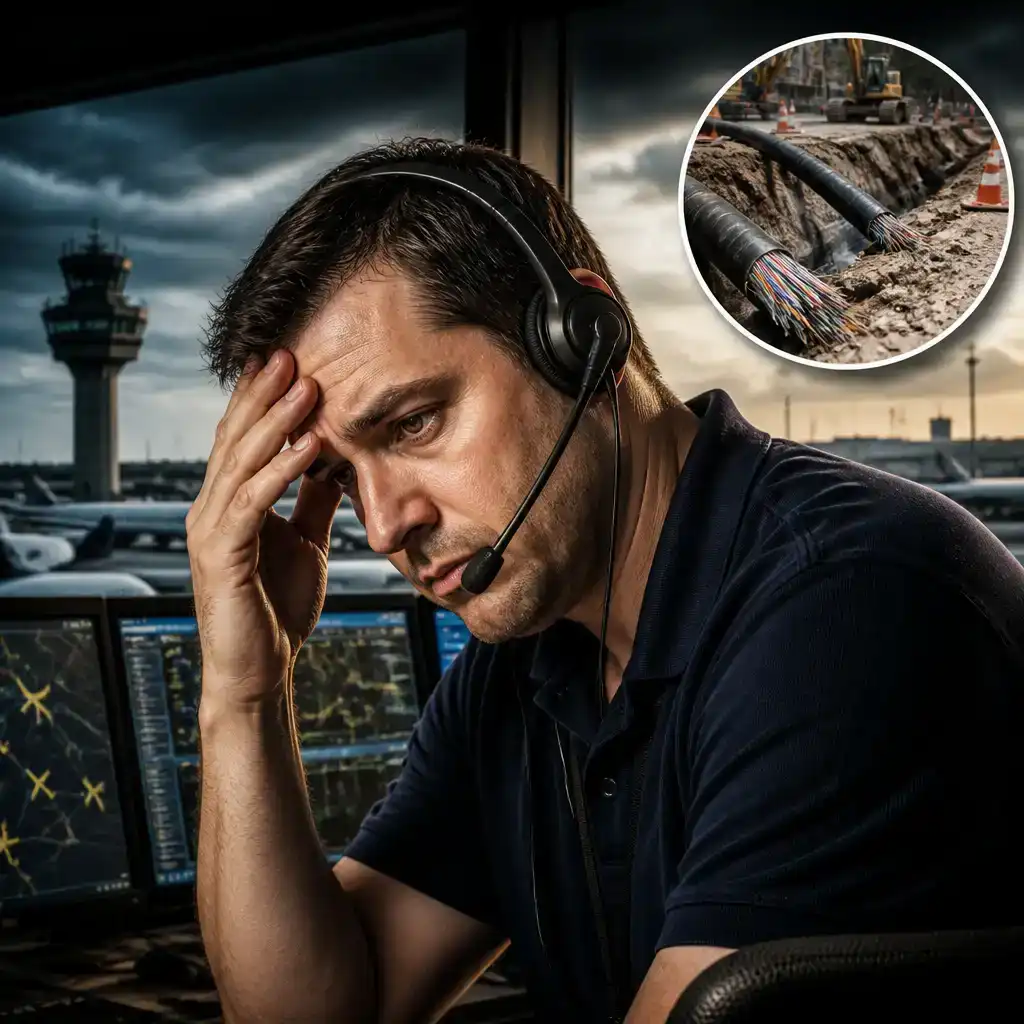
An air traffic control outage disrupted thousands of flights across the United States on Monday, September 21, after a primary communications circuit failed and officials discovered that its backup fiber route had already been cut. Airports across the Northeast imposed ground stops, including the three major New York-area hubs, while airlines cancelled or delayed flights nationwide.
The problem centered on the Federal Aviation Administration’s Philadelphia Terminal Radar Approach Control facility, known as Philadelphia TRACON. The center manages aircraft approaching and departing several busy airports. FAA Administrator Bryan Bedford said the primary circuit failed first, exposing damage to the backup connection.
That distinction matters. The cut cable did not start the outage by itself. Instead, an aging or otherwise faulty primary circuit failed at precisely the moment its backup was unavailable. Bedford offered a concise assessment: “The timing is absolutely horrible.” Few passengers waiting beside a departure board would have challenged that analysis.
How extensive was the flight disruption?
The outage quickly spread beyond Philadelphia. Ground stops affected John F. Kennedy International Airport, LaGuardia Airport and Newark Liberty International Airport, while Boston Logan International Airport also recorded substantial delays and cancellations.
Associated Press reported that Newark received no commercial arrivals from about 9:40 a.m. until shortly after 5:20 p.m. Reuters said delays there averaged 112 minutes. More than 600 Newark flights were cancelled, according to the AP.
Figures varied as the day progressed, but each count described a very large operational failure:
- ABC News recorded more than 5,000 delays and 820 cancellations across the United States during the day.
- FlightAware data cited later showed more than 1,000 cancellations nationwide.
- Philadelphia International Airport had more than 200 cancellations and 400 delays, according to figures reported by CBS Philadelphia.
- Boston Logan recorded more than 450 delays and 70 cancellations.
Philadelphia’s ground stop ended at 5 p.m. Transportation Secretary Sean Duffy said late Monday that repairs were complete and Northeast airport operations were resuming, though he warned that clearing the accumulated delays would take time. Repairing the cable was one task. Repositioning aircraft, crews and passengers was the considerably less tidy sequel.
Who cut the Verizon fiber cable?
The damaged cable ran between New Brunswick and North Brunswick in New Jersey. ABC News reported that the affected section was approximately 600 feet long.
Duffy initially blamed an Amtrak crew for severing the line. Amtrak disputed that account, saying the incident happened on New Jersey Transit property and involved a New Jersey Transit contractor.
New Jersey Transit later acknowledged that a contractor working on its Delco Lead project had cut the cable. Preliminary information indicated that the contractor had been operating about 10 feet from utility markings. The agency said it was investigating whether Verizon or the contractor was responsible for marking the cable’s location.
Verizon firmly rejected responsibility. The company said its equipment had been functioning and accused construction crews working in the area of digging up and cutting its cable.
No final determination of liability had been reported by Tuesday morning. The basic sequence was clearer than the responsibility: construction work damaged the backup connection, the primary circuit later failed, and the aviation system discovered its redundancy was mostly theoretical.
Why did one damaged backup cause such widespread problems?
Backup systems exist so a single failure does not interrupt essential services. In this case, the reserve fiber route had already been severed when the primary circuit stopped working. That combination disrupted communications at one of the Northeast’s key air traffic facilities and forced the FAA to restrict flights for safety.
Bedford said the primary circuit failure led officials to discover the cut cable. That raises questions beyond which contractor held the shovel, including how quickly damage to a critical backup route was detected and whether the FAA had another practical option available.
The episode follows repeated technology failures across the national air traffic control system. In 2025, Congress approved $12.5 billion for modernization and staffing, according to Reuters. The funding was intended to address aging equipment and workforce pressures that have repeatedly tested the system.
Monday’s disruption provided a straightforward demonstration of the problem. A modern aviation network depends on layers of communications infrastructure, but those layers are useful only when someone knows one of them is missing. On this occasion, that information arrived after the remaining circuit failed and thousands of travel plans had already become airport seating arrangements.