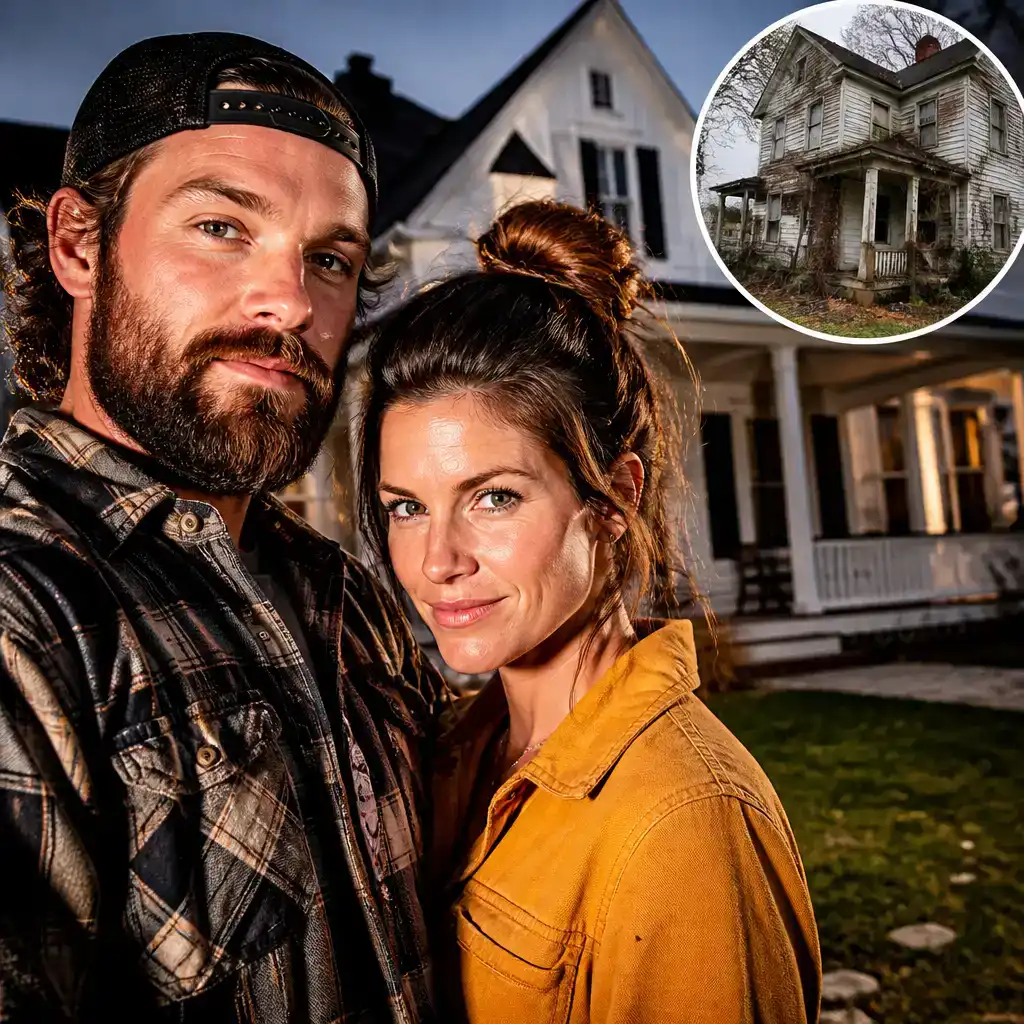
A $26,000 abandoned farmhouse sounds like a bargain. For Samantha and Sean Kilgore, it became a two-year renovation costing roughly $320,000 — and the beginning of a wider effort to persuade people that historic homes are worth rescuing.
The couple bought the neglected 160-year-old Michigan farmhouse in 2018, despite having no professional renovation experience. Samantha was 26 and Sean was 29 at the time, and the property had already stood vacant for 12 years.
Its condition was severe enough that demolition appeared to be the likelier ending. Instead, the Kilgores took on the structural work themselves, including the formidable task of lifting the house onto a new foundation.
“At the end of the day, I hope people remember that old homes aren’t problems to replace; they’re stories worth continuing,” Samantha, now 34, told PEOPLE exclusively.
The $26,000 farmhouse was close to demolition
There was little superficial charm left when the couple found the house. Its windows were missing or boarded over, graffiti covered the front walls and overgrown shrubs concealed the entrance.
The property had also accumulated local ghost stories and other tall tales during its years of abandonment. The damage, however, was considerably more tangible: the house had been vandalised and left without the maintenance needed to keep a historic structure standing safely.
According to the Kilgores, the owner had obtained an estimate to demolish the building and convert the land into a farm field. Saving it therefore meant committing to far more than a cosmetic refurbishment.
The low purchase price reflected that reality. What looked like a $26,000 house was, in practical terms, a substantial construction project with an old farmhouse attached.
The renovation eventually cost around $320,000
Over the following two years, Samantha and Sean rebuilt the property and turned it into their home. The final renovation bill reached approximately $320,000 — more than 12 times the original purchase price.
Among the largest jobs was raising the entire house and placing it on a new foundation. The couple carried out major structural repairs themselves despite entering the project without professional renovation backgrounds.
The figures also complicate the familiar fantasy of buying a neglected property for little more than the price of a new car. The farmhouse was inexpensive to acquire because nearly everything difficult came afterwards.
Still, the Kilgores did not approach the project as a conventional house flip. Their aim was to preserve the building and continue its history, rather than erase its age beneath whatever happened to be fashionable that year.
Samantha’s childhood shaped the decision to save it
Samantha’s attachment to older houses began long before the Michigan farmhouse appeared. She grew up in her great-grandparents’ home, which her parents renovated themselves throughout much of her childhood.
That experience gave her a different view of buildings that require years of work. To her family, renovation was not simply about updating a property; it was a way of adding another chapter without discarding what came before.
“Before ‘house flipping’ was a thing, my parents renovated every inch of our home themselves over pretty much my whole childhood,” she said.
“They didn’t need everything to be on-trend or shiny and new, but rather wanted to continue the story of the home, while telling the story of our family too. That’s something I’ve always valued, and knew I wanted to do the same for myself.”
That philosophy helped sustain a project whose costs and structural demands could easily have overwhelmed its romantic appeal. The couple were not merely restoring attractive details; they were attempting to keep the house viable for another generation.
The farmhouse became a preservation mission
As the Kilgores documented the transformation, they found an audience far beyond the property itself.
“We were shocked at how many people had such a shared joy watching an old home be given a second chance,” Samantha told PEOPLE.
The response helped inspire their work through After Hours Farm, which promotes the preservation of historic houses and the belief that ageing buildings should not automatically be treated as disposable.
Their renovation is hardly a promise that every abandoned home can be saved cheaply. A $320,000 rebuilding cost makes that plain enough. Nor does enthusiasm remove the practical risks of taking on a structure that has spent more than a decade exposed to neglect.
But the farmhouse offers a more useful argument than a simple before-and-after reveal: purchase price alone says very little about the scale of a restoration, while visible decay does not necessarily settle whether a building has a future.
In 2018, the house was close to becoming an empty field. Two years of work gave it another ending — and the Kilgores a reason to make sure other old homes are considered before the bulldozers arrive.