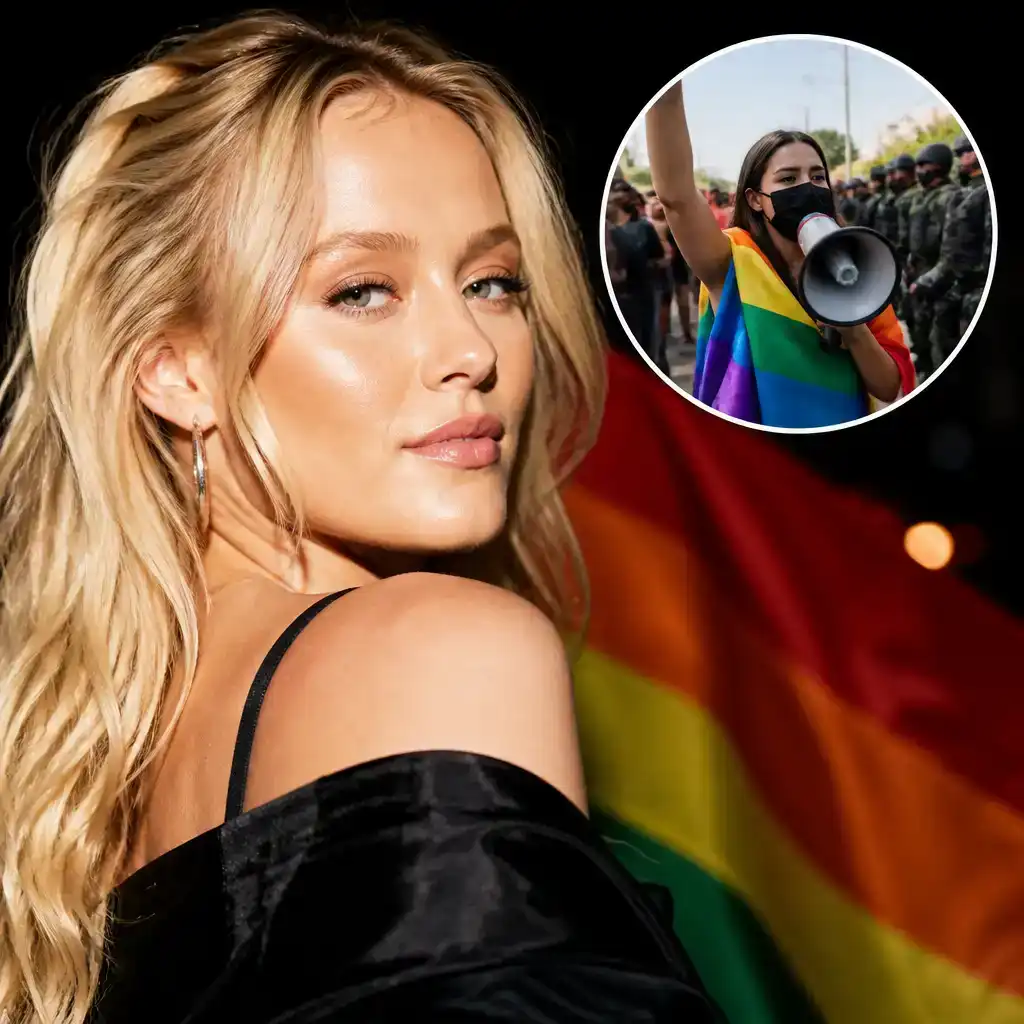
Zara Larsson has sparked a heated online debate after sharing an unapologetically political Instagram Story declaring her support for immigrants, LGBTQ+ people, reproductive rights and socialism, while delivering a particularly blunt message about US immigration enforcement.
The Swedish pop star's statement was provocative even by the standards of celebrity social media. Among her declarations was one that quickly became a point of controversy: "I love criminals."
Larsson subsequently addressed the reaction, explaining that her comments reflected frustration with the criminal justice system, particularly the incarceration of non-violent offenders, rather than an unconditional endorsement of criminal behaviour.
Her clarification brought a more complicated political argument into focus, although the original wording had already provided plenty for critics and supporters to debate.
What Zara Larsson actually posted on Instagram
Larsson made little attempt to soften her political positions when she published the statement on Instagram Stories.
Her message was structured as a series of declarations of support for groups, policies and ideas that frequently feature in political and cultural debates.
She expressed support for immigrants, transgender people, queer people, women who embrace their sexuality, contraception, abortion, welfare and socialism.
She also included criminals in that list before ending with an explicit denunciation of US Immigration and Customs Enforcement, better known as ICE.
The statement was unmistakably political, combining support for socially marginalised groups with positions on reproductive freedom, public assistance and immigration enforcement.
Unlike the carefully managed political statements often associated with major entertainers, Larsson's message offered little explanation or qualification. It was direct, confrontational and apparently unconcerned with appealing to everyone.
That approach helped make the post a subject of debate, but it also created room for competing interpretations of what she intended to say.
Why her comments about criminals became controversial
Of all the positions Larsson expressed, her declaration of affection for criminals presented the most obvious challenge to conventional interpretations.
Read literally, the statement makes no distinction between people convicted of minor, non-violent offences and those responsible for serious harm.
That distinction became central to Larsson's subsequent explanation.
Addressing the viral response, the singer clarified that her frustration was directed at the broader system, drawing attention to the mass incarceration of non-violent offenders.
Her explanation suggested that the original statement was intended as an expression of solidarity with people affected by punitive criminal justice policies, rather than a defence of every individual who has committed a crime.
The difference matters. Criticising incarceration practices or arguing that offenders deserve humane treatment is not equivalent to approving of the actions that led to their convictions.
Nevertheless, Larsson's initial wording did not make that distinction explicit.
The controversy therefore raises a familiar problem with political statements made through social media: language designed to communicate conviction in a few seconds can struggle to accommodate the qualifications needed for a more serious discussion.
Her criticism of ICE adds another political dimension
Larsson's condemnation of ICE, the US Immigration and Customs Enforcement agency, was another defining element of the Instagram Story.
ICE is a federal agency responsible for enforcing immigration laws, including aspects of detention and deportation. Its activities have long been the subject of political disputes in the United States.
Larsson's statement placed her firmly on the side of those who oppose the agency's approach to immigration enforcement.
Her subsequent clarification also connected her criticism of immigration policies with her broader concerns about how institutions treat people who become involved in the justice system.
These positions are related, but they are not identical. Immigration enforcement and criminal prosecution operate under different legal frameworks, even though detention, government authority and individual rights can become important questions in both.
Larsson did not provide a detailed policy proposal in the material available. Her comments were an expression of political opposition rather than a comprehensive argument about how immigration laws should be administered.
That distinction is worth preserving, particularly when a celebrity's short social media post becomes the basis for a much larger political argument.
Why Larsson's unfiltered approach attracts attention
Larsson's Instagram Story also illustrates the tension between celebrity influence and political communication.
Public figures can use their platforms to draw attention to issues that might otherwise receive less discussion. Their visibility, however, also means that ambiguous statements can reach audiences far beyond those who already understand or share their political outlook.
In this case, Larsson combined several distinct positions into one deliberately provocative message.
Support for LGBTQ+ rights, reproductive healthcare and social welfare appeared alongside an attack on immigration enforcement and a statement about criminals that required further explanation.
Grouping these positions together communicated a broad political identity, but it did not establish that every issue should be understood in precisely the same way.
In my view, Larsson's criticism of the treatment of non-violent offenders deserves a more serious hearing than the most provocative line of her original post might suggest. Her clarification identifies a legitimate subject for public debate: whether criminal justice systems respond proportionately to different offences. At the same time, I think her initial wording was unnecessarily imprecise. There is a meaningful difference between defending the rights and dignity of people convicted of crimes and appearing to celebrate criminality without qualification. Political conviction does not become less persuasive simply because it is expressed carefully.
The strongest part of Larsson's intervention may ultimately be the explanation she offered after the controversy, rather than the statement that started it.
The bigger question behind Zara Larsson's viral statement
Larsson's comments leave two separate questions for anyone examining the controversy.
The first concerns the political issues themselves: immigration enforcement, incarceration, reproductive rights and the treatment of marginalised communities.
The second concerns how effectively a public figure can communicate a position on those subjects through deliberately confrontational language.
Her original Instagram Story made her loyalties unmistakable. Her subsequent clarification demonstrated that at least one of those declarations needed additional context to convey its intended meaning.
There is no indication in the supplied account that Larsson has withdrawn her broader political positions. Instead, she has sought to explain the reasoning behind the line that attracted particular scrutiny.
The controversy could encourage a more substantive conversation about non-violent offenders and immigration policy. It could also remain focused on the wording of a single Instagram Story.
For now, the most revealing detail is that Larsson's briefest and most provocative declaration required the longest explanation. The political argument was always more complicated than the post made it appear.