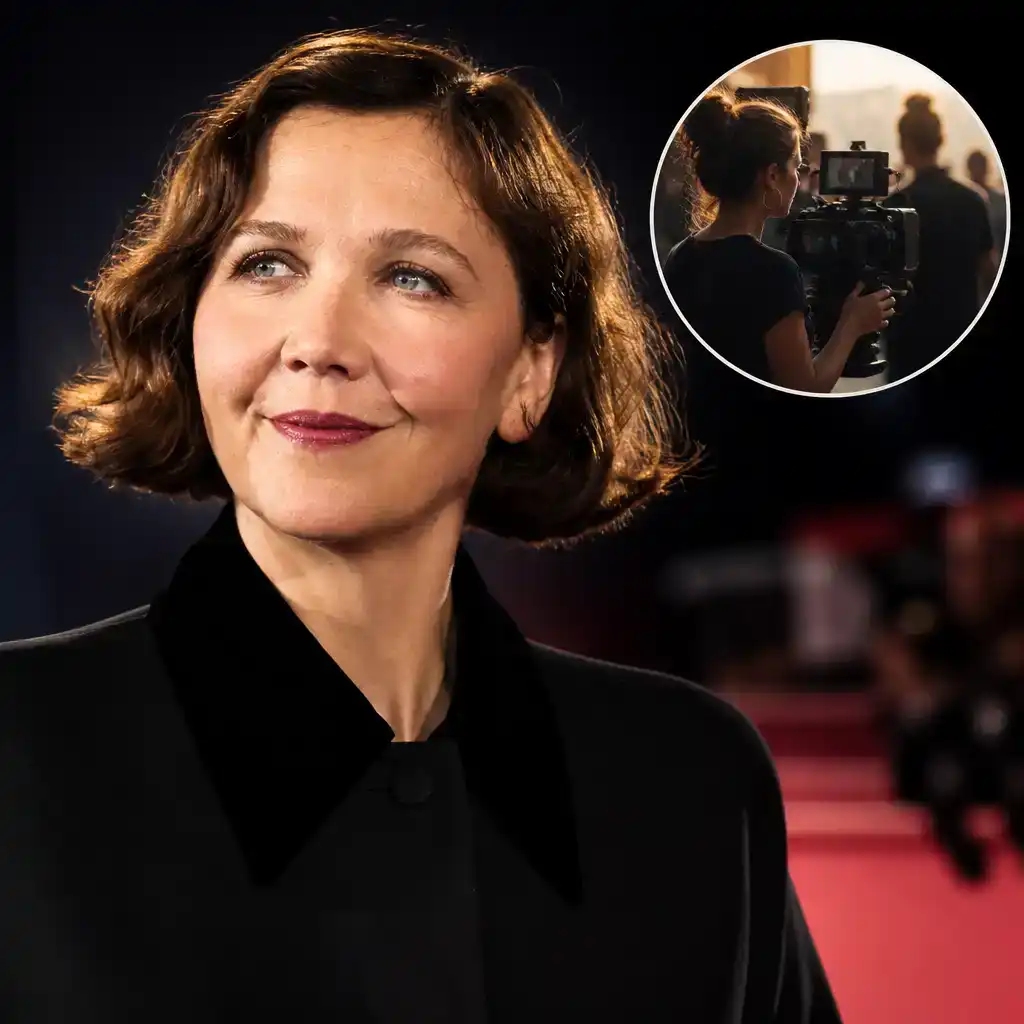
The Venice Film Festival gender gap took centre stage on September 2, when jury president Maggie Gyllenhaal questioned why only one of the event’s 21 competition films was directed solely by a woman. Politics soon joined the discussion, which was not exactly unexpected at a festival opening amid wars in Gaza and Ukraine, unrest in the United States and growing pressure on cultural institutions to state where they stand.
Asked whether cinema should be political, Gyllenhaal laughed before replying: “OK. May as well get into it.”
The actor and director of The Bride argued that films are “fundamentally, unavoidably political”, rejecting the idea that cinema can somehow remain sealed off from events outside the screening room.
“Look, we could say, how are we possibly here talking about movies right now when the world is in a state of emergency?” she said. Her answer was empathy, which she described as one of film’s essential functions.
Why Maggie Gyllenhaal says cinema cannot avoid politics
Gyllenhaal said films can help audiences understand lives and viewpoints far removed from their own, including people they may find corrupt or repellent.
“I think we can challenge ourselves to hear stories about the most corrupt, most perverse people because it opens up the opportunity to find empathy for those people,” she said. “I am here open. I am here curious.”
Her position contrasted sharply with comments made earlier in the year by Wim Wenders, then jury president at the Berlin International Film Festival. While answering questions about Israel and Palestine, Wenders said filmmakers should “stay out of politics”. The remark drew criticism, and Berlin artistic director Tricia Tuttle later defended artists’ right to choose whether they speak publicly about political issues.
Venice has encountered a similar dispute before the first major premiere even began. Organisers initially considered cancelling the traditional jury press conference because of scheduling problems. Critics suspected the decision might also spare jurors from difficult political questions. The festival restored the event after the timetable was rearranged. A scheduling issue had, with impressive efficiency, become a political issue.
How few women are directing films in competition?
Gyllenhaal also addressed the sharp fall in female representation among directors competing for the Golden Lion.
“I guess it’s finally become clear that men make better movies than women do,” she said, deadpan.
She then gave the serious answer: “There’s a systemic problem. It’s harder for women to get films financed.”
May el-Toukhy’s drama Woman Unknown is the only film among the 21 competition titles directed solely by a woman. That is a steep decline from 2025, when six films in the main competition had female directors. Cannes began its 2026 competition with five female directors among 21 titles.
The headline figure requires one qualification. Naza, a documentary co-directed by Rachel Szor and Yuval Abraham, was added to the Venice programme on August 24. That means two competition films have at least one female director, although only Woman Unknown has a woman as its sole director.
Artistic director Alberto Barbera raised Naza during the press conference after Gyllenhaal was questioned about the lineup. The Guardian-produced documentary examines reporting by The Guardian, +972 Magazine and Local Call on Israeli military systems and civilian deaths in Gaza. It is scheduled to screen on September 10.
Who decides what counts as quality?
Barbera said before the festival that programmers had searched extensively for suitable films directed by women. In a separate interview with Vanity Fair Italia, he called quality the festival’s only rigid selection criterion and argued that choosing films merely because women made them could expose those works to hostile judgment.
Gyllenhaal challenged the assumptions behind that defence rather than disputing the need for quality.
“Could it be possible that women, having had a different experience of being alive in the world, want to make movies about things that are not always deemed high art?” she asked. “Who decides what’s good? Who decides what is valuable?”
Her questions shifted the argument away from simple counting. Financing affects which films get made, while established ideas of prestige affect which completed films are treated as major festival material. By the time programmers make their selections, the field has already been narrowed by producers, investors and distributors.
Gyllenhaal also pointed out that Venice had appointed a woman to lead the competition jury. That seven-member panel includes Tunisian filmmaker Kaouther Ben Hania, Hong Kong director Johnnie To, Afghan filmmaker Shahrbanoo Sadat, French director Xavier Giannoli, British composer Daniel Blumberg and Italian film scholar Francesco Casetti.
Why Gaza is shaping the festival debate
The Venice4Palestine collective issued an open letter before the festival calling for “concrete action” in support of Palestine. Signatories included Nobel Prize-winning writer Annie Ernaux, musician Roger Waters and filmmakers Isabel Coixet and Matteo Garrone.
The group asked Venice to fly the Palestinian flag throughout the festival and suspend agreements with organisations linked to the Israeli government. The Associated Press reported that no large-scale demonstration was planned at that stage, unlike in 2025.
The issue has particular relevance for juror Kaouther Ben Hania. Her Gaza drama The Voice of Hind Rajab premiered in competition at Venice the previous year and won the Silver Lion. Reports placed its standing ovation at roughly 23 to 24 minutes, rather than the 22 minutes cited in some early accounts.
Barbera has described the 2026 programme as Venice’s most political selection in recent years. Its films address war, Palestine, migration, climate change, social conflict and restrictions on freedom. Elsewhere within the same institution, the 2026 Venice Art Biennale jury resigned en masse over Israeli and Russian participation, making the idea of politically neutral culture even harder to maintain.
What happens next at Venice?
The competition began on the evening of September 2 with Ink, Danny Boyle’s drama about Rupert Murdoch’s acquisition of British tabloid The Sun. All 21 films are world premieres, filling the maximum competition size allowed under festival regulations.
The festival runs until September 12, when Gyllenhaal’s jury is due to announce the Golden Lion and other awards. No further political intervention from the panel had been reported after the opening press conference.
For now, Venice has managed to place two familiar arguments beside each other: whether films are inherently political, and whether an industry can call its choices merit-based when women face greater obstacles long before selection begins. Gyllenhaal’s answer to the first was direct. Her questions about the second may prove less comfortable for the festival to resolve.