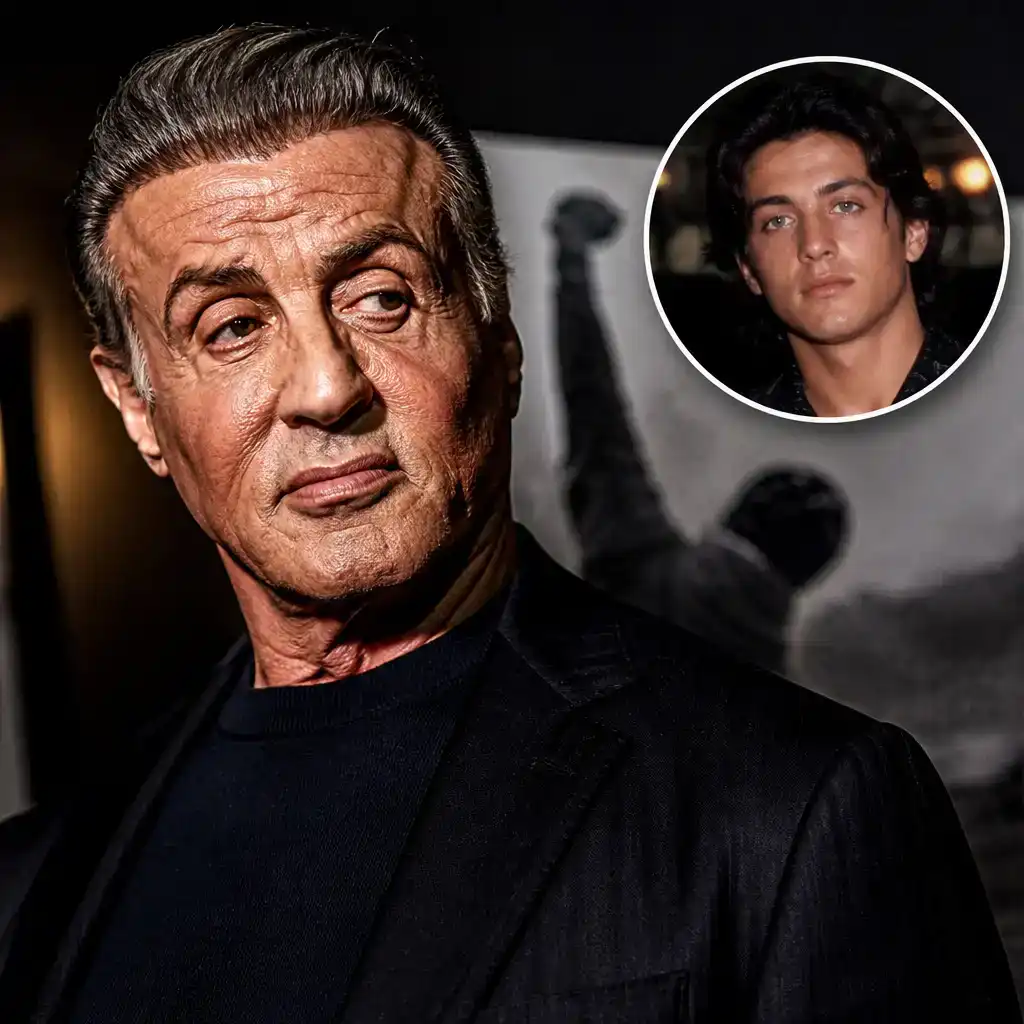
The Sylvester Stallone memoir The Steps looks beyond Rocky Balboa, Hollywood success and decades of action films to examine a far less polished subject: the actor’s family. Now 80, Stallone writes candidly about his parents, his son Sage’s death, a near-divorce and the emotional damage he spent much of his life trying not to inspect too closely.
That includes one especially stark admission. Stallone was playing golf when someone called to tell him that his mother, Jackie Stallone, had died in September 2020 at age 98. He did not attend her funeral.
“No,” he said when asked, before adding with a small laugh, “Now you’re getting the scoop.”
Their relationship, by his account, had never followed a conventional pattern. Jackie was a celebrity astrologer, trapeze artist, pianist and self-described “rumpologist” who claimed she could read fortunes from people’s buttocks. Apparently, the stars were not providing enough material.
Why Stallone stayed away from his mother’s funeral
Stallone describes Jackie Stallone as emotionally distant and openly cruel. He has previously recalled her telling him, “The only reason you’re here is because the hanger didn’t work.”
In The Steps, he also recounts inviting her to the 1977 Academy Awards, where Rocky won Best Picture. She refused to attend because he would not give her an additional ticket for her hairdresser. It was not the usual dispute over family seating.
“Some people just shouldn’t have children,” Stallone said. “And I think she knew that.”
He described his mother as immature and deeply invested in becoming famous. Despite her many public identities, he said she showed little interest in her children or grandchildren.
“She tried to be this palmist, this astrologist, this rumpologist, she was a trapeze artist, she played piano, but she never reached out for her grandchildren or her children,” he said.
Eventually, the relationship deteriorated to the point that she no longer wanted to speak with him. Stallone said she “died in isolation.” He believes the absence of affection also helped drive his creativity, arguing that people carrying the most unresolved problems often become the most inventive.
His father, Frank Stallone Sr., offered little more emotional support. According to Stallone, his father waited until he was dying at 96 to offer advice about love. The timing did not impress his son.
How buried grief threatened his marriage
For decades, Stallone treated emotional pain as something to suppress rather than process. That approach worked until it did not, which is the usual weakness in that strategy.
He said the accumulated grief eventually erupted like an emotional “Vesuvius” several years ago. The crisis nearly ended his marriage to Jennifer Flavin, the mother of his daughters Sophia, Sistine and Scarlet.
Flavin filed for divorce in August 2022. At the time, she was 54 and Stallone was 76. The couple reconciled within weeks after discussing their problems at home.
“Thank God,” Stallone said of the reconciliation.
He dedicated The Steps to Flavin, writing, “Your love has been a beautiful miracle!” Looking back, he sees the marital crisis as part of a much broader collapse after years of refusing to confront loss.
“Finally all the grief, everything just came out, and it was horrible,” he said.
Stallone now believes childhood pain can remain hidden for decades before resurfacing in adulthood. His memoir forced him to revisit memories he had buried for survival, including the absence of affection from both parents. He said writing some passages left him in tears.
The most painful recollections, he added, consistently returned to his mother and father. “There are no good memories.”
The sudden death of Sage Stallone
The deepest source of grief was the death of Stallone’s eldest son, Sage Stallone, in 2012. Sage was 36 when he suffered a heart attack caused by coronary artery disease.
Stallone remembers exactly where he was when he received the news. He was in his office writing a screenplay when Dr. Stephen Levine, Jackie Stallone’s third husband, called him. Stallone had never met Levine and remains unsure why he was chosen to deliver the message.
“He goes, ‘I’m calling to say he’s gone,’” Stallone recalled.
The brief, detached delivery made the shock worse. “It was just so cut and dry and unemotional. ‘Sorry, gone. See you later. Bye.’ That was it. Not like, Can I help you? Nothing. And that was devastating.”
Sage, whose mother was Stallone’s first wife, Sasha Czack, had spoken publicly about a difficult relationship with his father. In 1990, he played Rocky Balboa Jr. opposite Stallone in Rocky V. Six years later, Sage said one of the film’s confrontations drew directly from their real lives.
“When I was screaming, ‘You never spent time with me! You never spent time with my mother!’ that was true,” Sage said. He explained that father and son cried while making the film and reconciled afterward.
Stallone believed Sage had found a promising path outside acting and said he had no idea his son was ill. Photographs can still bring the loss back immediately. “When you see a photo, it’s rough,” he said. “Real rough.”
His relationship with his younger son Seargeoh
Stallone also discussed his younger son, Seargeoh Stallone, who has autism and lives in Los Angeles with Sasha Czack. Seargeoh is 47.
“She’s never abandoned him,” Stallone said of Czack. “So he has constant companionship, and they live in LA.”
The actor acknowledged that he does not see Seargeoh often because he now lives on the East Coast and rarely travels to California. It is one of several family realities presented without an attempt to make them more flattering.
That directness runs throughout The Steps. The title refers to the 72 stone steps outside the Philadelphia Museum of Art that Stallone ran up in Rocky, creating one of cinema’s most recognizable training sequences. In the book, however, the climb begins long before the film.
Stallone traces his life back to a freezing, cramped apartment in Hell’s Kitchen and a childhood dominated by his parents’ violent marriage. When he was 2, they sent him to live in a Queens boarding house used by traveling salesmen. His parents visited roughly once a month, and he remained there until he was 6.
A facial nerve injury during his birth caused his crooked mouth and permanent slur. Those features later became part of his screen identity. During childhood, they mostly made him a target at each new school.
What happened during Stallone’s troubled childhood
By age 16, Stallone had attended 12 schools in Philadelphia. He was eventually sent to Devereux, an institution for troubled teenagers in Berwyn, Pennsylvania.
At 17, staff placed him in a punishment block known as the Snake Pit. In the memoir, he describes it as “basically a mental hospital doing double duty as a solitary confinement detention hall.” Some residents sat in their own feces, he writes, while others had visible scars from lobotomies.
Stallone also recounts being sexually assaulted there by a large, naked inmate nicknamed Jay Bird. According to the actor, the man grabbed at his genitals and tried to tear off his trousers while Stallone screamed for help.
Reconstructing those years was traumatic. Stallone said people often bury memories to survive, allowing them to harden into emotional scar tissue. Returning to them as an adult raised questions he had avoided for years.
“Why was it so difficult to be loved?” he asked. “Why was it so difficult to make friends?”
The writing process repeatedly overwhelmed him. Yet it also allowed him to connect those early experiences with later patterns in his relationships, work and health. His relentless ambition did not appear from nowhere. It developed in a child who received almost no encouragement and learned to rely on himself, whether or not that was a healthy arrangement.
How hardship produced Rocky Balboa
In the early 1970s, Stallone returned to New York with little money and no meaningful career momentum. Without a refrigerator, he kept cottage cheese on his windowsill and survived partly on raw eggs. He worked at a deli and as a cinema usher while auditioning and writing scripts.
“Even though I had zero opportunities and zero encouragement, I never thought about plan B,” he said. “Even though it was frightening because there was no plan B. I would’ve been destitute.”
That mixture of desperation and conviction eventually produced Rocky Balboa, the Philadelphia club fighter given an improbable chance at the heavyweight championship. Stallone wrote the screenplay while still an unknown actor and refused to sell it unless the studio allowed him to play the lead.
The decision could easily have ended with continued poverty. Instead, Rocky became a major success, won Best Picture and turned Stallone into an international star.
“I don’t know if that’s arrogance or what, but I think you need a little of that,” he said.
Fame carried its own damage. While filming Rocky III, Stallone became so fixated on his physique that he developed bulimia and reduced his body fat to 2.6 percent. He has also acknowledged using steroids. Years of physically punishing performances have resulted in nine back operations, two shoulder operations and three neck fusions.
Success solved the money problem. It was less effective as medical treatment for everything else.
What Stallone plans to do next
Time is now the memoir’s central concern. “It’s my currency,” Stallone said. “I’m at the end of my life.”
Rather than slowing down completely, he plans to compress as much work as possible into the years ahead. His current projects include the Paramount series Tulsa King, created by Taylor Sheridan. Stallone said the role has evolved into a performance designed around his personality rather than another variation on the silent action hero.
He told Sheridan he wanted the writing shaped so that he could simply be himself. The result, he said, feels unusually tailored and requires less reliance on the familiar tough-guy persona.
“You don’t have to be a tough guy,” Stallone said. “You just show up and let the words carry you away.”
After a career built around proving doubters wrong, he insists that stage is over. There are no further transformations waiting to be revealed and no final demonstration required.
“I have nothing to prove,” Stallone said. “I have no more tricks in the bag. You’ve seen the magician.”
The Steps presents that conclusion less as retirement than recognition. Stallone remains productive, but he is no longer pretending that achievement erased the damage behind it. Rocky reached the top of the steps decades ago. The man who created him is finally looking back at the climb.