The Stuart Fails to Save the Universe intro has given viewers something to debate before the HBO Max comedy has even settled into its weekly run. Unfortunately for the production, that debate is less about clever title design and more about whether generative AI was involved.
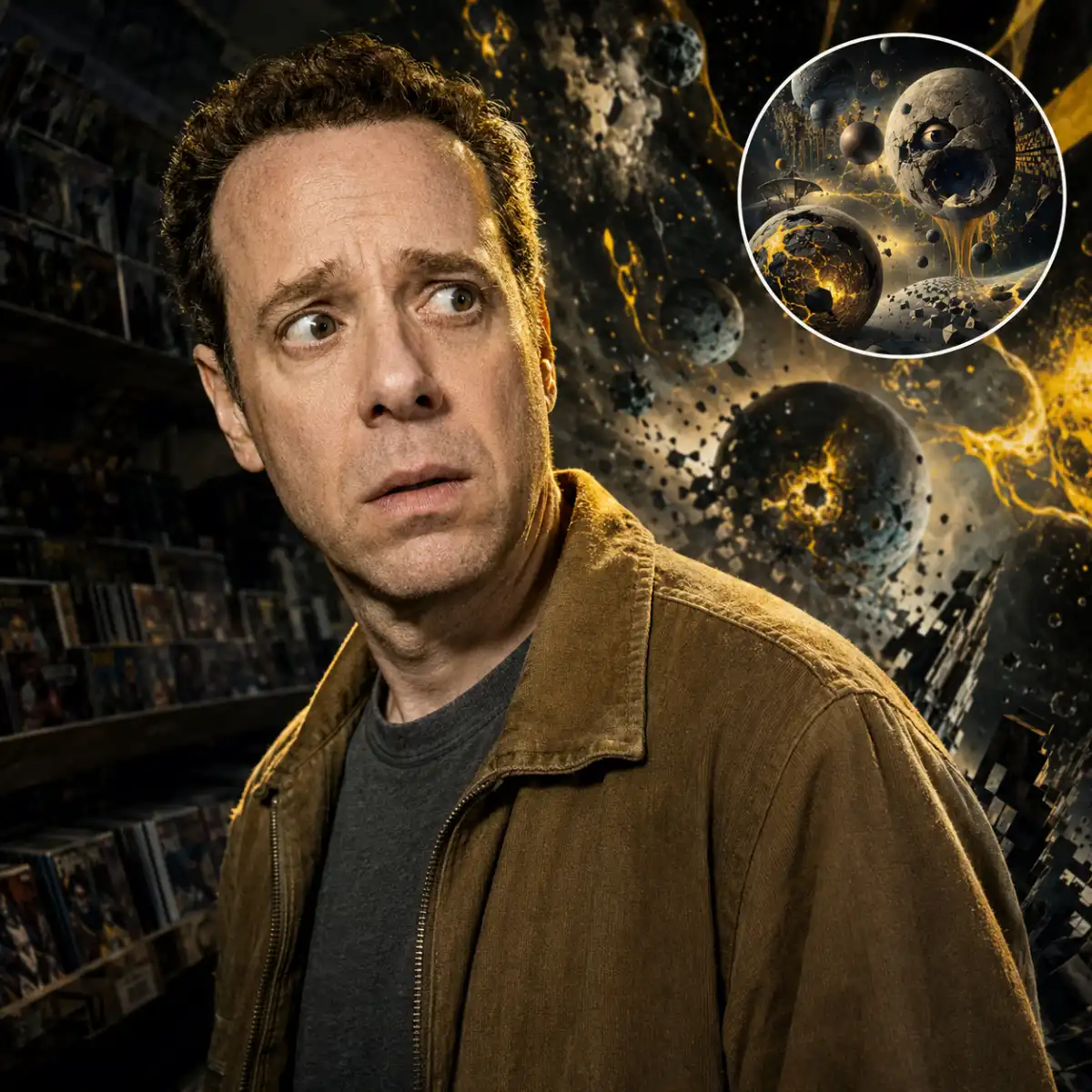
The series premiered on July 23, 2026, and follows comic book store owner Stuart Bloom after he accidentally triggers a multiverse crisis using a device built by Sheldon and Leonard. When its opening sequence was released online, viewers quickly focused on its surreal imagery, strange lettering and self-aware captions telling audiences not to skip it.
Why do viewers think the opening uses AI?
Social media users pointed to malformed text on comic-store dividers, unusual object details and unnatural movement as possible signs of generative imagery. Frame-by-frame screenshots circulated on Reddit, where several viewers independently reached the same conclusion.
The sequence’s jokes did not help. Captions including “how about these graphics, huh?” appeared to invite praise for the visuals, while other text acknowledged the apparent lack of budget and urged viewers not to skip the intro. That confidence landed poorly with people who already suspected corners had been cut.
One commenter described it as an “irony-poisoned ‘self-aware’ AI-generated intro” and “some of the most soulless s**t I’ve ever seen in my life.” Another criticized the “self-congratulatory ‘don’t skip’ text,” accusing the production of boasting about making “AI slop” cheaply.
Others noted that the franchise has never required elaborate openings. The Big Bang Theory largely used a rapid slideshow of images, while Young Sheldon kept things brief with Iain Armitage, a green screen and, on occasion, a cow. Expensive graphics were not exactly an established requirement.
Has HBO Max confirmed generative AI was used?
As of July 28, HBO Max, Warner Bros. Television and the show’s creators had not publicly confirmed or denied using generative AI in the title sequence. No named title designer, visual-effects vendor or production credit has surfaced to establish how the images were made.
That leaves the most important claim unresolved. The screenshots may look suspicious to some viewers, but visual oddities alone do not prove that a generative model produced them. Reddit commenters also raised the possibility that the sequence could use conventional CGI or have been deliberately designed to resemble unstable AI imagery.
The distinction matters beyond one television intro. If generative tools were used, viewers and industry workers may reasonably want to know whether union artists were involved, which models were used and whether any source material was licensed. If the visuals were created conventionally, the artists behind them are now watching their work get publicly diagnosed by strangers using blurry screenshots. A glamorous week for title design, then.
Until the production offers credits or an explanation, the AI accusation remains a widely shared suspicion rather than a confirmed fact.
How has the series itself been received?
The backlash to the opening does not reflect a uniformly negative response to the comedy. Rotten Tomatoes currently lists a 74% critics score based on 35 reviews and an 80% audience score from more than 50 ratings. Those are small samples and should not be confused with viewership figures, but they suggest many people are enjoying the actual episodes.
Reviews have been notably mixed. Variety called the series a “playful, creative romp,” while the Los Angeles Times described it as an “out-of-this-world comedy.” TechRadar praised the show’s intelligence after what it considered a rough premiere.
Other critics were less convinced. RogerEbert.com and TV Guide criticized the complicated mythology, underdeveloped characterization and jokes that sometimes feel dated. The disagreement makes sense for a spin-off attempting to turn familiar sitcom supporting characters into the center of a comic-book-scale multiverse story.
That ambition was deliberate. Co-creator Chuck Lorre said he wanted to make “something radical” outside his comfort zone, as well as something the original Big Bang Theory characters might debate. Actor John Ross Bowie offered a less polished summary, calling the ensemble “the X-Men for f**k-ups” because their scientific and comic-book knowledge complements one another.
Where does the spin-off fit in the franchise?
HBO Max ordered a 10-episode first season from Chuck Lorre Productions and Warner Bros. Television. The project reunites The Big Bang Theory creators Chuck Lorre and Bill Prady while adding Zak Penn, whose credits include work on the X-Men film franchise.
It is the franchise’s third offshoot after Young Sheldon and Georgie & Mandy’s First Marriage. Rather than following another branch of the Cooper family, the new series gives Kevin Sussman’s Stuart Bloom the central role and expands the sitcom’s long-running affection for science fiction into a literal multiverse disaster.
That shift also raises the emotional stakes for a character usually positioned at the edge of the group. Stuart spent much of the original series as the struggling, awkward owner of the comic book store. Here, he is responsible for a reality-threatening mistake and must work with other familiar outsiders to repair it.
New episodes are scheduled to arrive weekly, with the next installment due July 30. Whether the title sequence receives an explanation remains unclear. For now, viewers have two mysteries to consider: how Stuart will save the universe, and who made those graphics.