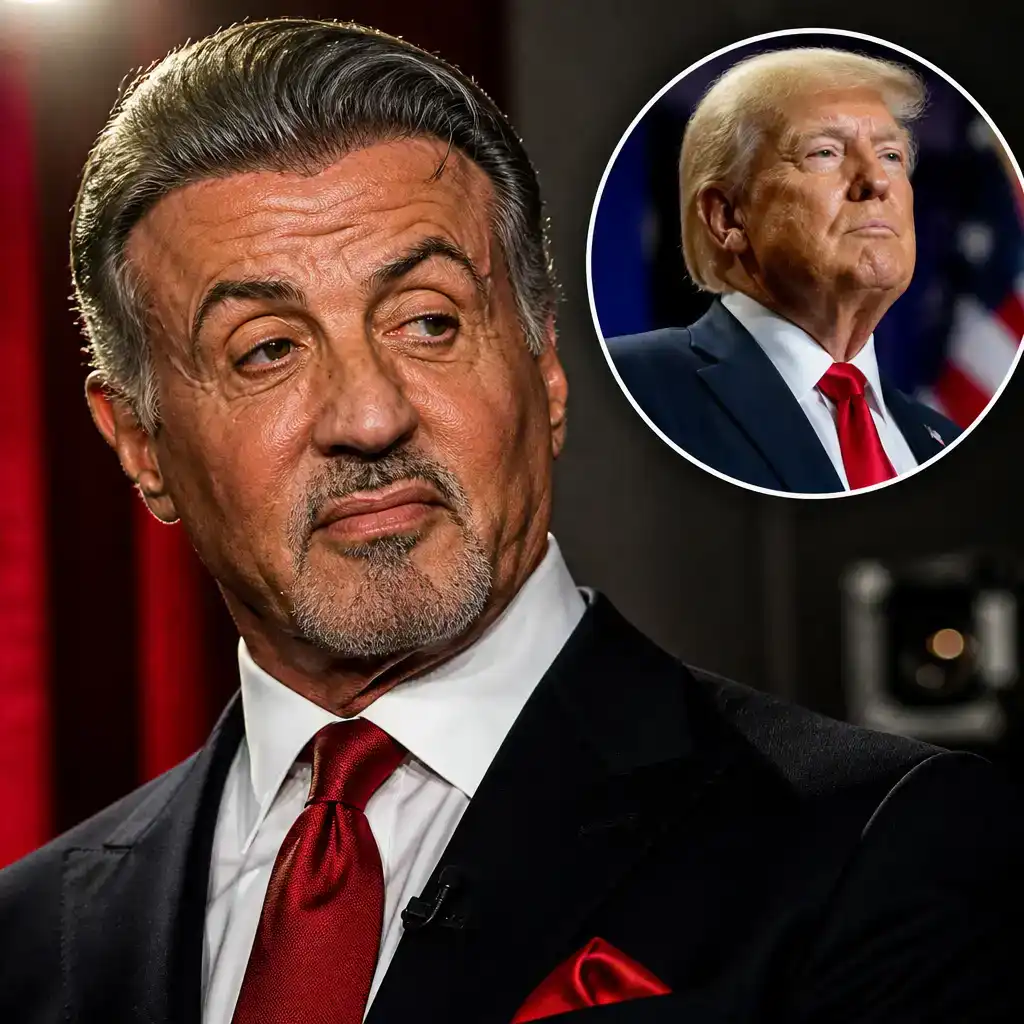
Sylvester Stallone’s Hollywood ambassador role apparently began with the traditional diplomatic procedure of learning about it on television. The actor says President Donald Trump did not consult him before publicly naming him alongside Mel Gibson and Jon Voight as a special envoy tasked with helping revive American film and television production.
Stallone, 80, told The Sunday Times that he was watching TV when the announcement appeared.
“I was watching TV one night, and they go, ‘So Stallone and Mel Gibson and Jon Voight will be...’ And I went, ‘What?’” he recalled. “I said, ‘Excuse me? Really?’ Because if they had asked me in the beginning, I would have said, ‘This is not possible.’”
That sounds like a rejection of the job. The fuller picture is slightly more complicated: Stallone resisted the vaguely defined ambassadorial title, but later backed the main policy associated with it, a federal incentive for productions filmed in the United States.
Why Stallone thought the assignment would fail
Donald Trump announced the three appointments on Truth Social on January 16, 2025, days before his second inauguration. He described Hollywood as a “great but very troubled place” and said Stallone, Gibson and Voight would serve as his “eyes and ears.” Their suggestions, Trump added, would help bring entertainment work back from foreign countries and restore a new “Golden Age of Hollywood.” Modest expectations, then.
Stallone said the problem was not necessarily the goal. It was the idea that three actors could walk into a highly fragmented corporate industry and start issuing useful instructions.
“Hollywood, I guess it’s like feudal states,” he told the newspaper. “They have their little kingdoms. You don’t go in and tell six studios how to do things.”
He also described himself, Gibson and Voight as independent personalities rather than natural members of a coordinated policy group. “No, it won’t work,” he said.
Stallone later explained his position directly to Trump. “I said thank you and ciao, because it’s impossible,” he recalled. “Hollywood works, and it will evolve.” He added that corporate executives were unlikely to welcome financial advice from him.
As of September 22, neither Trump nor Stallone had clarified whether the actor had formally resigned from the informal post. No presidential response to the interview had emerged either.
Gibson was surprised, while Voight got to work
Mel Gibson also said Trump’s January announcement caught him by surprise. “I got the tweet at the same time as all of you and was just as surprised,” he told Variety at the time.
Gibson nevertheless said he would answer the call and offer whatever help he could as a citizen. He then asked whether the position came with an ambassador’s residence, which was at least an attempt to identify a practical benefit.
Jon Voight took the role more actively. A longtime Trump supporter, he met with White House officials and pushed for policies intended to bring film and television work back to the United States. His efforts, conducted with manager Steven Paul and Paul’s associate Scott Karol, focused heavily on a federal production tax incentive.
Asked by The Hollywood Reporter whether Stallone and Gibson were participating, Voight said both actors had been extremely busy. Paul offered a somewhat different emphasis, saying Stallone had been occupied with his television series but remained “very involved” and had signed the group’s letter.
That claim aligns with reports from the Los Angeles Times and The Guardian. Both reported that Stallone signed an industry coalition letter in May 2025 supporting federal incentives. So he may have declined the ceremonial assignment while endorsing the one part that could actually move money and jobs.
How the proposal became a bipartisan tax plan
The campaign has since moved beyond celebrity appointments and into Congress, where policy becomes less glamorous but considerably more real.
On August 31, Trump called Hollywood a “Complete and Total Disaster,” argued that productions lacked an incentive to remain in the country and urged lawmakers from both parties to develop legislation supporting the American entertainment industry.
Senator Adam Schiff and Representative Laura Friedman, both California Democrats, welcomed the proposal. Schiff urged Congress to pass a federal incentive immediately to restore jobs that had moved overseas. Friedman said Trump’s support prompted a flood of offers to help, adding: “Everyone in every state loves movies and television.”
According to Variety, lawmakers are drafting a federal film and television production credit worth 20%. That could rise to 30% through bonuses tied to factors including:
- Independent productions
- Filming in rural areas
- Projects returning from overseas
- Spending spread across multiple states
Representatives Nathaniel Moran, Linda Sánchez, Laura Friedman and Brian Jack have been involved in the discussions. Lawmakers also announced a bipartisan American Film & TV Production Caucus on September 16.
The structure matters because this is no longer simply a plan to assist Los Angeles studios. Bonuses for rural locations and multistate projects could direct production spending into regions that rarely appear in debates about Hollywood, except when a politician needs a convenient target.
Why production losses are driving the debate
The push comes amid a prolonged slowdown in Greater Los Angeles production. FilmLA recorded 4,711 shoot days in the second quarter of 2026, about 13% fewer than during the same period a year earlier and 36% below the five-year average.
Productions have increasingly considered overseas locations and competing US states that offer lower costs or generous local incentives. California has expanded its own incentive program, but FilmLA spokesperson Philip Sokoloski cautioned that the full effect will take time to appear in the data.
A federal credit would approach the problem nationally rather than forcing states to compete alone. Supporters argue that it could make the United States more attractive against countries offering established production subsidies, while also preserving work for crews, vendors and local businesses.
The proposal still has to survive the usual congressional questions about cost, eligibility and who receives the largest benefit. No final legislation has passed, and the exact terms remain under discussion.
Stallone’s position is therefore less contradictory than it first appears. He did not believe an actor-led advisory mission could instruct major studios on how to operate. He did, however, sign onto a concrete proposal aimed at changing the financial calculation behind where productions are made.
Trump offered him an undefined ambassadorial portfolio without warning. Stallone declined the grand assignment, then supported the tax policy underneath it. Even in Hollywood, the less cinematic paperwork sometimes matters more.