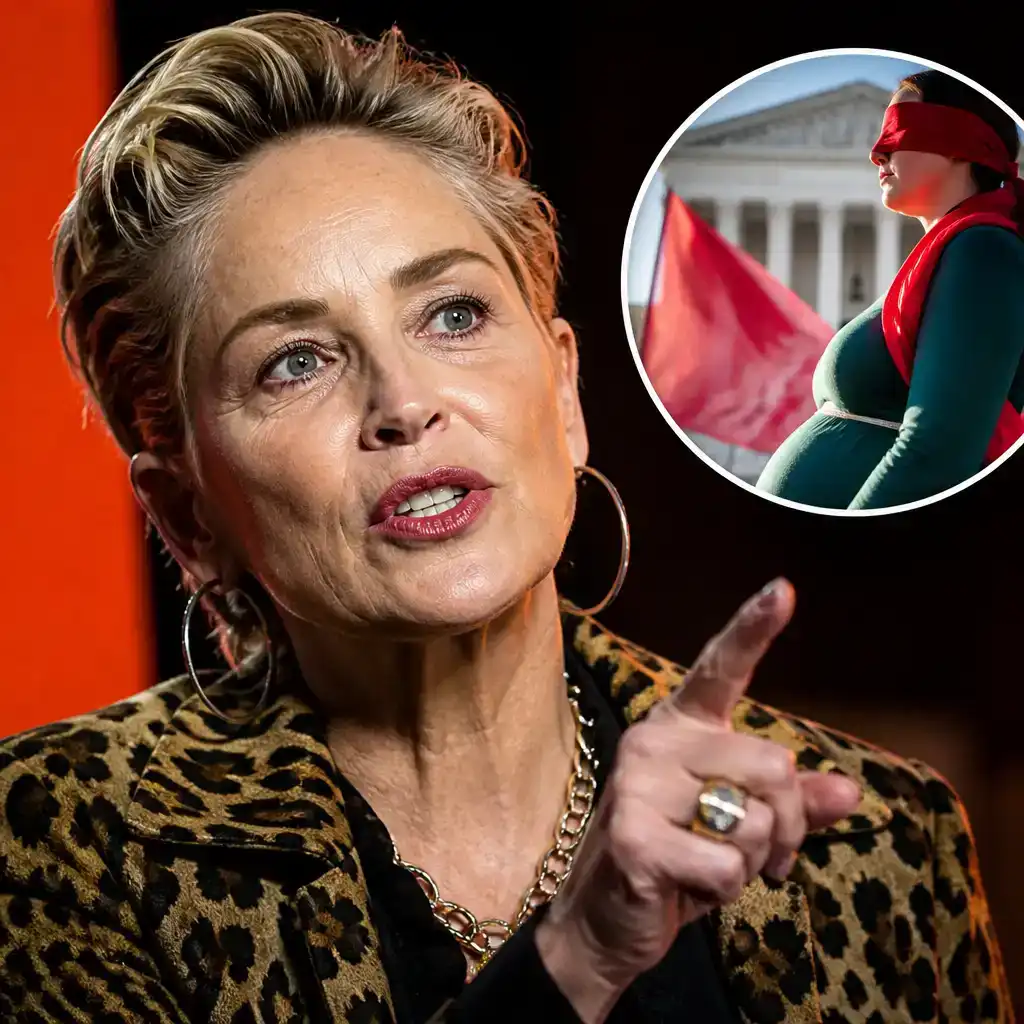
Sharon Stone has delivered a pointed take on abortion rights, suggesting that access to reproductive healthcare would look dramatically different if men were the ones capable of getting pregnant.
The actress, best known for her role in Basic Instinct, expressed her argument in a single sentence that leaves little room for misinterpretation.
"If men could get pregnant, you could get an abortion from a vending machine."
The remark has prompted debate online, with supporters praising its blunt criticism of political priorities and critics arguing that it reduces a complicated issue to an overly convenient metaphor.
Stone's argument is not really about vending machines, of course. It is about who makes decisions concerning reproductive healthcare, whose experiences shape those decisions, and whether access to abortion would be treated differently if pregnancy affected men.
Sharon Stone's abortion comment challenges political priorities
The central argument behind Stone's statement is straightforward: political attitudes towards reproductive healthcare may be influenced by the people most directly affected by restrictions.
By imagining a world in which men could become pregnant, Stone challenges audiences to consider whether abortion would face the same political obstacles under different biological circumstances.
The vending machine imagery is deliberately exaggerated. It suggests a level of convenience and accessibility that contrasts sharply with the controversy surrounding abortion rights.
Rather than proposing a literal healthcare solution, the actress uses an absurd hypothetical scenario to make a broader argument about gender, political influence and bodily autonomy.
It is a provocative comparison, but its simplicity is precisely what makes it memorable.
Why the statement has divided opinion
According to the material describing the reaction, Stone's comments have attracted both support and criticism online.
Supporters see the remark as an effective way of highlighting what they consider unequal political treatment of reproductive healthcare.
For them, the argument raises a legitimate question about whether laws governing pregnancy would be approached differently if the biological circumstances were reversed.
Critics, however, argue that the comparison oversimplifies an issue involving medical care, ethical disagreements, legal frameworks and deeply held personal beliefs.
That objection deserves consideration. Abortion policy involves competing arguments that cannot be fully explained by a single hypothetical scenario, however memorable the wording might be.
Stone's statement does not attempt to address those complexities individually. Instead, it focuses attention on one particular question: whether political power and personal experience influence the way reproductive rights are regulated.
Why the vending machine comparison matters
The effectiveness of Stone's remark comes from its contrast between a serious healthcare debate and an everyday symbol of instant convenience.
A vending machine represents something readily available, requiring little explanation or negotiation. By connecting that image to abortion, Stone suggests that access to reproductive healthcare could become substantially easier under different circumstances.
It is an argument built around perceived inequality rather than a detailed examination of legislation.
The distinction matters because a rhetorical statement can raise a legitimate concern without providing a complete explanation of the issue it addresses.
Stone's hypothetical cannot establish how governments would actually legislate abortion if men could become pregnant. That question is impossible to test directly.
What it can do is encourage scrutiny of the assumptions behind existing political debates, particularly those concerning who should have authority over decisions involving pregnancy.
Does Stone's argument go too far?
In my view, Stone's comparison is effective as political commentary precisely because it does not pretend to be a comprehensive policy argument. Its purpose is to expose a possible imbalance in how reproductive healthcare is discussed, and the exaggerated imagery makes that criticism immediately understandable. However, the hypothetical cannot prove that abortion would become universally accessible if biological roles were reversed. That limitation does not make the underlying question irrelevant, but it does mean the statement is better understood as a challenge to political assumptions than as evidence of how policy would change.
Stone's direct approach also illustrates a familiar tension in public debate: the statements that attract the most attention are rarely those that accommodate every possible qualification.
Her remark compresses a complicated discussion into a memorable image, leaving audiences to argue over the broader implications.
The larger question behind Sharon Stone's remarks
The debate surrounding Stone's statement ultimately extends beyond the actress herself.
It concerns the relationship between reproductive healthcare, political representation and the ability of individuals to make decisions about their own bodies.
Supporters and critics may disagree about whether Stone's comparison is fair, but the disagreement exposes two distinct questions: whether reproductive healthcare is governed equitably, and whether a deliberately exaggerated hypothetical is a useful way to examine that issue.
The supplied account does not establish when or where Stone originally made the statement, nor does it provide independently documented figures measuring the online reaction.
Those details matter when assessing the scale and context of any public controversy.
For now, the substance of Stone's argument remains the more interesting issue. Her comparison asks audiences to imagine reproductive policy from an entirely different position of personal experience.
The vending machine may be imaginary. The disagreement over who controls reproductive healthcare is anything but.