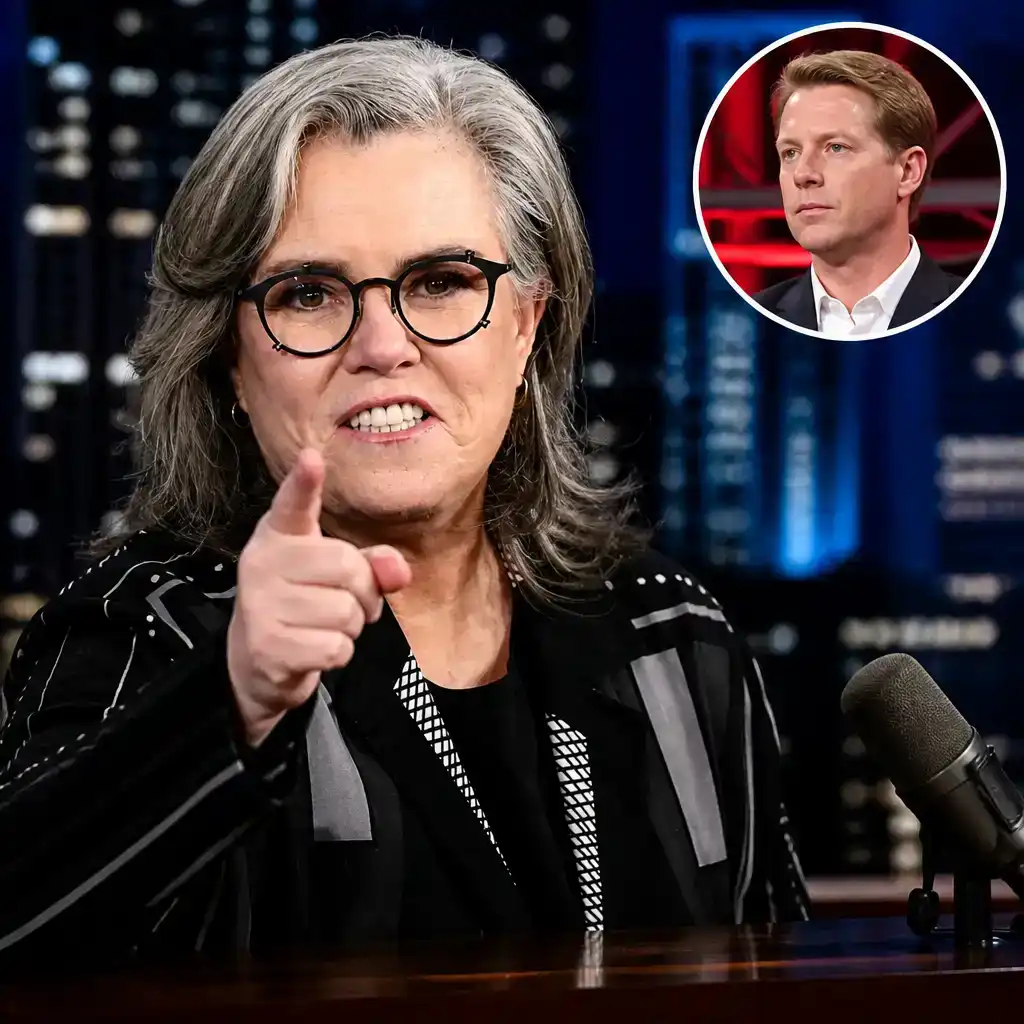
Rosie O’Donnell’s Jimmy Kimmel Live takeover began as an unlikely booking and quickly became a test of two things: whether old television grudges can expire, and whether political conflict still brings viewers to late night. Jimmy Kimmel chose the former talk-show host for his summer absence, calling the week a “special treat” for President Donald Trump, whose feud with O’Donnell has now survived roughly two decades, several television formats and any reasonable expectation of exhaustion.
Her opening monologue on ABC made sure Trump knew she had arrived. “Hi, I know you’re watching,” she said, before telling viewers to “buckle up.” She then mostly resisted discussing him, closing with the suggestion that he was probably “crying because I haven’t mentioned him.”
Why Kimmel’s invitation caught O’Donnell off guard
The offer was not the predictable result of a long friendship. O’Donnell told Variety that it “came out of the blue” because she and Kimmel had never spoken in person and previously had what she called an “adversarial relationship.”
“We’ve never spoken on the phone; we’ve texted a few times,” she said. Howard Stern had tried to ease the tension, and the two had attended some of the same parties, though O’Donnell said she generally spoke with Kimmel’s wife rather than with him.
Her view of Kimmel at the time was fairly direct: “OK, one of the bro guys.” She also noted that she had never even appeared as a guest on his show, making an entire week behind the desk a substantial first visit.
Their relationship softened after the 2011 death of Kimmel’s uncle, Frank Potenza, a former New York Police Department officer who became a familiar comic presence on Jimmy Kimmel Live!. O’Donnell contacted Kimmel to offer condolences, and he replied.
When her publicist later called with the guest-hosting proposal, O’Donnell first checked that it was real. Once assured that Kimmel genuinely wanted her, she accepted. “I was surprised, to tell you the truth, and very thankful,” she said.
What O’Donnell did with her late-night return
O’Donnell used much of her debut to discuss moving to Ireland after reading Project 2025 rather than building the entire monologue around Trump. The choice gave her appearance a political focus without turning it into a full evening of direct insults, an achievement that may qualify as restraint given the history involved.
Trump’s hostility toward O’Donnell dates back to her criticism of his business record and bankruptcies on The View. Their exchanges continued for years, making Kimmel’s booking both a television event and an expertly targeted irritation.
O’Donnell also viewed the assignment as support for late-night hosts facing political and corporate pressure. She defended Kimmel after ABC briefly pulled his programme in 2025 and praised his willingness to speak publicly about the government.
“I support him in what he’s doing with the First Amendment, and our ability as entertainers and citizens to speak out against our government,” she told Variety.
She argued that Stephen Colbert deserved similar backing after CBS cancelled The Late Show. Kimmel’s own programme, meanwhile, averaged a record 3.15 million viewers in June, according to Variety. He joked that CBS cancelling Colbert “really helped,” because television executives do appreciate measurable consequences, even when those consequences are awkward.
Why O’Donnell is worried about CNN
Her broader concern is David Ellison’s proposed combination of Paramount and Warner Bros. Discovery. The deal would place CBS News and CNN under the same corporate structure while also bringing together Paramount+ and HBO Max, along with two major film studios.
O’Donnell warned that Ellison’s control of CNN could reshape the television news business. “It would be like Fox taking over all news channels,” she said. “That’s what’s happening with Hollywood now and the Ellisons, and it’s tragic.”
She pointed to changes at CBS News and 60 Minutes, blaming Ellison and Bari Weiss for what she described as a right-wing overhaul. “Look at what’s happened to CBS News and 60 Minutes, which was the gold star of their entire network, and they blew it up,” O’Donnell said.
Her harshest comment targeted people willing to cooperate with powerful political figures. “If you’re in a room with 10 Nazis at a table and you’re the only one who’s not, there’s a pretty good chance you’re a Nazi,” she said.
Ellison has directly rejected claims that he intends to impose his politics on CNN. He wrote that he would not “bend newsrooms to my views” and said CNN journalists would answer to facts rather than a political party or cause.
What stands between Ellison and the merger
The Associated Press describes the transaction as an $81 billion merger, not a completed takeover. Paramount has agreed to delay closing until a court ruling or June 1, 2027, while lawsuits from 12 states and the Writers Guild of America proceed.
A federal judge found that the states had raised “serious questions” about whether the combination would reduce competition. California Attorney General Rob Bonta welcomed the delay, saying it was good news for audiences, cinemas and entertainment workers. Paramount insists the merger would benefit competition, consumers and creators, which is the standard corporate position when regulators ask whether one company may be acquiring rather a lot of the industry.
Britain has cleared the transaction after Paramount made legally binding commitments covering service diversity and editorial independence. The remaining American legal fight carries significant consequences because CNN remains a valuable business. Warner Bros. Discovery expects the network to generate about $600 million in profit on $1.8 billion in revenue in 2026, according to Variety.
The fight also reaches Hollywood jobs
The dispute extends beyond CNN’s editorial direction. A merger of this scale could affect where productions are made, how many people they employ and which streaming services control access to major film and television libraries.
Actor Noah Wyle criticised Ellison’s suggestion that productions could move away from California, calling it “saber rattling.” Wyle said The Pitt supported 600 jobs and generated $125 million in economic activity for the state, figures that make production geography considerably more concrete than a disagreement between executives.
O’Donnell’s hosting week therefore landed at a useful moment. Her performance tested whether a familiar political feud could lift late-night audiences, while her comments drew attention to a merger that may reshape news, streaming, film production and entertainment employment. Trump received his promised “special treat,” though O’Donnell’s larger target was the corporate structure forming behind the television screen.