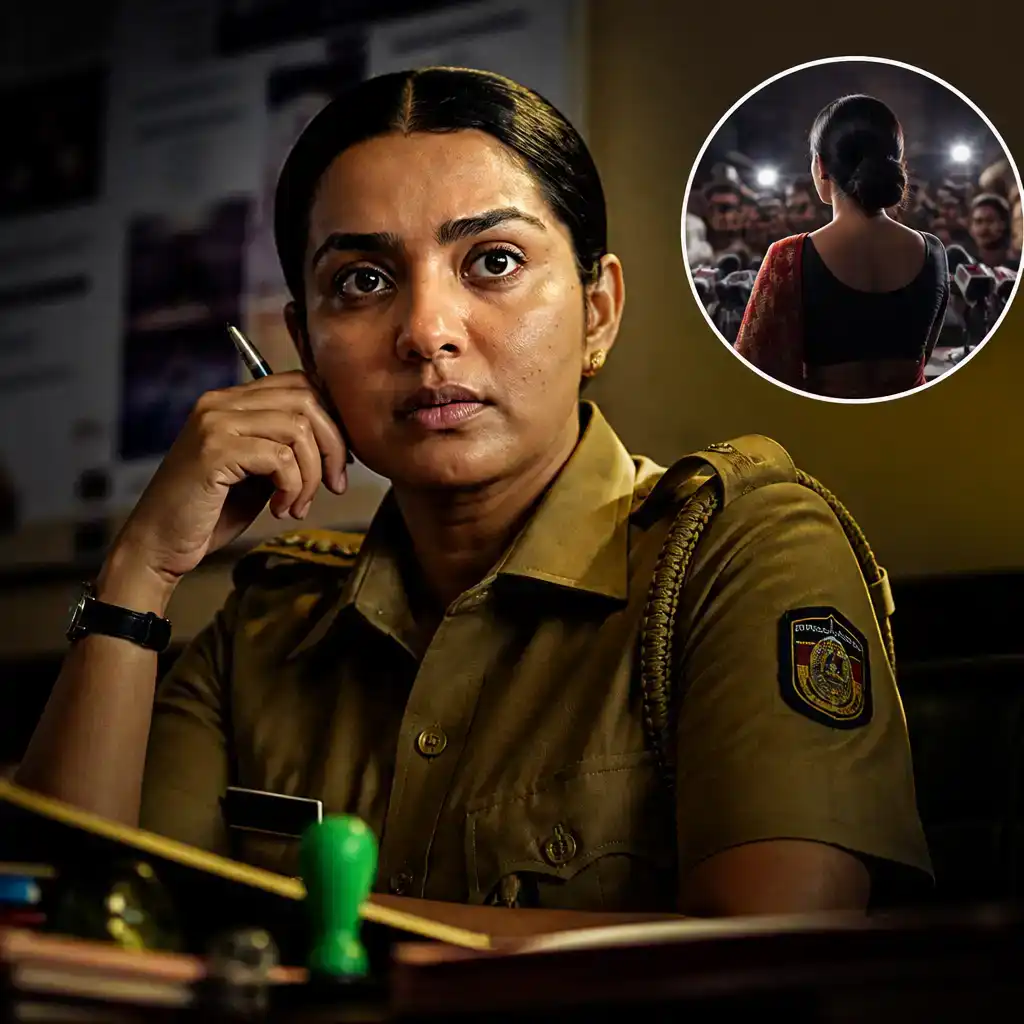
Parvathy Thiruvothu has spent much of her career playing women who resist broken systems. In Pradhama Drishtiya Kuttakkar, she takes a different position: inside one. The Malayalam police thriller gives her a uniform, an institution to defend and a moral crisis that arrives almost immediately. It also mirrors her off-screen decision to remain in a film industry she has publicly challenged over misogyny, harassment and unequal opportunities.
Released on September 11, the Shahad Nilambur-directed film has drawn generally positive reviews for changing the usual mechanics of a police procedural. Its commercial performance is less clear. Two box-office trackers have produced totals separated by more than ₹13 crore, because apparently even basic arithmetic can develop narrative twists.
What makes Aleena Abraham different?
Thiruvothu plays Aleena Abraham, a woman who joins the police through a compassionate appointment after the death of her husband, who was also a constable. The system offers her employment after bereavement, then expects competence, loyalty and emotional control on schedule.
Aleena works alongside Divya, Dasan and Sreenath in a local station where an unexpected criminal case destabilises the officers and their assumptions about guilt. Rather than conceal the central crime until the final act, the screenplay reveals it within roughly the first 10 to 15 minutes. The suspense comes from whether those involved will be exposed and what they will do under pressure.
“I loved it,” Thiruvothu said of portraying someone working within a state institution. “Most of the time people don’t understand what it is like to stay within a rotten structure and try to change it.”
Written by P. S. Subramanian and Vijesh Thottungal, the film repeatedly gives viewers enough information to form a verdict, then introduces another complication. Thiruvothu credits Subramanian with its procedural structure and Thottungal with its emotional core. She described the storytelling as “two steps forward, one step back.”
How did she prepare for the police role?
Although this is Thiruvothu’s first uniformed police role in Malayalam cinema, it is not her first time playing an officer. She portrayed plainclothes deputy commissioner Kranthi Shenoy in the Prime Video series Dhootha. She also dubbed the Malayalam version of Kareena Kapoor Khan’s police character in Daayra.
Preparing for Aleena required learning police procedure and then carefully appearing less skilled at it. Thiruvothu trained to perform the correct salute but deliberately reduced its precision during filming because Aleena is not supposed to look thoroughly experienced. Technical accuracy, in this case, meant knowing exactly how much accuracy to remove.
Real policewomen also worked as extras during their days off, giving the production direct access to their movements and routines. Thiruvothu had previously discussed policing at length with Indian Police Service officer Ajeetha Begum.
The film runs between 156 and 161 minutes, depending on the listing, and its cast extends well beyond its central character. Vijayaraghavan, Unnimaya Prasad, Mathew Thomas, Sidharth Bharathan, Azees Nedumangad, Vinay Forrt and R. Parthiban all appear in the ensemble.
Did the director change course after Anuragam?
For Shahad Nilambur, the project also became a professional reassessment. He told Manorama that the failure of his previous film, Anuragam, forced him to examine what had gone wrong and approach his next production differently.
That rethink appears to have paid off critically, if not with complete unanimity. S. R. Praveen of The Hindu found novelty in a familiar Malayalam genre, while Vignesh Madhu of The New Indian Express praised the screenplay’s intelligence and abundance of twists. Rediff critic Sreeju Sudhakaran also highlighted its “smart writing.”
Other reviews were less persuaded. The Indian Express awarded the film 2.5 out of five, while The Times of India argued that the screenplay lacked focus and did not explore guilt and panic convincingly enough.
Madhyamam praised Thiruvothu’s movement between fear, confusion, confidence and resistance, but also singled out Unnimaya Prasad, Azees Nedumangad and Vijayaraghavan. That assessment frames the film less as a star showcase and more as an ensemble piece, despite the marketing emphasis on its lead.
How original is its central premise?
The compassionate appointment that brings Aleena into policing resembles the premise of Sandhya Suri’s Santosh. That film stars Shahana Goswami as a widow who assumes her late husband’s police position and premiered at Cannes before India’s censor board blocked its domestic release.
Thiruvothu had not seen Santosh when discussing the similarity. “I should probably write to Shahana and ask her if there’s a way I can watch it,” she said. The censorship decision, she added, “says enough about the movie as to why it’s important.”
Mint went further than simply noting the shared premise. Its review observed that the opening of Pradhama Drishtiya Kuttakkar resembles Santosh, including the restrained disclosure of the policewoman’s husband’s death. That complicates claims of complete novelty, although the Malayalam film develops into a more overtly twist-driven thriller.
The resemblance does not erase the later differences, but it places both films in a wider conversation about women entering institutions through loss and discovering that employment does not automatically provide authority.
What has the film earned at the box office?
Public estimates disagree sharply. Sacnilk calculated ₹18.34 crore net in India and ₹19.97 crore worldwide through September 20, nine days after release. The Numbers separately recorded US$35,766 in Australia following an opening there on September 18.
Filmibeat, however, reported only ₹6.15 crore. Neither total came from audited producer accounts, and Sacnilk labels its figures approximate. The gap is more than threefold, which makes any firm declaration of hit or failure premature.
The dispute illustrates a broader problem with Malayalam-film box-office reporting. Trackers often rely on different samples, territories and estimates, while official studio totals may never appear. Numbers then circulate as settled facts despite lacking a common method. The film may be performing solidly, modestly or somewhere inconveniently between the two. For now, the honest figure is a range, not a verdict.
Arjun Selva produced the thriller through 11 Icons Film Productions.
Why does Aleena’s position feel personal?
Thiruvothu has faced intense scrutiny since speaking publicly about misogyny in Malayalam cinema. She dates that intervention to around 2016, with the backlash becoming especially visible from 2017 onward. Her work with the Women in Cinema Collective and her response to the Justice Hema Committee findings placed her among the industry’s most prominent advocates for structural reform.
The Kerala government formed the committee in 2017 to investigate sexual harassment and gender discrimination in Malayalam filmmaking. It submitted its findings in 2019, but the report became public only in August 2024 after a Kerala High Court order. Its findings detailed harassment, wage inequality and the blacklisting of women who complained.
“Anything I say or don’t say, there is always a verdict placed on me,” Thiruvothu said. Public approval, she argued, shifts quickly depending on whether observers believe she has spoken enough, chosen the correct issue or aligned with the expected side.
She remains deeply sceptical of institutions that ask women to wait for justice. Explaining why she has not pursued legal cases of her own, she recalled asking police to provide one example proving that justice had been served to a woman in comparable circumstances. She said they could not.
Has industry activism produced concrete change?
Thiruvothu points to Internal Complaints Committees on film sets as a tangible gain. Indian sexual harassment law already required such mechanisms, but entertainment-industry unions resisted their implementation for years. Their presence now offers workers a formal channel for complaints, even if a committee alone cannot repair an unsafe workplace.
“That’s a big win in terms of feeling safe enough at our workplace,” she said.
Representation remains uneven elsewhere. According to Thiruvothu, Malayalam productions still employ fewer women than Hindi productions as department heads, cinematographers and editors. Female actors also receive fewer chances to recover from commercial failure than men.
She cited Mamitha Baiju, Anna Ben and Anaswara Rajan as performers who have delivered successful films, while arguing that individual hits do not amount to equal opportunity. “The same choice levels or the number of choices that are given to anyone who is male in this industry has to be given to women and other minorities,” she said.
Her point is not that every film led by a woman must succeed. It is that failure should not function as a permanent employment ban for one group while remaining a temporary inconvenience for another.
What comes next for Thiruvothu?
Thiruvothu is working across four projects, including Storm, produced through Hrithik Roshan’s HRX banner with Prime Video, and the second season of Dhootha. She is also attached to two unannounced Hindi productions and the Malayalam ensemble film Homo Sapiens, which she described as lighter than much of her recent work.
Comedy remains the major omission from her résumé. She wants romantic comedies and broader comic roles, citing Mike Leigh’s Happy-Go-Lucky and Anne Fletcher’s The Proposal as reference points. “That is something that no one has even given me a chance to audition,” she said. “I want to prove that I can do it.”
For now, Aleena may be the role that most closely reflects Thiruvothu’s own position. Both remain inside institutions they distrust, attempting to protect themselves without leaving.
“My choice to continue to be in the film industry is probably going to always be one of the bravest things that I would do,” she said. Remaining present, she argued, can itself become resistance when the preferred institutional solution is for the difficult woman to disappear.
She recognised the connection only after watching the completed film. Aleena refuses to run, chooses self-preservation and continues doing her job. Thiruvothu has made much the same calculation.
“I enjoy watching patriarchy fall apart,” she said. “I enjoy it, so I would rather stay in.”