The Orlando Bloom threesome scene in Werner Herzog’s Bucking Fastard has prompted the expected internet response: discomfort, outrage and several firm declarations that nobody asked for this. Yet the festival film is neither widely released nor a straightforward account of two real twins, and reports from production suggest the sequence is less explicit than the more excited headlines imply.
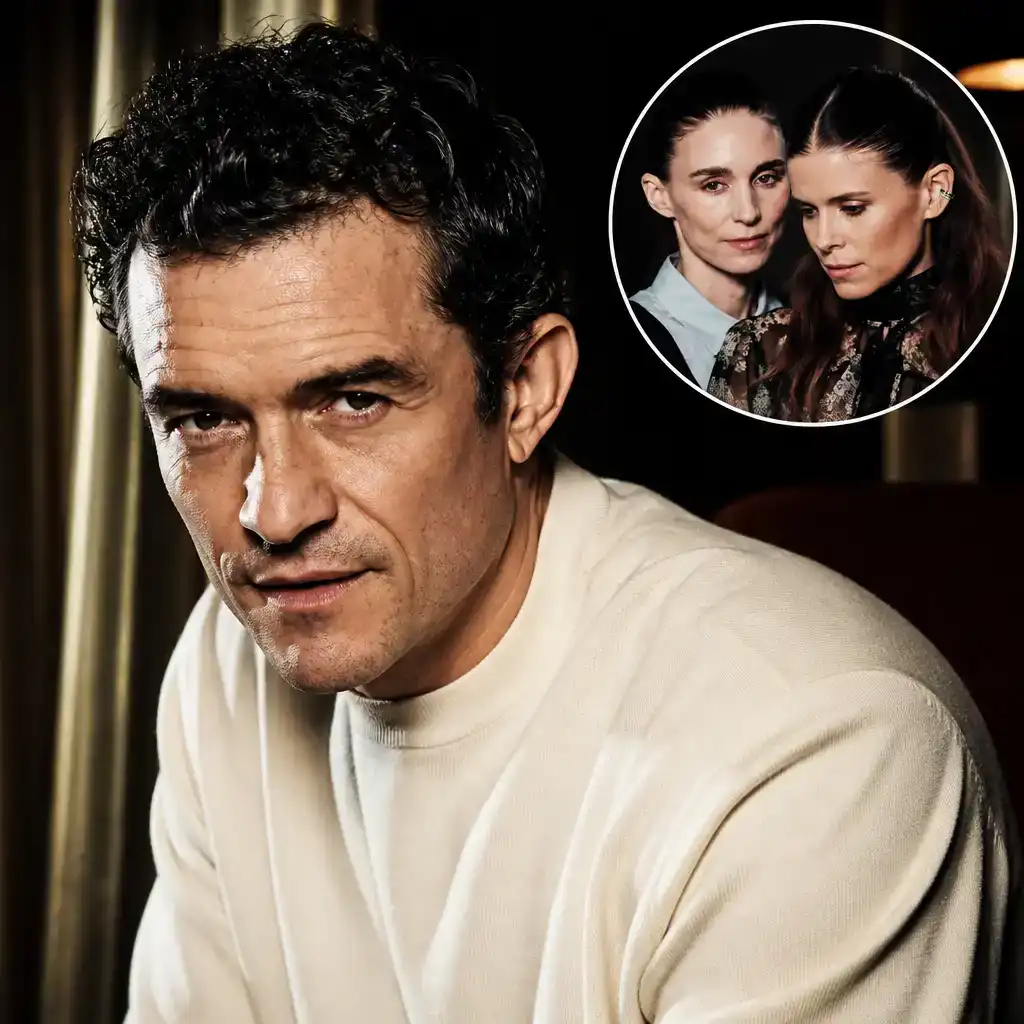
Bloom appears opposite real-life sisters Kate Mara and Rooney Mara, who play fictional sisters Jean and Joan Holbrooke. His smooth-talking character becomes the object of affection for both women, leading to an intimate scene involving all three performers.
Speaking at the San Sebastián Film Festival, Bloom described the characters as having simple “carnal desires,” while stressing what he viewed as the sisters’ innocence.
“My character, the Bucking Fastard, is sensitive too,” he said. “And he’s quite quickly out of his depth in some ways. It was a very sincere sort of moment that was created.”
What actually happens in the intimate scene?
Herzog said he deliberately gave Bloom little direction while filming the sequence.
“In the love scene, I said to Orlando: ‘You are in bed, and you have two women in your arms. How you deal with it, I cannot give instructions,’” the director said. “It is beautiful because it has such charm and depth.”
That explanation did not calm everyone. Reddit users called the setup “weird,” “disgusting” and “so wrong on so many levels,” focusing primarily on Kate and Rooney being sisters outside the film. One commenter asked why the production needed to cast actual siblings, while another said they would not watch it.
The description of a “steamy threesome sex scene” also appears to be doing some promotional heavy lifting. Earlier production reporting said the Mara sisters wore nightgowns and Bloom was naked only from the waist up. It remains an intimate scene between a man and two fictional sisters played by real siblings, but it is not necessarily the explicit spectacle suggested by some coverage.
No further public response from Bloom, Kate Mara or Rooney Mara has emerged since the backlash circulated.
Is Bucking Fastard based on a true story?
The film draws inspiration from Freda and Greta Chaplin, British twins who became tabloid subjects during the 1980s following a stalking case. Herzog met the pair roughly 45 years ago, but he has rejected the idea that his screenplay directly retells their lives.
The Associated Press reported that Herzog called the resulting characters and story a “complete invention.” That distinction matters because some early reports described Bucking Fastard simply as a true story, which gives audiences a considerably different impression.
Herzog wrote the screenplay in five days and transformed the source of inspiration into an invented outsider fairy tale. Jean and Joan speak together, move in close coordination and share an intense emotional world. Bloom’s character becomes part romantic interest, part disruption and, eventually, a man who realizes he may not be controlling the arrangement after all.
The result is more stylized fable than biographical drama. Herzog taking a grim real-life episode and converting it into something stranger should surprise approximately nobody familiar with his work.
How did Kate and Rooney Mara play the sisters?
Bucking Fastard marks the first film Kate and Rooney Mara have made together. Their central challenge was not the bedroom sequence but performing Jean and Joan as a synchronized pair, often matching dialogue, movement and rhythm.
Rooney told the Associated Press that their shared childhood gave them “this unspoken world between us.” She also said she had never laughed so much while making a film. Kate described the sisters’ coordinated speech as “very musical” and said the rhythm came naturally to them.
Herzog initially planned two weeks of rehearsal but reduced that period to five days. Bloom praised the director’s loose approach, saying Herzog creates “a sacred space for magic to happen.” In the love scene, that apparently meant placing the actors in bed and leaving them to solve the practical details themselves. Efficient, if not especially reassuring to the internet.
Even critics who disliked the film have acknowledged the technical precision of the Maras’ shared performance. Their ability to speak and move as one unit is central to Herzog’s deliberately artificial world, rather than a minor novelty built around their family connection.
When will audiences be able to watch it?
The 109-minute film premiered at the Venice Film Festival on September 3, where it received an ovation lasting nearly seven minutes. It later screened at San Sebastián, but the Associated Press reported that no United States release date had been announced. Calling it broadly “released” therefore gets ahead of the distribution calendar.
Critical opinion remains sharply divided. Rotten Tomatoes currently records a 74 percent score from 42 reviews and has no audience score, while Metacritic categorizes the response as mixed or average. Sight and Sound described it as Herzog’s best fiction feature in years; The Guardian called it a “dud.” Cinema has once again avoided consensus.
For now, much of the outrage concerns a scene most commenters have encountered through headlines and quotations rather than by watching the film. The casting choice is undeniably provocative, but Bucking Fastard appears to be selling an odd, invented story about synchronization, desire and dependence, not presenting a faithful reconstruction of the Chaplin twins’ lives.