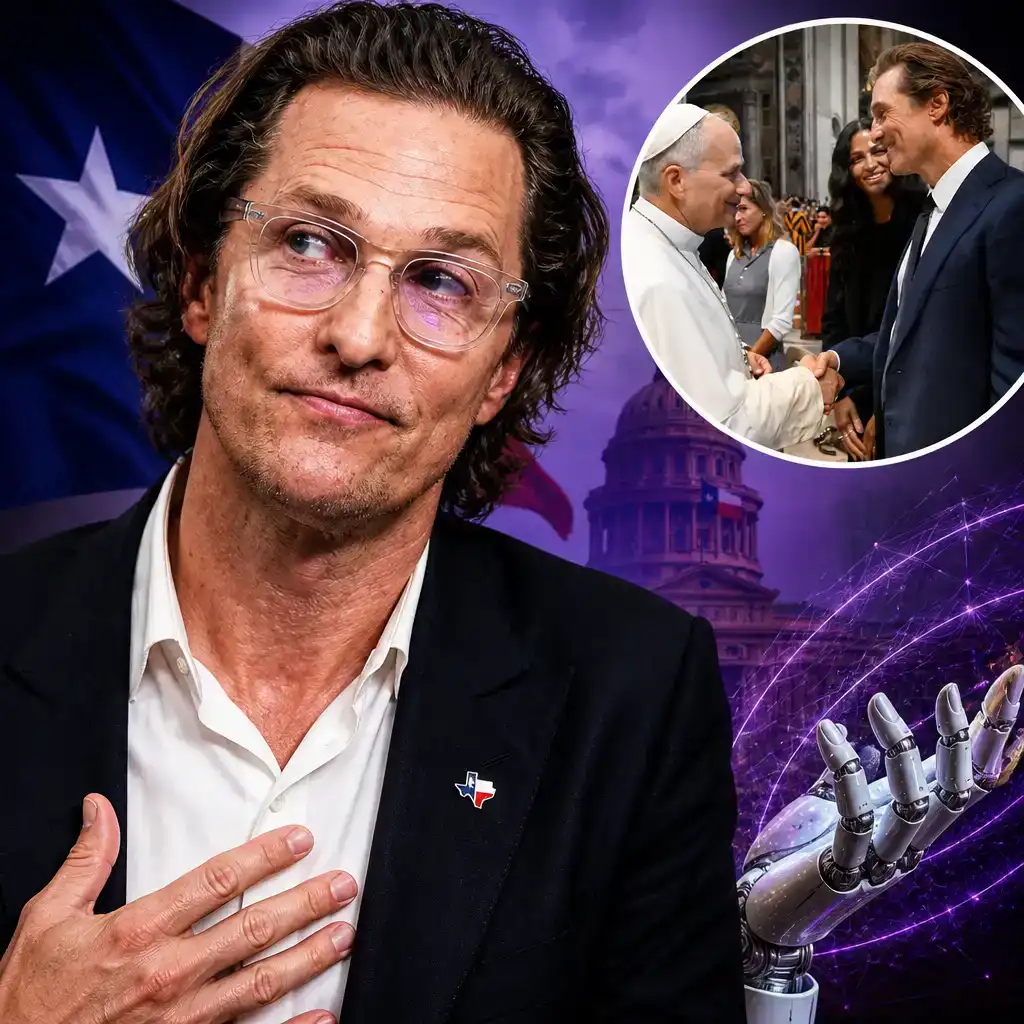
Matthew McConaughey’s political ambitions remain theoretical after his Vatican appearance with Pope Leo XIV. The actor spoke expansively about religion, government and artificial intelligence following the Aug. 5 encounter, yet he did not announce a candidacy, choose an office or identify a political party. Politics, for now, remains an area of study rather than his next confirmed role.
McConaughey and his wife, Camila Alves, attended Leo’s general audience at St. Peter’s Basilica. He later told USA Today that the experience encouraged him to think about shared moral principles and their place in public life. That is a substantial discussion topic, although not quite the same thing as filing campaign documents.
What happened at the Vatican?
Reports from USA Today, the Associated Press, ANSA and Rome Reports described McConaughey’s encounter with Pope Leo as a brief, public greeting during the general audience. None independently confirmed a lengthy private meeting or formal policy discussion.
McConaughey said he had several subjects in mind but deliberately avoided preparing a fixed speech. He wanted to ask about religion’s place in modern society, its decline and what he sees as renewed interest among younger people seeking structure and meaning.
“They’ve tried other things that they’re seeing are vapid and don’t really work because they’re looking for more,” he told USA Today, adding that young people were trying to find more than the world around them had offered.
The actor said the details of what he and Leo discussed would remain private. That leaves an unavoidable gap between the broad ideas McConaughey described afterward and what was actually said during the encounter. A Vatican greeting occurred. A private political summit has not been established.
His claim of a youth religious surge also needs some restraint. Pew Research Center has found that Christianity’s long decline in the United States has slowed, but later polling has not shown a clear nationwide religious revival among young adults since 2020.
What is his idea for a religious constitution?
McConaughey describes himself as a political centrist and said religious teachings could inform political values without erasing the separation of church and state.
“Life is essentially a religious experience,” he said. “There’s a lot of things we can learn about living life, how to treat others and how to treat ourselves, through religious texts and teachings.”
He then proposed something more ambitious: a constitution based on principles that different religions could accept.
“There’s still a constitution out there to be written that all religions could agree on,” McConaughey said. “There’s so much commonality.” He suggested he might be interested in contributing to such a project.
The concept sounds closer to a shared ethical document than a detailed plan for government. The United States already has the First Amendment’s framework protecting religious practice while preventing the establishment of religion by the state. McConaughey did not explain how his proposed text would interact with that system, who would write it or how agreement among many faiths would be reached. The constitution, like the campaign, remains unwritten.
Has McConaughey moved closer to running for office?
Not in any measurable way. McConaughey considered entering the 2022 race for Texas governor but announced in November 2021 that he would not run. Speaking to governors in July 2024, he described himself as being on a political “learning tour” while continuing to consider a future in public office.
No subsequent report through Aug. 19, 2026, indicates that he has formed a campaign, selected an office or declared a party affiliation.
His most prominent policy advocacy followed the May 2022 school shooting in his hometown of Uvalde, Texas, where 19 children and two teachers were killed. At the White House, McConaughey called for expanded background checks, a higher minimum age for purchasing assault-style rifles and laws allowing courts to temporarily remove firearms from people considered dangerous.
He later praised the Bipartisan Safer Communities Act as evidence that political compromise was possible. That work gave him practical exposure to Washington, but advocacy on one issue does not automatically become a candidacy. American politics has plenty of exploratory language already. It is rarely in short supply.
Why did artificial intelligence enter the conversation?
McConaughey said he also wanted to discuss standards for artificial intelligence. He warned that some people were already treating AI as a “digital God” and argued that the technology would reflect humanity through the questions people ask and the results they demand.
“There’s great upside and I’m excited about it,” he said, while calling for caution so humans remain in control of the tool rather than becoming controlled by it.
Those concerns align closely with Pope Leo’s existing agenda. In May 2026, Leo issued Magnifica Humanitas, calling for strong AI regulation and warning that systems driven mainly by profit could weaken human agency.
McConaughey’s position also predates this Vatican visit. At Salesforce’s Dreamforce conference in 2023, he warned about humanity creating a “digital god.” The latest remarks therefore look less like a political awakening inspired by Leo and more like a continuation of ideas he had already expressed.
For now, McConaughey is discussing the moral foundations of politics without entering politics himself. The Vatican appearance added a prominent setting, several philosophical questions and one more round of speculation. It did not add a campaign.