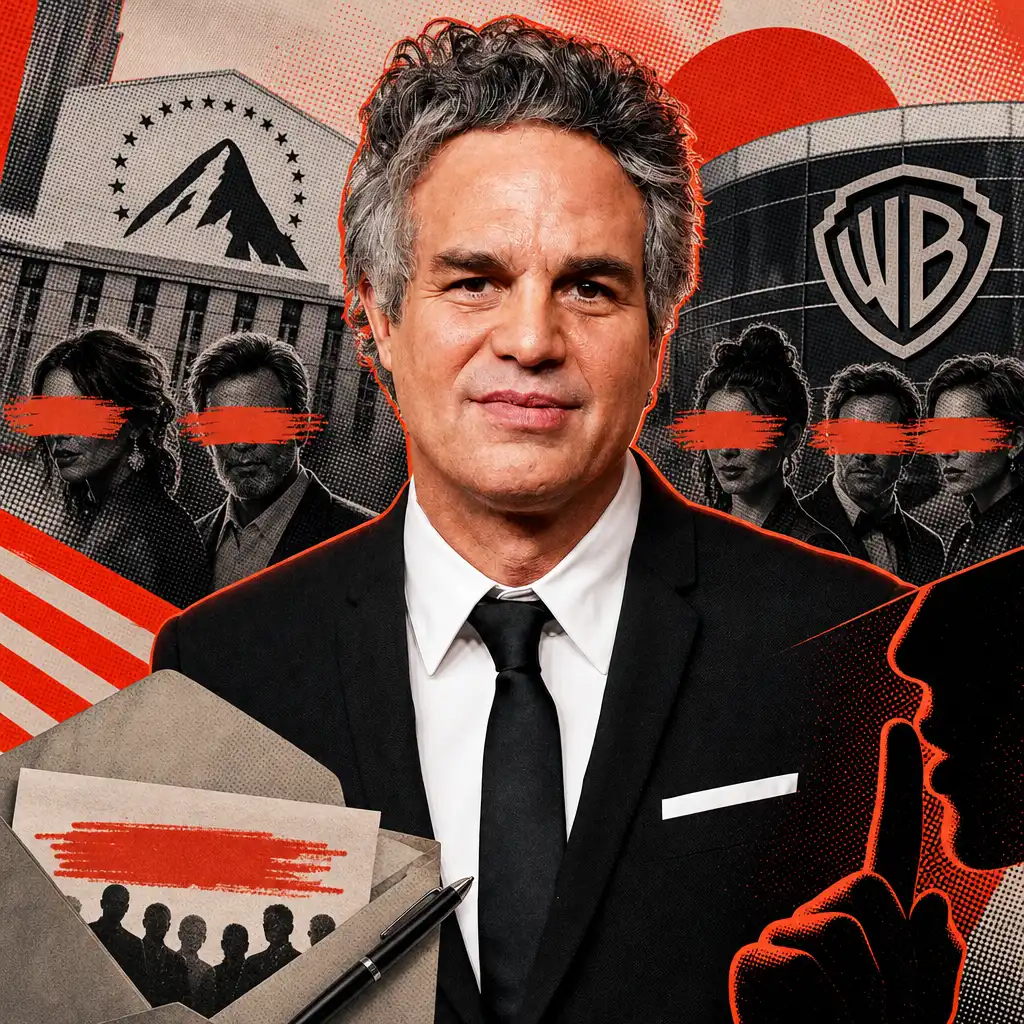
Mark Ruffalo says the most telling part of Hollywood’s campaign against the proposed Paramount-Warner Bros. Discovery merger is not only who signed on, but who felt they could not.
In a new New York Times op-ed co-written with Matt Stoller, research director at the American Economic Liberties Project, Ruffalo argues that fear of professional retaliation has kept some major industry figures from putting their names on an open letter opposing the deal.
“The most revealing thing about that letter wasn’t the people who signed. It was the people who didn’t. Not because they disagreed, because they were afraid,” Ruffalo and Stoller write. “There are many reasons to block this deal, but we now believe the most fundamental one is what we encountered when asking artists to use their voices: fear. A deep, ugly and pervasive fear of speaking out.”
A merger fight with Hollywood names attached
The open letter began circulating in April and has since drawn more than 4,000 signatures from across film and television. The list includes actors Florence Pugh, Pedro Pascal and Edward Norton, along with directors Yorgos Lanthimos, Sofia Coppola and Denis Villeneuve.
According to the organizers, 75 Oscar winners are among those who have signed.
The letter opposes the proposed merger between Paramount and Warner Bros. Discovery, a deal that still needs approval from regulators in the United States and Europe. It could also face legal challenges from state attorneys general seeking to block it.
For artists, the concern is not abstract market theory. Consolidation means fewer major buyers for movies and television, fewer places to sell projects, and less leverage for the people who make them. The letter argues that the deal would shrink the number of major U.S. film studios to just four.
“As filmmakers, documentarians and professionals across the movie and television industry, we write to express our unequivocal opposition to the proposed Paramount-Warner Bros. Discovery merger,” the letter states in part. “This transaction would further consolidate an already concentrated media landscape, reducing competition at a moment when our industries, and the audiences we serve, can least afford it.”
It continues: “The result will be fewer opportunities for creators, fewer jobs across the production ecosystem, higher costs, and less choice for audiences in the United States and around the world. Alarmingly, this merger would reduce the number of major U.S. film studios to just four.”
Ruffalo points to fear of retaliation
Ruffalo and Stoller write that they repeatedly heard from artists who supported the letter but declined to sign because they feared consequences for their careers.
“We heard time and time again from artists, when asked to sign this letter, that they supported it but were afraid of retribution. Their fear is not unjustified,” the op-ed says.
They cite two recent examples connected to the merger fight.
First, they point to The Ankler, described in the op-ed as one of the last independent trade publications. Ruffalo and Stoller say that when the publication’s editorial director, who also founded the outlet and writes as a columnist, was seen at an event carrying a bag of “Block the Merger” buttons, Paramount reportedly pulled its advertising in response.
Second, the op-ed says Ruffalo was suggested as a guest for a CNN discussion about the merger, but a producer later said the network had passed on the segment. According to Ruffalo and Stoller, CNN reportedly told the letter’s organizers: “It’s a delicate subject for us at CNN given Warner Bros. Discovery is our parent company, and there are legal considerations around what we can and cannot cover or say while the merger is ongoing.”
That is the kind of corporate-parent complication that turns media coverage into a maze, and not the fun kind with a soundtrack.
Why the pressure matters now
The op-ed argues that one consequence of the proposed merger is already visible, even before regulators have ruled on the deal.
“This merger will cause many harms in Hollywood, but one is already in effect: People are afraid to say what they think about their own industry,” Ruffalo and Stoller write.
Their broader case is that large media companies gain power not only by buying rivals, but by creating conditions where workers, artists and even outlets hesitate to criticize them. In Hollywood, where a studio can be an employer, distributor, advertiser and corporate parent all at once, that pressure can be difficult to separate from the work itself.
Ruffalo and Stoller close by framing the letter as part of a larger antitrust fight, one aimed at stopping more control of film and television from being concentrated in fewer hands.
“We’ve seen what happens when monopoly-leaning companies benefit from a fear that silences dissent,” they write. “But our growing coalition is demonstrating that when we don’t get stuck on the sidelines, don’t bow down to inevitability and join together to fight, we can win. And who knows? If we can defeat the oligarchs trying to seize control of our TV shows and movies, maybe we can do it elsewhere, too.”