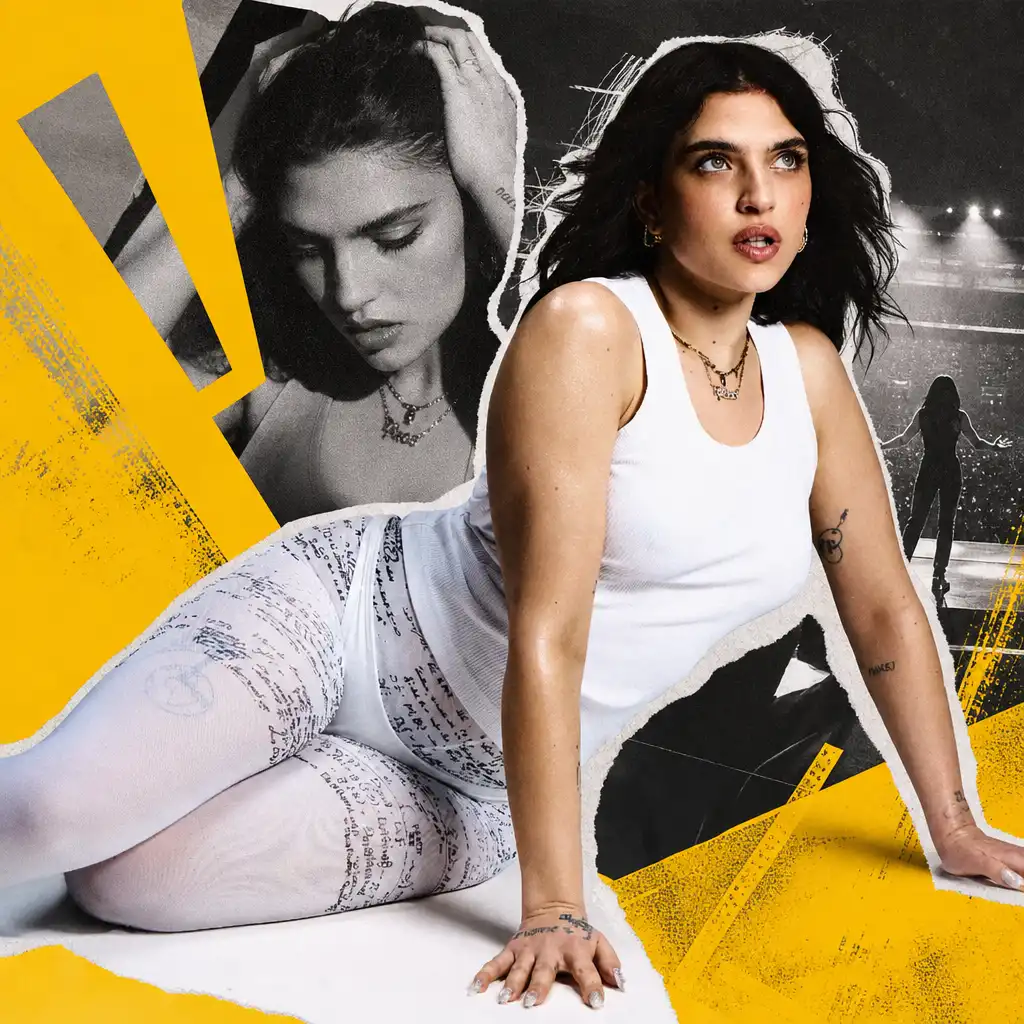
Mae Muller may quit music for good after telling fans she is “at the end of my tether” in a now-deleted TikTok, three years after representing the United Kingdom at the Eurovision Song Contest.
The 28-year-old singer, who finished second from last in the 2023 Grand Final with 24 points, said she has been feeling “miserable” and asked followers to remind her why she should keep going. It was less a polished celebrity statement than a late-night voice note to the internet, which is always a safe and orderly place for emotional processing.
What did Mae Muller say about quitting music?
Speaking directly to the camera, Muller told fans she wanted to be “vulnerable for a second” because she saw them as her “close friends.”
“This music thing, I need you guys to tell me not to quit because why is it so hard,” she said.
She added: “I feel like I’ve been doing it for so long now and I just feel like all the joy and fun has been sucked out and it’s kind of making me miserable.”
Muller went on to say she still loves making music and performing, but no longer knows whether she can keep handling what the job has become.
“I don’t know guys, I need you guys to remind me why I like doing this cos I absolutely love ya’ll, I love you, I love making music, I love performing, I love everything about it but I just feel like what it’s turned into, I don’t know if I have it in me guys,” she said.
“I do have it in me but I’m getting to the end of my tether and I don’t wanna be miserable, I wanna be happy. Tell me not to quit.
“I don’t wanna quit on you guys, but it’s testing my last nerve, I can’t.”
On the video, she wrote: “trigger warning: me being vulnerable.” In the caption, she added: “Like can I just be a songwriter atp girl I’m tiiiiiiired.”
Fans urged her to take a break, not disappear
The video has since been deleted, but fans quickly rallied around Muller, encouraging her not to give up entirely even if she needs time away from the pressure.
One supporter wrote: “Genuinely please don’t quit. It’s not all about being the biggest star, you can successfully be a fab niche artiste. There are so many amazing divas out there killing it!”
Another said: “Never quit but take breaks when needed. You’re such a talented icon and the world deserves to hear you serve it.”
A third added: “Don’t you dare quit… girl I need your music to live honestly. Maybe take a break, look after yourself first always. We will all understand.”
The response speaks to the awkward middle ground many artists end up in: adored by a committed audience, but still worn down by the demands of the industry around that audience.
Muller had previously parted ways with her record label and cancelled a tour, adding context to why the post landed as more than a passing bad day.
Her Eurovision result did not end the conversation
Muller represented the UK at Eurovision in 2023 with “I Wrote a Song,” but the live result was rough. She placed second from last in the Grand Final, receiving 24 points.
In the weeks after the contest, she was blunt about what went wrong, especially vocally. Writing on Twitter at the time, she said: “Not gonna lie, anyone who tries to drag me for my vocals at Eurovision is wasting their time cos I already know they were trash.”
She admitted she “got nervous” and told followers: “Ya girl didn’t give her best performance vocally.”
Muller still managed to find one bright spot, joking that her boobs “looked good” on stage. A small victory, perhaps, but still logged.
She later said she felt like she had been “thrown to the lions,” explaining that the song was “meant to be sung with heavy autotune.”
Despite the difficult Eurovision result, her career did not stall immediately afterward. “I Wrote a Song” reached the UK top 10, and her debut studio album, Sorry I’m Late, made the UK top 40.
She has been open about Eurovision pressure
A year after competing, Muller criticised Eurovision for what she saw as a lack of care around artists’ mental health.
Asked why she no longer engaged much with the contest, she said: “The pressure is just too much, it’s a shame cos I love performing and I love music, but the fans were the only thing that made it enjoyable.”
She added: “More needs to be done to protect the artist’s mental health, because it’s not actually normal what they go through.”
That concern now sits behind her latest comments. Muller’s post was not only about one performance, one chart position, or one public backlash. It was about the accumulation of pressure around a career that requires artists to be available, charming, resilient, online, marketable and emotionally fine, preferably all before lunch.
How Mae Muller first entered the music industry
Muller’s connection to the music world began long before Eurovision. As a child in 2007, she appeared in the music video for Mika’s “Grace Kelly,” which was directed by her aunt.
She later uploaded her own music to SoundCloud, where she was discovered and signed. Her debut EP was released in 2018.
Across her career, Muller has released four further EPs and supported Little Mix, steadily building the kind of pop résumé that can look tidy on paper while being far less tidy to live through.
Eurovision brought her a much wider audience, but also sharper scrutiny. For many viewers, she became the face of the UK’s 2023 entry overnight, with all the praise, criticism and national scoreboard disappointment that came with it.
She has also challenged Eurovision politics
Muller has not only spoken about performance pressure. She has also criticised the politics surrounding the contest.
Before her Eurovision appearance, old tweets resurfaced in which she said she “hated” the UK during Boris Johnson’s time as prime minister. Muller later said the posts “weren’t ideal” given that she was representing the country, but she stood by the feeling behind them.
“It’s a privilege to be born here and that’s why I felt strongly. We deserve the best and at that time this amazing country wasn’t getting the best. We were being let down,” she said.
Last year, she was one of more than 70 former Eurovision acts to sign an open letter to the European Broadcasting Union calling for Israel to be banned from the contest. The letter accused the Israeli Public Broadcasting Corporation Kan of being “complicit in Israel’s genocide against the Palestinians in Gaza.”
Speaking recently on the podcast The Pieces, Muller said that “pretending that music and art is not political is silly.” She also pointed to what she described as “a double standard,” noting that Russia was removed from Eurovision after invading Ukraine while Israel was still allowed to compete.
Muller, who grew up in a Jewish household in London, has previously spoken about her grandfather Robert fleeing Nazi Germany at the age of 12 and coming to the UK.
Her latest comments suggest the question now is not whether she can make music. She has already proved she can. The question is whether the version of the industry around her still feels survivable.