The Look Mum No Computer Eurovision 2026 gamble gave the United Kingdom one of the night’s strangest performances and, in scoreboard terms, almost nothing back. Sam Battle, the 37-year-old musician and YouTuber behind the Look Mum No Computer name, finished 25th and last in the Grand Final after the UK received just one point.
That single point came from Ukraine’s jury. The public vote gave the UK zero, a small but painful detail for a country that has become rather familiar with that particular corner of Eurovision mathematics.
What did the UK send to Eurovision 2026?
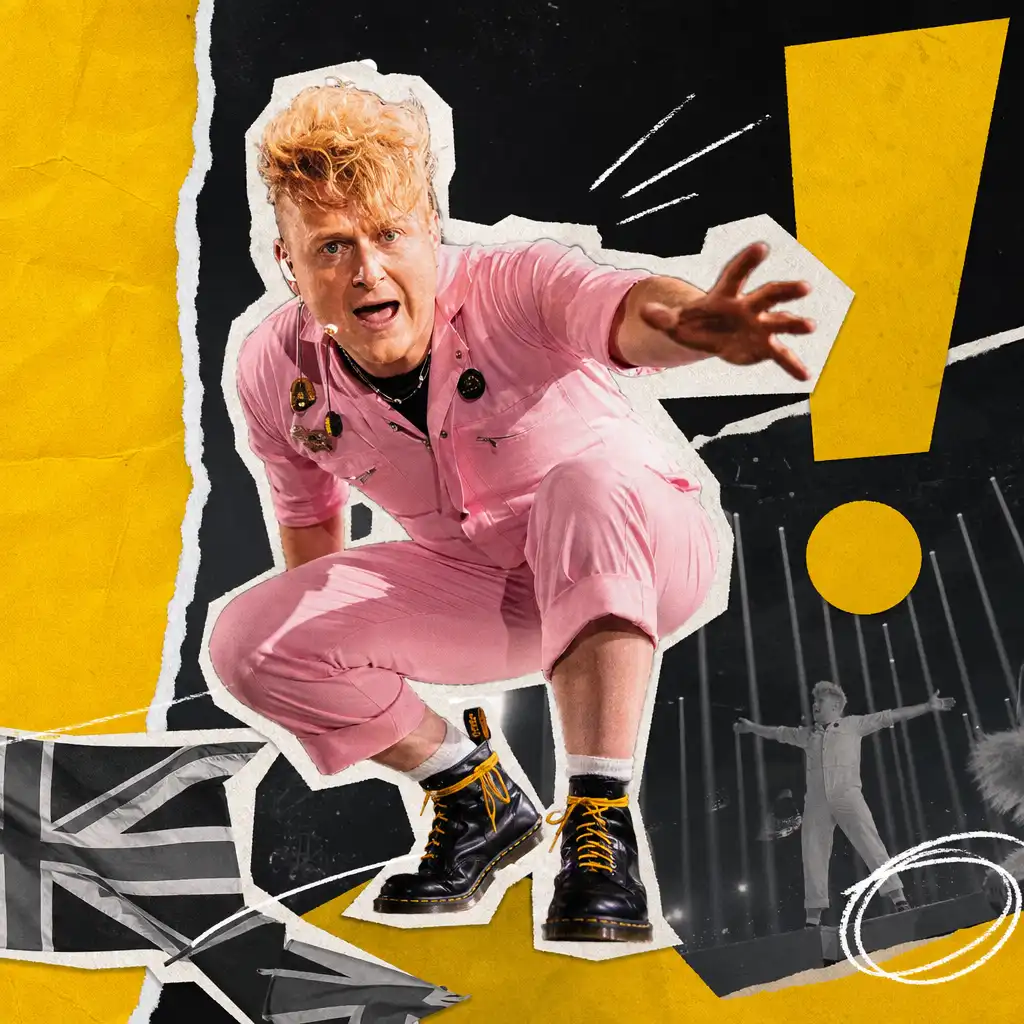
Battle represented the UK with “Eins, Zwei, Drei,” a chaotic electro-punk entry built around the handmade electronic instruments that have made him a cult figure online. His Look Mum No Computer persona is rooted in homemade synths, mechanical oddities, and the cheerful sense that a workshop has somehow learned to shout.
On the Eurovision stage at the Wiener Stadthalle in Vienna, Austria, that identity was not toned down much. The performance began in a staged office setting, with dancers wearing computer monitors for heads. It then shifted into a louder, more frantic workshop-style party, with Battle performing in his trademark boiler suit.
The concept was deliberately abrasive and odd: office-drudgery visuals, shouted German call-and-response, and a DIY electronic setup that stood far apart from Eurovision’s more polished pop entries. It was memorable, at least. Unfortunately for the UK, memorable and vote-winning are not always the same job.
How badly did the UK score?
The UK ended the Grand Final in 25th place, last among the 25 competing countries. Battle received:
- 1 point from the jury vote
- 0 points from the public vote
- 1 point in total
Ukraine supplied the only jury point, preventing the UK from finishing on a complete zero. The audience vote, however, did not move at all.
The result continued a difficult recent pattern for the UK at Eurovision. Battle became the third UK act in a row to receive nul points from the public vote, following Remember Monday in 2025 and Olly Alexander in 2024.
Battle had already acknowledged before the final that “Eins, Zwei, Drei” was a divisive entry. That proved accurate. The performance drew attention, but it did not translate into broad support across Europe or beyond, which is generally the inconvenient part of a voting competition.
How did Sam Battle react after finishing last?
Battle did not sound crushed after the result. Instead, he kept his response upbeat and congratulated Bulgaria, which won Eurovision 2026 with DARA’s “Bangaranga.”
In a post after the competition, Battle called Bulgaria the “deserved winner” and said he had met “a lot of amazing folk” during the contest.
“The most important thing is [that] we all tried our hardest,” he wrote. “Regardless of what is against us. Whatever it may be. Gotta keep trying your hardest regardless of the… outcome.”
He also shared footage of himself and fans chanting “UK” and “ein Punkt,” German for “one point.” It was a neat bit of gallows humor, if your gallows happen to be fitted with custom wiring and a homemade synthesizer.
Who won Eurovision 2026?
Bulgaria won the contest with 516 points, earning the country its first Eurovision victory. DARA took the crown with “Bangaranga,” finishing comfortably ahead of Israel, which placed second with 343 points.
The Grand Final took place at the Wiener Stadthalle in Vienna and featured 25 countries. For Bulgaria, it was a historic night. For the UK, it was another reminder that Eurovision often rewards boldness, but not automatically.
Battle’s entry will likely remain one of the more unusual UK performances in recent memory. It had a clear identity, a distinctive creator behind it, and a staging concept that could not be mistaken for anyone else’s. It also finished last with one point. Both things can be true, which is Eurovision at its most brutally efficient.