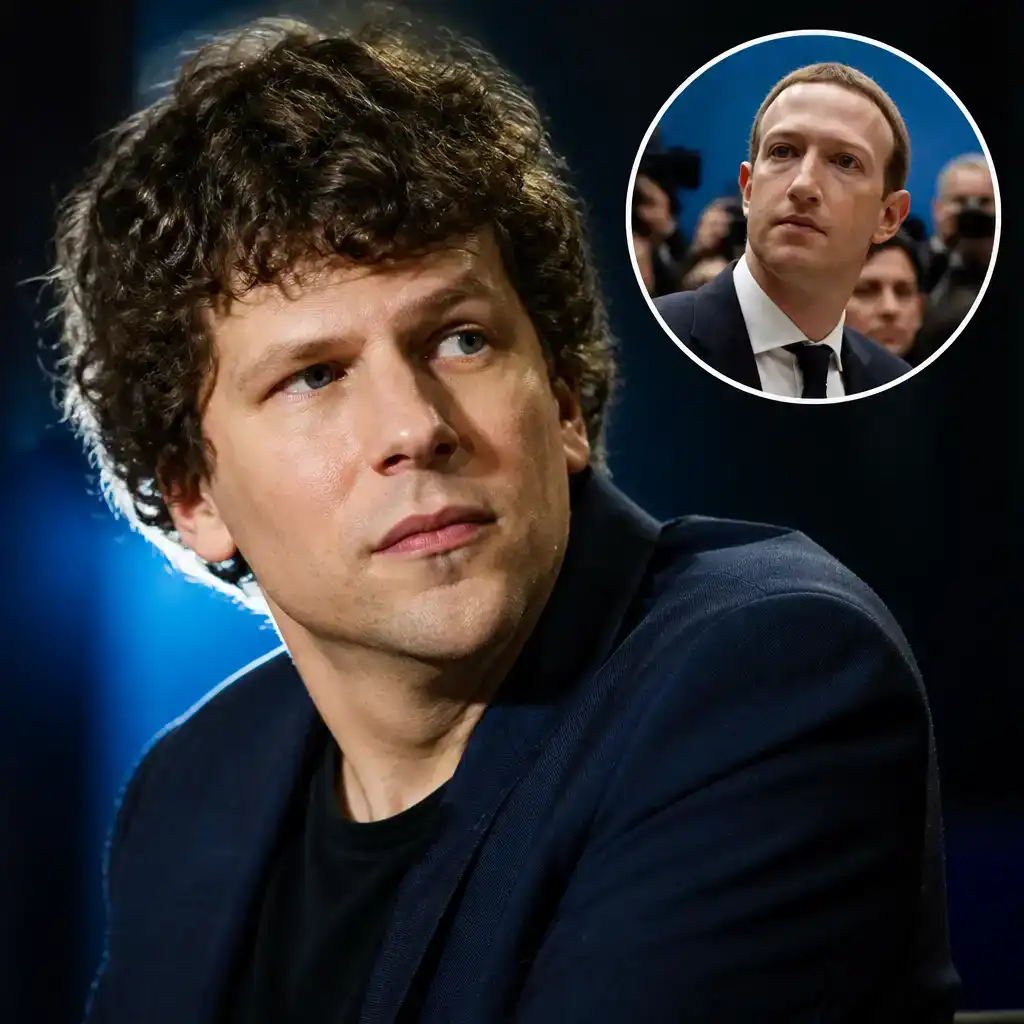
Jesse Eisenberg’s portrayal of Mark Zuckerberg helped turn The Social Network into one of Hollywood’s defining accounts of the Facebook era. Sixteen years later, the actor wants considerably more distance between himself and the man he played.
Jesse Eisenberg has explained why he will not return as Zuckerberg in Aaron Sorkin’s upcoming The Social Reckoning, saying he no longer wants “to be associated” with the technology mogul — and offering a stark assessment of the world social media helped create.
“If this guy is the creator of this world, I don’t want to live in that world,” Eisenberg said during an in-conversation event at the Karlovy Vary Film Festival, where he was receiving the President’s Award.
The decision means Jeremy Strong, best known for Succession, will take over the Zuckerberg role in Sorkin’s follow-up to David Fincher’s acclaimed 2010 drama. For Eisenberg, however, the change is about more than simply moving on from an old character.
Eisenberg no longer wants the Zuckerberg comparison
Eisenberg was asked whether he felt any “responsibility” for influencing the public image of Zuckerberg through his performance in The Social Network, which dramatized the origins of Facebook.
His answer highlighted how dramatically the context surrounding the role has changed.
“In fact, at the time, the movie seemed like such a strange thing to me because no one really knew who he was,” Eisenberg said. “He was interviewed on ‘60 Minutes,’ which is our big news show, but otherwise he wasn’t in the public a lot. I thought of it like an interesting character.”
Zuckerberg’s profile, of course, did not remain particularly low.
“And then he’s become famous and now I don’t want to do the movie […] I don’t want to be associated with him anymore because I don’t really like the comparison,” Eisenberg said.
That distinction is central to Eisenberg’s explanation. When he took the role, he says he approached Zuckerberg largely as an unusual dramatic character rather than as an already omnipresent public figure whose name had become inseparable from debates surrounding social media.
Now, Eisenberg appears uncomfortable with the extent to which audiences still connect actor and subject.
Jeremy Strong takes over in The Social Reckoning
Eisenberg’s absence will be immediately visible in The Social Reckoning, which brings Sorkin back to the world explored in The Social Network.
Sorkin wrote the 2010 film, while Fincher directed it. This time, Strong will play Zuckerberg as the story shifts away from Facebook’s creation and towards a later chapter in the company’s history.
Mikey Madison, the best actress Oscar winner for Anora, plays Facebook engineer Frances Haugen. Jeremy Allen White, the star of The Bear, plays the Wall Street Journal reporter to whom Haugen blows the whistle on some of the social network’s most closely guarded information.
The casting gives the new film an obvious point of separation from its predecessor. Strong is not being asked simply to continue Eisenberg’s performance; he is stepping into a role whose real-life subject has become vastly more recognisable — and more culturally contentious — since the original film appeared.
Eisenberg, meanwhile, has made clear that the separation suits him.
Fincher never asked Eisenberg to imitate Zuckerberg
There is an irony in Eisenberg now being so closely identified with Zuckerberg: according to the actor, his original preparation for The Social Network was not particularly focused on reproducing Zuckerberg himself.
Eisenberg recalled making an audition tape with his younger sister before being flown to California to meet the filmmakers.
“I think they were having trouble finding the person to play the part or something,” he said. “It’s a very strange kind of role.”
He arrived having memorised 15 pages of dialogue, expecting a conventional audition. Fincher apparently had something else in mind.
“They flew me out to California. I memorised 15 pages of dialogue, and then, when I got into the room with [Fincher], I said: Do you want me to read anything? He was like, ‘Nah, put that away. I just want to tell you about this guy I knew,’” Eisenberg recalled.
Fincher then described a studio executive whose behaviour he wanted Eisenberg to channel.
“You just never know what he’s thinking and he could just stare at you and you have no idea what he’s thinking. It’s very unnerving,” Eisenberg recalled Fincher telling him.
Eisenberg’s response was uncomplicated: “Oh, that sounds great. I would love to do that. And that was it.”
It is a revealing detail because the performance that would become closely associated with Zuckerberg was, in Eisenberg’s telling, partly constructed around somebody else entirely.
The role has changed because Zuckerberg’s place in culture has changed
When The Social Network was made, Eisenberg says Zuckerberg was still sufficiently unfamiliar that playing him could feel like approaching an intriguing fictional character.
That is difficult to imagine now. Eisenberg’s comments suggest that the growth of Zuckerberg’s public profile has retroactively changed his own relationship with the role.
The first film asked audiences to watch a dramatized version of an ambitious young technology founder building Facebook. The new one arrives in a world where Facebook and the wider social-media industry have become far more deeply embedded in public life — precisely the world Eisenberg now says he does not want his image tied to.
Strong will therefore inherit more than a famous role. He is playing Zuckerberg at a different cultural moment, while The Social Reckoning turns its attention to Haugen and the secrets she disclosed about the company.
Eisenberg’s association with The Social Network is unlikely to disappear; the performance remains one of the roles most closely connected with his career. But reprising it would have renewed a comparison he has spent years living alongside.
This time, the actor has decided that somebody else can stare unnervingly across the room.