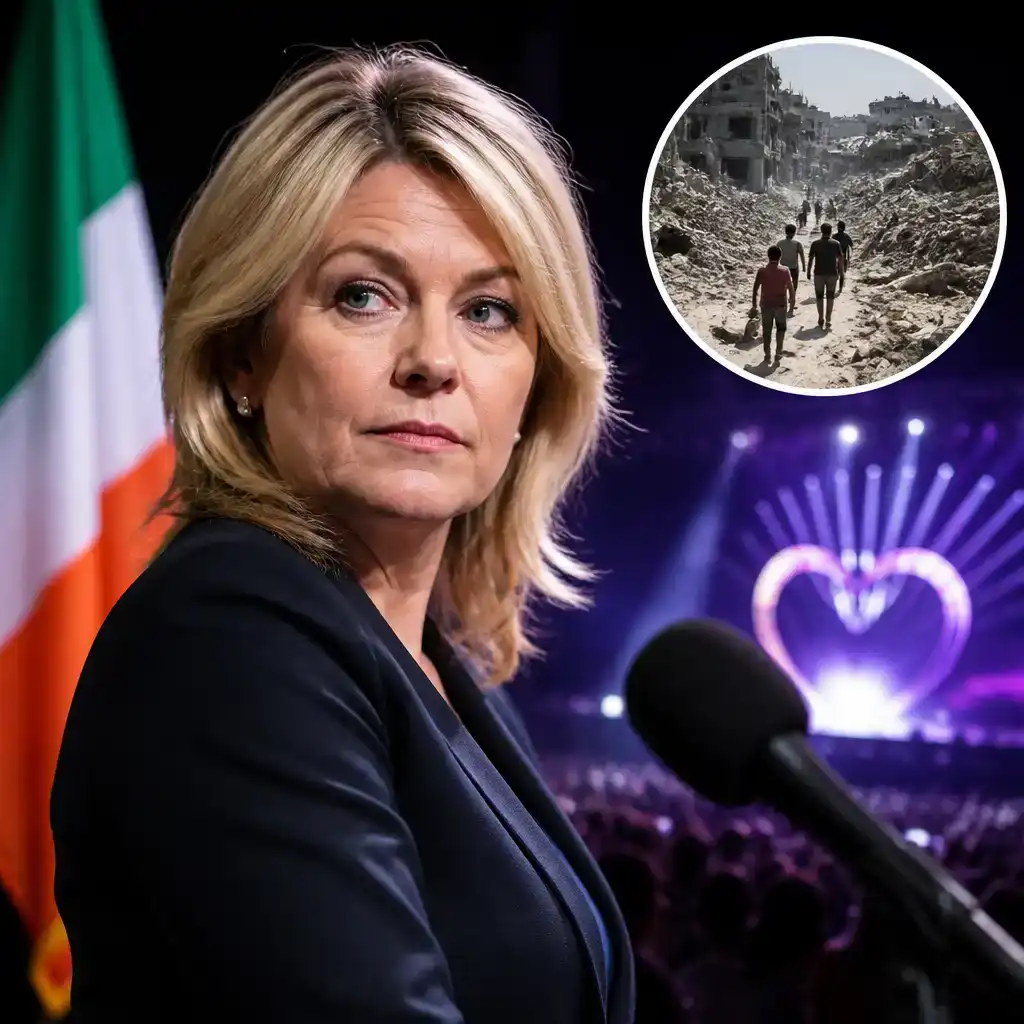
Ireland will boycott the Eurovision Song Contest 2027, with national broadcaster RTÉ blaming the continuing loss of life and humanitarian crisis in Gaza. The broadcaster also confirmed that it will not air the competition, due to take place in Bulgaria.
“RTÉ feels that Ireland’s participation cannot be justified given the appalling and ongoing loss of lives in Gaza and the humanitarian crisis there which continues to put the lives of so many civilians at risk,” it said in a statement.
RTÉ added that it remains “deeply concerned” about international journalists continuing to be denied independent access to the territory.
Why is Ireland withdrawing again?
The decision extends Ireland’s absence from Eurovision into a second consecutive year. RTÉ withdrew from the 2026 contest in Vienna after the European Broadcasting Union confirmed that Israeli public broadcaster KAN would be allowed to compete. It also declined to show that event.
Ireland was one of five countries to pull out in 2026, joining Iceland, the Netherlands, Slovenia and Spain. The dispute has continued into preparations for 2027, suggesting Eurovision’s familiar promise of unity remains subject to some fairly substantial conditions.
In August 2026, the Netherlands confirmed that it would also boycott the Bulgaria contest because of Israel’s participation and what Dutch public broadcaster AvroTros described as the “severe humanitarian suffering” inflicted on Gaza.
AvroTros said recent changes to Eurovision’s rules did not go far enough. Those changes prevent a winning country from hosting the following year’s competition if it is involved in an armed conflict.
Belgium, one of the competition’s founding countries, has also said it is unlikely to participate in 2027 if Israel remains in the line-up.
Which countries are joining Eurovision 2027?
While several established participants are heading for the exit, Canada is preparing to enter. Its public broadcaster confirmed participation after becoming a full member of the European Broadcasting Union at the organisation’s 96th General Assembly in Prague.
Full membership allows an eligible broadcaster to take part in Eurovision, although joining the union does not automatically require entering the contest. Canada has nevertheless chosen to compete, giving the 2027 event a notable newcomer while several long-standing European entrants stay away.
The European Broadcasting Union has not been reported as reversing its position on KAN’s eligibility. Unless that changes, further broadcasters may face the same decision as Ireland, the Netherlands and potentially Belgium.
What is Ireland’s Eurovision record?
Ireland’s withdrawal carries particular weight because of its history in the competition. Together with Sweden, it holds the record for the most Eurovision victories.
The country first entered in 1965 and has made 58 appearances. Since semi-finals were introduced in 2004, Ireland has reached the Grand Final nine times in 21 attempts.
Recent results have been considerably less dominant than the record books might suggest. Ireland finished last in its semi-final in both 2019 and 2021. Even so, its decision to miss two contests in a row represents a sharp break for one of Eurovision’s most successful and established participants.
For RTÉ, however, the issue is no longer Ireland’s chances of collecting another trophy. Its position is that competing, or even broadcasting the show, cannot be justified while civilians continue to die in Gaza and independent international reporting from the territory remains restricted.