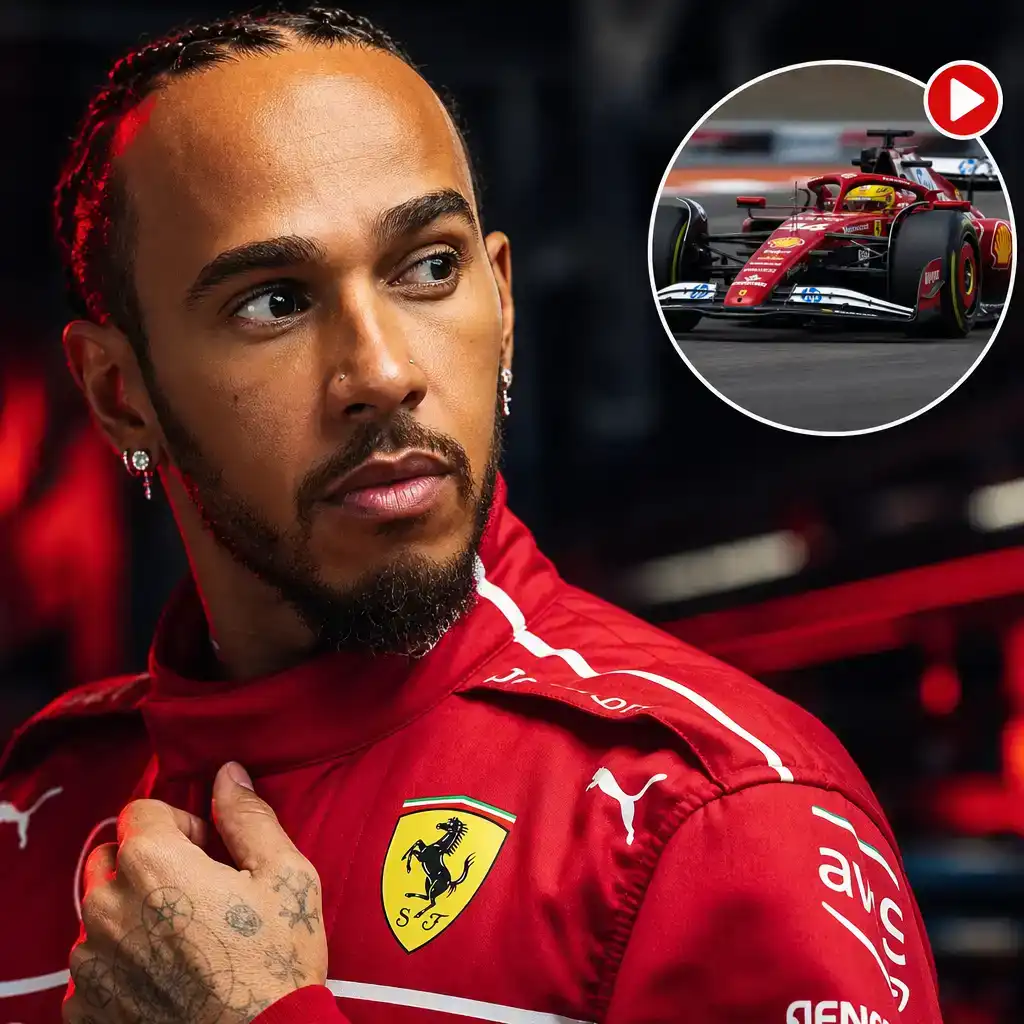
Lewis Hamilton’s first Ferrari win was not just a trophy ceremony with red shirts and familiar noise. It had been a season that left him questioning his level, hearing others do the same, and at times sounding close to the door.
The 41-year-old had described last season as a “nightmare”, called himself “just useless”, and at one point suggested Ferrari should find another driver. That was not standard elite-athlete modesty. It was a driver with seven world titles trying to make sense of why the pace had disappeared.
On Sunday, after taking in the reaction from Ferrari and fighting back tears on the podium, Hamilton made clear how much that period had taken out of him.
“After a year like last year,” he said, “there were definitely moments that I was like, ‘Sheesh, maybe it is true that, you know, when you get to a certain point, you lose it.’ But I’ve proven that you don’t. You always have it and it just takes work.”
What Hamilton said after the win
Hamilton did not pretend the criticism had bounced off him. He said it had affected him, which is not exactly a radical admission, but still unusual in a sport that often prefers emotional damage to be rebranded as focus.
“I mean, I’m only human,” he said. “So, there’s moments where I see the stuff and for sure there’s moments where I allowed it to get to me and penetrate deeply.”
His response over the winter was to step away from social media and rebuild the parts of his preparation he felt had slipped or been disrupted. He said the physical work had been more demanding than at any other point in his career, partly because of an injury he suffered early last year.
“The training that I put in was harder than I’ve ever experienced, to keep myself in good shape,” Hamilton said, “because I think at the beginning of last year I got injured here, actually, and carried that for months.”
The reset, as he framed it, was not only physical. It was also a return to basic confidence after a season that had tested it.
“Just things that I know is to never second-guess yourself, never doubt yourself,” he said. “You’ve got to continue to believe in yourself at the core. And those are the things that I’ve managed to reimplement into my mentality. I’ve rebuilt my mind to this point, to get myself back to where I was.”
Why the result matters in Formula 1 history
The win puts Hamilton in rare company. He is only the fourth driver in his 40s to win a Formula 1 race since 1958. The others are Graham Hill in 1969, Sir Jack Brabham in 1970, and Nigel Mansell in 1994.
That is not a ceremonial statistic. It matters because Formula 1 does not usually wait politely for older drivers to rediscover themselves. The sport moves quickly, teams revise cars constantly, and younger rivals arrive with very little interest in legacy management.
Hamilton’s victory also landed after a difficult first Ferrari season in which the gap between his reputation and his results had become impossible to ignore. At points, watching him try to understand the lack of pace was uncomfortable. The public language became harsher. The doubts, including his own, became part of the story.
This result changes the reference point. It does not erase the previous season, and it does not settle the championship. But it does prove that Hamilton can still convert a competitive Ferrari into a race win, and do it convincingly.
For a driver who has been chasing an eighth world title since the disputed 2021 finale in Abu Dhabi, that is a meaningful shift. Not a guarantee, despite what the louder end of the paddock may prefer, but evidence.
Toto Wolff sees several reasons for the revival
Toto Wolff, the Mercedes team principal who worked with Hamilton through six of his seven championships, said the comeback appears to be the product of several factors.
Wolff pointed first to Hamilton’s own work. He also said the new generation of cars may be better suited to him than those of the previous four years, when aerodynamic design, stiffness, and bouncing made the machinery harder to read and harder to feel.
“Hard work,” Wolff said, “and I think this is a car that is maybe different to the previous era cars with the bouncing, with the stiffness, maybe not easy to feel. And this is back to more conventional driving in terms of at least aerodynamics and vehicle dynamics.”
He added that engine management is now “completely different”, but said the signs from Hamilton’s driving and his relationship with Ferrari’s race operations looked positive.
“The dynamics in the team look to be good between him and his race engineer,” Wolff said. “I saw him on the podium, on the telly. I mean, that face shows me that he’s very happy.”
Wolff also suggested Hamilton’s relationship with Kim Kardashian may have helped provide stability away from the circuit.
“Maybe the girlfriend helps,” he said. “Helped me to have a partner that you have a stable family life, and they seem to be getting on really well. I think it’s all of those factors that put together the emotional and the personal and professional perspective. If they are in a good place, you win.”
How Hamilton has pushed Ferrari internally
Hamilton’s impact at Ferrari has not been limited to lap times. He has pushed for changes to the car to suit him, but also for changes in attitude and working methods inside the team.
That matters because Ferrari is not just another employer in Formula 1. It is a team with long memory, strong internal culture, and an unusual amount of external noise. Reform there is rarely achieved by suggestion box.
Hamilton said his arrival was disruptive because he is direct about what he wants.
“Me coming was a big shock to the system because I am very, very vocal,” he said.
“If I see something that I don’t think is right, or I push very, very hard, that’s at the core of who I am and I’m relentless with it.
“And I think it’s not easy to be on the receiving end of that when you’re also juggling a whole organisation, you know, and a culture that in its own is set in a certain way.”
His voice has aligned with that of Ferrari team principal Frederic Vasseur, who played a central role in bringing Hamilton to Maranello. Vasseur has been pressing the team in his own way, and Hamilton’s stature gives those demands added weight.
That does not mean Ferrari has suddenly become a frictionless operation. It means the internal case for change now comes with a seven-time champion repeatedly making it, which tends to make meetings less abstract.
Vasseur credits Hamilton’s commitment, not himself
Vasseur resisted the idea that he should be credited for Hamilton’s personal reset. His assessment was more restrained: Ferrari and Hamilton are learning each other, and the improvements are incremental.
“The collaboration, we are improving,” Vasseur said. “We know each other, at least Ferrari and Lewis, we know each other a bit more each day. And it’s all a matter of details.”
He called the victory a major positive for the operation, but also warned against treating one Sunday as if it had transformed everything.
“I’m taking it as a mega good result, mega positive result,” he said. “Good reward for everybody, for Lewis, for the team in Maranello, for the team on track. But it’s not that the situation is completely different compared to last week.”
On Hamilton’s return to form, Vasseur was explicit.
“I have zero merit on this,” he said. “It’s more Lewis himself. He was able to come back after a tough moment of weekends. He was able to come back and do a full reset. To continue to push, to continue to come at the factory on Tuesday morning.”
For Vasseur, that level of commitment has an effect beyond the driver’s side of the garage.
“This commitment is a huge support,” he said. “Coming from a world champion, it’s even more, I would say. It was also a huge motivation for everybody at the factory.”
Why Barcelona changed Ferrari’s season
Ferrari entered the year believing that new chassis and engine regulations could help return the team to the front. The early evidence was less encouraging. Mercedes won the first six races, and Ferrari’s power deficit was clear.
The car itself was strong in the corners, possibly as good as anything on the grid. But cornering performance alone was not enough when Mercedes had the advantage on power.
Barcelona altered the picture. Ferrari introduced its second major upgrade of the season, following an earlier package at the fourth race in Miami. On a circuit where engine power matters less to overall lap time, the new package made a decisive difference.
That context is important because Hamilton had been beaten by Antonelli in Monaco the previous week, at a track where power is even less significant. In Barcelona, however, Hamilton was the fastest driver in the race.
The result also changed the standings. Combined with Antonelli’s first retirement of the season, Hamilton cut his gap to the Italian to 41 points and extended his advantage over Russell to nine.
There may be more to come on the technical side. Under Formula 1’s engine rules, Ferrari have been granted two upgrades this season, while Mercedes have only one. The first Ferrari engine upgrade could reportedly arrive as early as the next race in Austria.
Can Hamilton still fight for an eighth title?
Hamilton has been pursuing an eighth championship since the controversial Abu Dhabi finale in 2021. Winning it with Ferrari would be one of the largest stories Formula 1 has produced, which is saying something for a sport that can turn a tyre choice into a diplomatic incident.
Hamilton, though, was careful not to overstate what one victory means.
“With the way that the year started out, I have not really been thinking about it like that,” he said. “I’ve not been thinking about an eighth.
“Mercedes have come out the gates with a blistering car and blistering pace, both drivers doing such a great job. We know we have this power deficit.
“There’s going to be tracks where we go to with long, long straights where that makes it even harder.
“But we’ve got a great car at the core and if we keep adding performance and we can go through the corners quicker, maybe we can narrow that deficit down a little bit until we improve or until we close the gap on power.”
That is the practical version of optimism: the chassis is strong, the engine still needs work, and the calendar will not be equally kind.
Wolff, who knows Hamilton’s title-race habits better than most, sounded wary of what could follow.
“I’d rather not fight with him for a title because I know what he’s capable of,” Wolff said. “If he smells blood, he goes. I’ve seen it many years where suddenly the Lewis Hamilton train started to go and then it’s very difficult to stop it.”