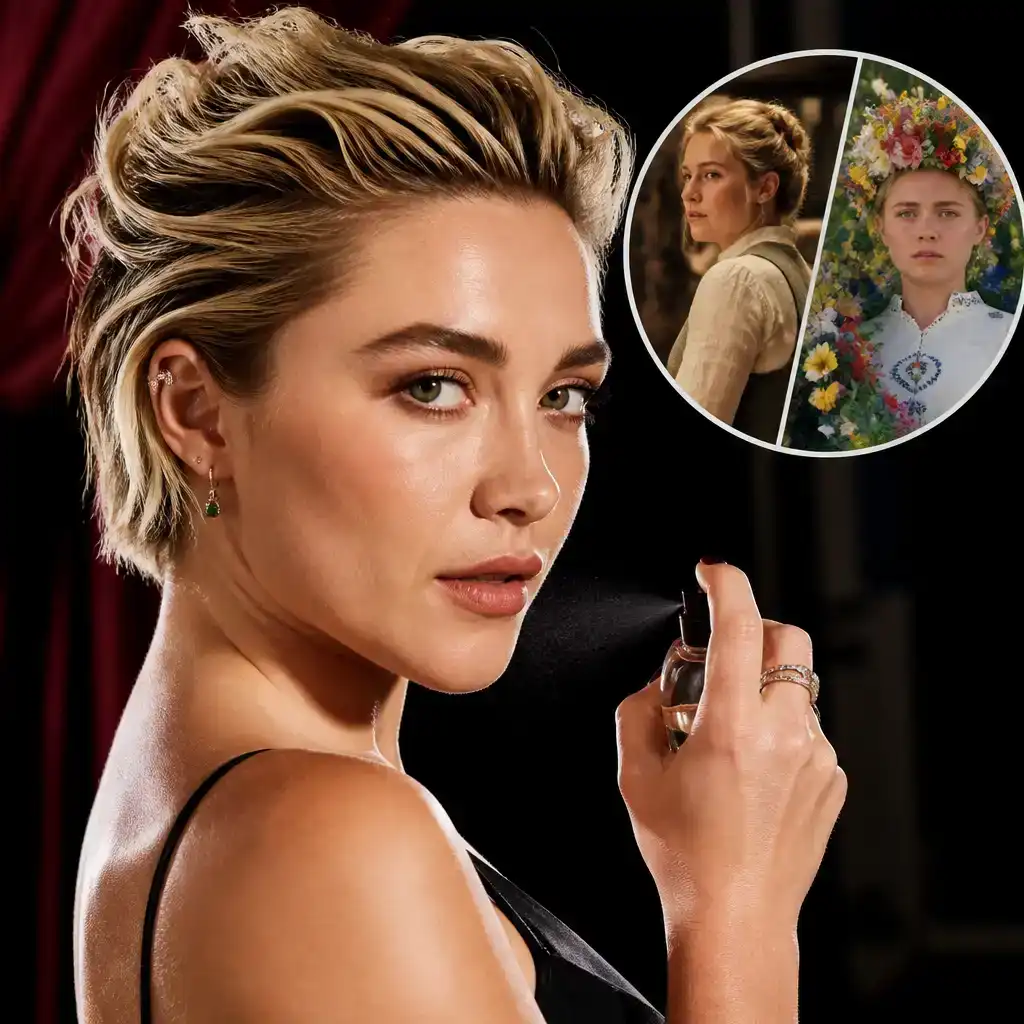
Florence Pugh has found a particularly literal way to get into character: she gives each role its own smell. The actress has revealed that part of her preparation for a new character involves buying a perfume specifically for them — including fragrances she would never normally choose for herself.
It means that some of Pugh’s best-known performances, from Dani in Midsommar to Amy March in Little Women and Yelena Belova in the MCU, effectively come with their own invisible piece of costume design.
Method acting, perhaps, but considerably easier on everyone else in the room.
Florence Pugh gives every character a perfume
Pugh explained that choosing a fragrance helps her create a clear distinction between herself and the person she is playing.
“I go and buy a perfume that is their smell, and there’ll be smells that I would never buy as me,” she said.
The detail is small, but the distinction is interesting. Rather than simply choosing a scent she likes and associating it with a project, Pugh deliberately allows the fictional character’s imagined preferences to override her own.
In practical terms, that gives the role another identity marker: something separate from costumes, hair, make-up or dialogue, and something that exists even when the audience cannot directly experience it.
From Midsommar to Marvel, the collection must be growing
Pugh has already inhabited characters from dramatically different worlds, which makes the perfume ritual particularly intriguing.
Dani in Midsommar, Amy in Little Women and Yelena Belova in the Marvel Cinematic Universe are hardly variations on the same person. If Pugh follows the same process for each role, every character effectively occupies a different olfactory space as well as a different visual and emotional one.
The audience, of course, never gets to smell any of it. Unless cinema technology takes a deeply unnecessary turn, that part of the performance remains entirely Pugh’s.
But that may be precisely why the technique works for her. The perfume does not need to communicate anything directly to viewers. Its purpose is to help the actress recognise the character privately.
Why scent makes an unusual acting tool
What makes Pugh’s approach distinctive is how personal the cue appears to be. A costume can transform how an actor looks and a particular voice can change how they sound, but fragrance creates a sensory marker that belongs almost entirely to the performer.
Her comment also suggests that the process involves making decisions from the character’s perspective. A perfume that Florence Pugh would never buy for herself might still feel completely appropriate for somebody she is preparing to play.
That creates a simple boundary between actor and role: this is not my smell; it is theirs.
In my view, that is what makes the ritual more interesting than the usual collection of eccentric acting anecdotes. Based on Pugh’s explanation, the perfume is not a gimmick designed to make a performance appear more elaborate. It is a private shortcut into character, and the fact that she deliberately chooses scents outside her own taste suggests the separation is the point.
Every role leaves something behind
There is also an entertaining consequence to the technique. With Pugh having played such different characters across her career, each new production potentially adds another fragrance to a collection connected to a very specific fictional identity.
Whether she continues using those perfumes once filming ends is not established by the information available, so the full extent of that collection remains unclear.
What Pugh has revealed is enough to give a slightly different perspective on her performances. Audiences watching Dani, Amy or Yelena see the clothes, expressions and physical choices that make those characters distinct.
Pugh, apparently, can smell the difference too.