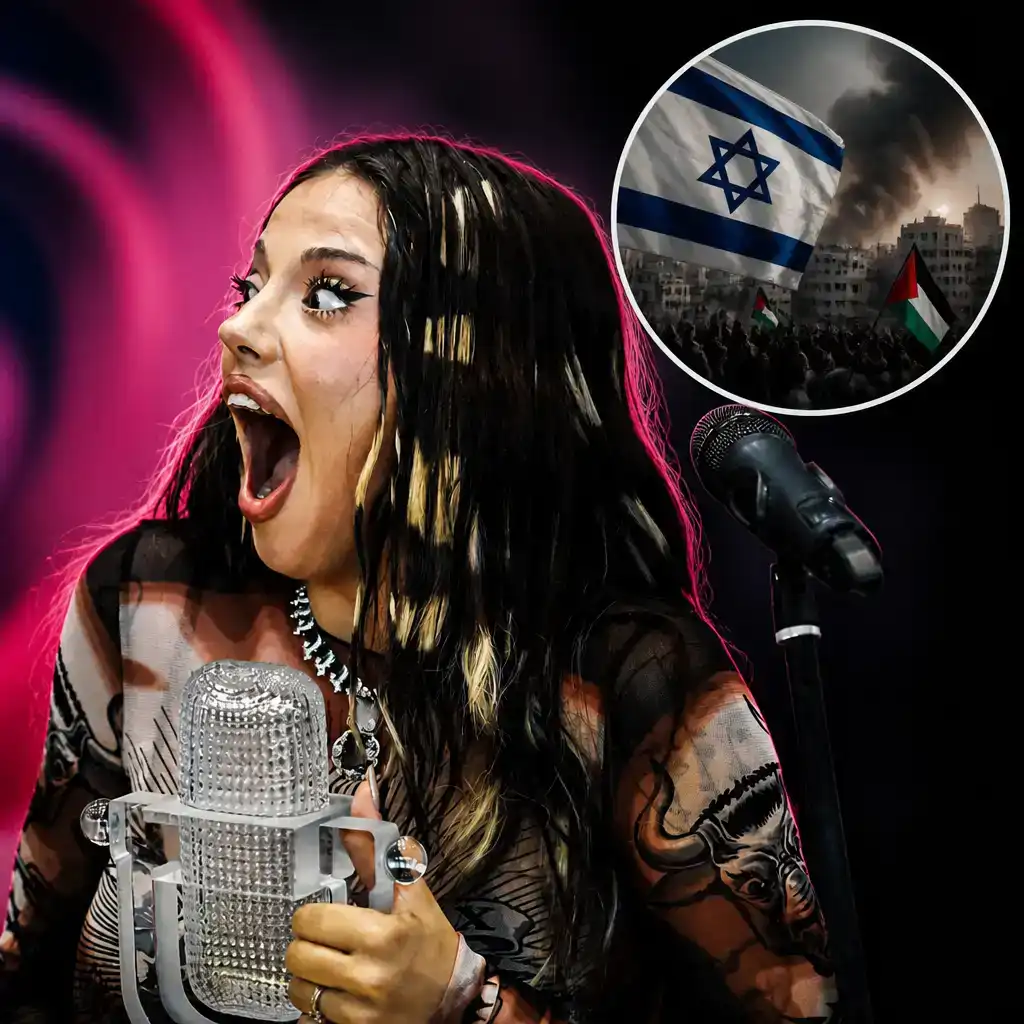
Winning Eurovision has traditionally brought a trophy, national prestige and the costly privilege of organising the next edition. The new Eurovision hosting rules separate those rewards: a broadcaster may still compete and win, but its country can be blocked from staging the contest if war or regional instability makes hosting unsafe.
The European Broadcasting Union said a winning broadcaster will be automatically ineligible to host when an armed conflict, a sensitive geopolitical situation or another condition materially affects the security, safety or stability of its country or surrounding region. An independent security assessment and consultations may inform the decision.
That does not affect Bulgaria’s plans for 2027. Bulgarian National Television and the EBU have selected Burgas, a Black Sea port, over Sofia. The semifinals are scheduled for May 11 and 13, followed by the final on May 15.
Can a country still compete while at war?
Yes. The change concerns hosting rights, not automatic suspension from the competition. A broadcaster may enter, win and then watch another broadcaster organise the next contest elsewhere. Eurovision has found a way to make victory conditional, which is certainly one method of keeping the trophy cabinet separate from the security assessment.
If the winner cannot host, the EBU will choose an alternative broadcaster. Reports in El País indicate that the substitute would take independent control of the production and would not be required to honour or represent the winning country.
That differs from the arrangement for Eurovision 2023. Ukraine won in 2022 with Kalush Orchestra but could not safely stage the following contest because of Russia’s invasion. The United Kingdom hosted in Liverpool on Ukraine’s behalf, with Ukrainian culture and the country’s victory built into the event.
Contrary to one widely repeated claim, Ukraine has hosted Eurovision before. Kyiv staged the competition in both 2005 and 2017. Liverpool was the exception created by the war, not Ukraine’s first lost opportunity to host.
Why did the EBU change the rules?
The EBU has not said the measure targets any particular country. Eurovision director Martin Green described it as part of the organisation’s annual review, guided by feedback from member broadcasters.
“These changes are about giving everyone involved greater clarity, protecting artists and ensuring the contest continues to provide a safe and welcoming environment,” Green said, while also referring to the competition’s “spirit and integrity”. Eurovision has spent several years discovering how difficult those words become once governments, wars and public broadcasters enter the same arena.
The timing inevitably puts Israel at the centre of the discussion. Organisers have faced sustained pressure over its participation since the Gaza war began in 2023, alongside protests over Israeli military operations and raids in the occupied West Bank. Critics and boycott organisers have described Israel’s campaign in Gaza as genocide and accused the EBU of applying different standards to Israel and Russia.
Israel remains eligible to compete under the revised policy. It could also win, but any attempt to host would face the new security test. The EBU told Al Jazeera that the rules apply to every participating broadcaster and that any assessment would happen closer to the event.
Why was Russia excluded but Israel allowed to enter?
Russia was removed from Eurovision in February 2022 after its full-scale invasion of Ukraine. Its broadcasters were subsequently outside the competition, eliminating both participation and hosting.
Israel, an entrant since 1973, has continued to compete. It last hosted in Tel Aviv in 2019 after Netta won the previous year. In Vienna in 2026, Israeli singer Noam Bettan finished second, meaning the country came close to creating precisely the hosting question the new policy now addresses.
More than 1,000 musicians and cultural workers signed a letter before the 2026 final accusing the EBU of hypocrisy. They recalled that the organisation had argued Russia’s presence could bring Eurovision into disrepute, while refusing to impose the same consequence on Israel over Gaza and the occupied West Bank.
Sven Kühn von Burgsdorff, a former European Union representative to the occupied West Bank and Gaza, made a similar argument in May. He said suspending Israel would be consistent while the country maintained what he described as its illegal occupation of Palestinian territory and suppression of Palestinian rights.
Israeli President Isaac Herzog defended the country’s inclusion during the dispute, writing in December 2025 that Israel “deserves to be represented on every stage around the world”.
Which broadcasters boycotted Eurovision 2026?
Five broadcasters stayed out of the Vienna contest after the EBU confirmed Israel could participate:
- The Netherlands: AVROTROS alleged Israeli interference in the previous competition and cited violations of press freedom during the Gaza war. It said participation could not be reconciled with the broadcaster’s public values.
- Ireland: RTÉ pointed to the loss of life and humanitarian crisis in Gaza.
- Slovenia: Its national broadcaster said it was withdrawing on behalf of the 20,000 children it said had died in Gaza.
- Spain: RTVE said the situation in Gaza and Israel’s political use of the contest made Eurovision increasingly difficult to present as a neutral cultural event.
- Iceland: RÚV joined the boycott on December 10, 2025, after the other four broadcasters announced their decisions on December 4.
Thirty-five broadcasters ultimately competed in Vienna. None of the five boycotting organisations has indicated that a hosting restriction alone would resolve its objection. Their dispute concerned Israel’s presence in the contest, not merely the location of a future final.
That distinction matters. The revised policy addresses physical risk and organisational stability. It does not settle arguments about international law, political neutrality or whether participation itself gives governments reputational value.
How did Bulgaria secure the 2027 contest?
Bulgaria earned hosting rights after DARA won Eurovision 2026 in Vienna. She topped both the jury and public votes and finished a record 173 points ahead of Israel’s Noam Bettan.
The EBU and Bulgarian National Television later chose Burgas instead of the capital, Sofia. Green said the coastal city had the required “ambition, infrastructure, and passion”. BNT director-general Milena Milotinova said the broadcaster now faced intensive work to meet the expectations of millions of viewers, while Burgas Mayor Dimitar Nikolov called the selection a major honour.
Bulgaria’s victory also provides the first practical setting for several broader rule changes. Contestants must now be at least 18, up from 16. Backing vocals and instrumental parts may be prerecorded, but the lead vocal must remain live and cannot receive what organisers call “undue assistance”. The machinery may help; the singer still has to sing.
Eurovision began in 1956 and is co-produced by the EBU and participating broadcasters, usually led by the previous winner. The union has 115 members across 57 countries, so eligibility has always depended more on broadcasting membership than a strict reading of Europe’s map.
Will boycotts shrink the competition?
The EBU is losing some established participants, at least for now, but it is also expanding. CBC/Radio-Canada will debut in Burgas after becoming a full EBU member, making Canada the first new Eurovision country since Australia joined in 2015.
Canada’s arrival may soften the numerical effect of the boycotts, but it cannot erase the political dispute behind them. Nor do the new hosting provisions answer the central demand from Spain, Ireland, Iceland, Slovenia and the Netherlands: that Israel should not participate while the Gaza crisis continues.
What the policy does provide is a formal route for denying hosting rights without removing a broadcaster from the contest. It also ends any assumption that an alternative host must stage the show as a tribute to the displaced winner.
That is a significant change to Eurovision’s symbolism. Winning can now produce two separate outcomes: one country receives the trophy, while another gets the expense, scrutiny and several months of logistical anxiety. Burgas will host under the traditional arrangement in 2027. Future winners may not be so fortunate, depending on one’s definition of fortunate.