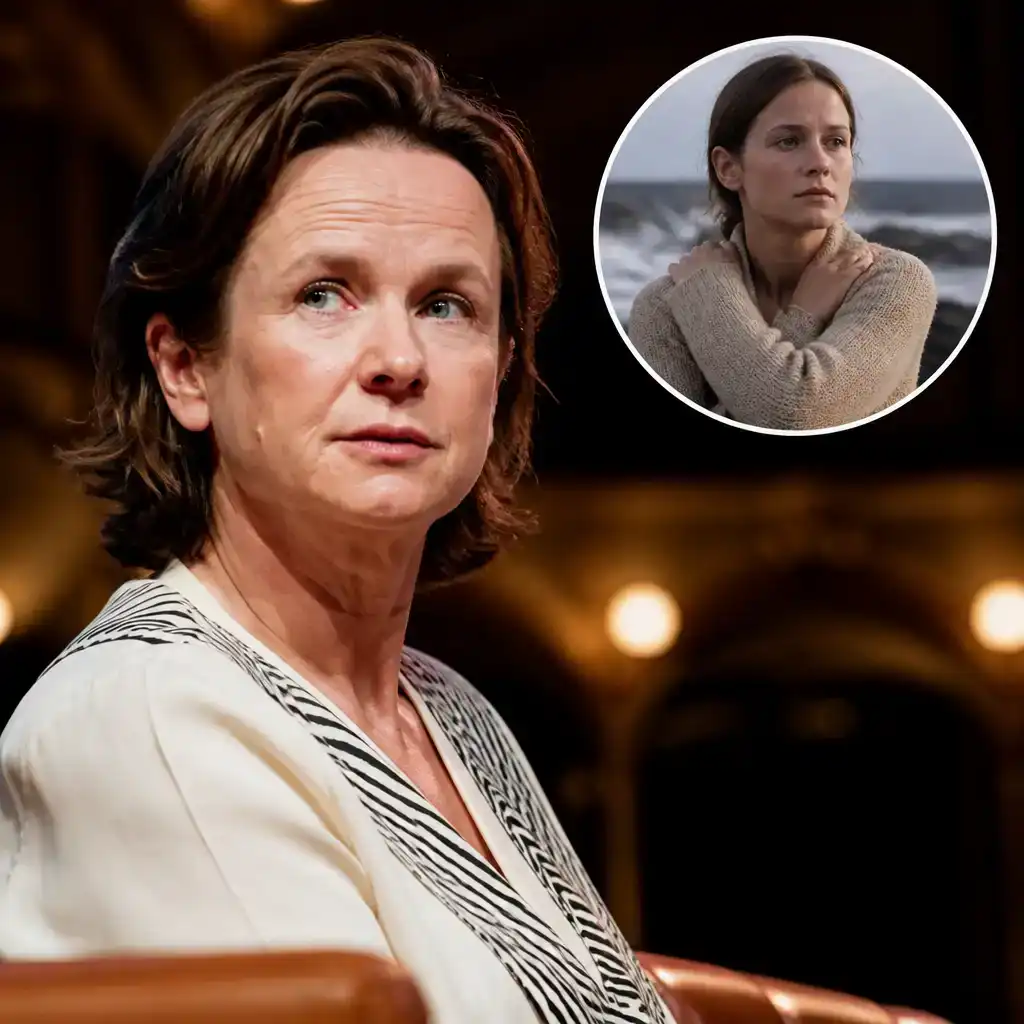
Emily Watson says her cult upbringing nearly stopped her from making Breaking the Waves, the 1996 film that turned a 29-year-old screen newcomer into an Academy Award nominee. Speaking at the 2026 Sarajevo Film Festival, she described accepting the role as both a professional breakthrough and a painful separation from the community that had shaped her childhood.
Watson is serving as president of Sarajevo’s feature-film jury and receiving an honorary Heart of Sarajevo Award. Festival director Jovan Marjanović praised her “extraordinary emotional precision and strength,” while noting that this is her first visit to the festival in 20 years.
Her appearance also gave Watson room to explain why the religious repression in Breaking the Waves was not merely useful research. The resemblance to her own life was not exactly subtle.
Why Breaking the Waves forced a decisive break
Watson grew up within the London-based School of Philosophy and Economic Science, also known as the School of Economic Science. The organization promoted conservative sexual ethics and rigid gender roles. Former members have described it as a sect, a new religious movement or a cult. Watson now uses the last description.
“Parts of it were very happy, and parts of it were very strange,” she said in Sarajevo. She recalled being deeply devotional and needing years to understand how the experience had affected her.
After beginning her career onstage with the Royal Shakespeare Company, Watson accepted the role of Bess McNeill in Lars von Trier’s Breaking the Waves. Bess lives in a severely religious community in northern Scotland and marries a Danish oil worker, played by Stellan Skarsgård. After he suffers a disabling accident, she enters a series of sexual encounters that violate her community’s rules.
When members of the School of Economic Science learned about the film, Watson said she was summoned and ordered not to participate. She was told to “go on your undignified way.”
She went anyway.
What Watson says happened after she left
Watson described that confrontation as a rupture from the institution, her friends and the world she had known. She was devastated but also felt “an incredible freedom,” as though her own instincts had finally become louder than the group’s instructions.
“That’s part of why it works,” she said of the film. “I was like a piece of wire being unplugged.”
Her account in Sarajevo echoed comments she made on BBC Radio 4’s Desert Island Discs on May 24. There, Watson said the rejection left her in “freefall,” before acting and the role itself gave her something to hold onto. She has repeatedly credited acting with saving her life.
Watson also offered a more complicated assessment of the organization’s teachings. She said its philosophy could be “a beautiful thing” in principle, but that its practice was “very repressive to women and young girls.” In a 2023 interview reported by The Guardian, she described her schooling as involving “cruelty and unpleasantness.”
That distinction matters. Her memories concern not only an unconventional childhood but an institution with a documented history of mistreatment.
What an inquiry found at affiliated schools
A privately commissioned inquiry chaired by James Townend KC investigated conduct at St James and St Vedast schools, which were linked to the School of Economic Science. It concluded that pupils had been “criminally assaulted” and otherwise mistreated between 1975 and 1985.
Watson told Desert Island Discs that her parents had “unwittingly put us potentially in harm’s way.” She said she and her sister were protected in ways that other children “maybe were not.” Her account therefore sits beside a broader institutional record, rather than existing as an isolated dispute over one film role.
She has not reduced her childhood to a simple story of villains and victims. Watson described her family as loving and said parts of her early life were happy. At the same time, she has become increasingly direct about the damage created by strict authority, especially for girls.
That greater openness came slowly. In the early 1990s, she said, public discussion of childhood trauma was far less common. “It has taken me a lifetime to unpick it all,” she told the Sarajevo audience. “I wouldn’t have been able to articulate any of this in 1996. I was very defensive.”
Why Cannes felt unsafe rather than glamorous
Breaking the Waves premiered at the Cannes Film Festival in 1996 and brought Watson the first of her two Academy Award nominations. The second followed for Anand Tucker’s Hilary and Jackie. She also went on to receive multiple nominations from the Golden Globes and the British Academy of Film and Television Arts, along with wins including a Silver Bear, a European Film Award and a Screen Actors Guild Award.
At Cannes, however, Watson was not enjoying a polished arrival on the international stage. She remembered trying to appear “the most normal, boring person in the world” because allowing strangers to know anything personal did not feel safe.
Her parents, who were still connected to the religious group, attended the festival. Watson said they supported her personally, although they did not defend her within the organization. Her father emerged from a screening looking as white as her dress, an understandable response from a parent who had just watched that particular film.
The family relationship remained complicated, but not permanently broken. “We matured, we communicated, and we were good,” Watson said.
She did not tell Skarsgård about her upbringing while they were making the film. The disclosure came more than two decades later, reportedly during production of Chernobyl in 2018. The acclaimed miniseries was released in 2019. Skarsgård reacted with astonishment, while Watson explained that she had not understood the connection clearly enough to discuss it in 1996.
How coercive belief systems followed her career
Watson’s early life offers useful context for a recurring feature of her work: characters trapped inside powerful systems that define obedience as virtue.
In Breaking the Waves, religious leaders police Bess’s body and choices. In HBO’s Chernobyl, Watson played nuclear physicist Ulana Khomyuk, a fictional composite character confronting a state apparatus built around secrecy and submission. In Dune: Prophecy, she plays Valya Harkonnen, a leader within another institution shaped by discipline, faith and control.
Watson has previously described such material as familiar territory for her. That does not mean every role is disguised autobiography, but the pattern is difficult to miss once she has explained the background.
She also used her Sarajevo appearance to discuss who gets to direct these stories. Watson said she wants to work with more women filmmakers but has had too few opportunities, blaming the structure of the industry rather than her own preferences. “The fight to get to that level is a lot easier for men,” she said.
Her experience with Chloé Zhao on Hamnet was an exception she praised enthusiastically. Watson said Zhao takes performers on “a spiritual journey” and builds the film around that process.
What Watson said about awards and access
Watson recalled finding the Oscar campaigns for Breaking the Waves and Hilary and Jackie overwhelming, though she believes awards promotion has since become “much more extreme.” She criticized its commercial nature, arguing that success is not a true meritocracy when campaign spending carries so much influence. Hollywood has rarely objected to money making itself useful.
By contrast, she praised Sarajevo as a festival centered more directly on storytelling. The feature-film jury she leads is due to announce the Heart of Sarajevo winners on August 21, 2026. The best-feature award includes a €16,000 prize.
A Palestinian audience member asked Watson about the barriers facing marginalized performers, particularly those working in countries affected by war. She acknowledged that fully imagining those conditions required a considerable leap from her own experience, but argued that major cultural works do not belong only to wealthy or stable countries. “Shakespeare belongs to Palestine as much as everywhere else,” she said.
After watching Michael Winterbottom’s Welcome to Sarajevo, Watson said she had been reminded of the power of storytelling to advocate for people and places. Resources may be scarce, she added, but a camera can still witness whoever stands before it.
What Emily Watson is doing next
Watson is set to return for the second season of HBO Max’s Dune: Prophecy. She will also appear in Mira Nair’s historical drama AMRI.
Another announced project is Mars Express, the directing debut of Mackenzie Crook, co-starring Toby Jones. The film follows the real-life story of Colin Pillinger and Judith Pillinger and their late-1990s effort to search for life on Mars.
For now, Sarajevo has given Watson a different role: judge, honoree and unusually candid witness to her own career. Three decades after Breaking the Waves, she can finally describe why the performance carried such force. The film did not merely launch her screen career. Making it required her to choose that career over the authority that had once told her who she was allowed to be.