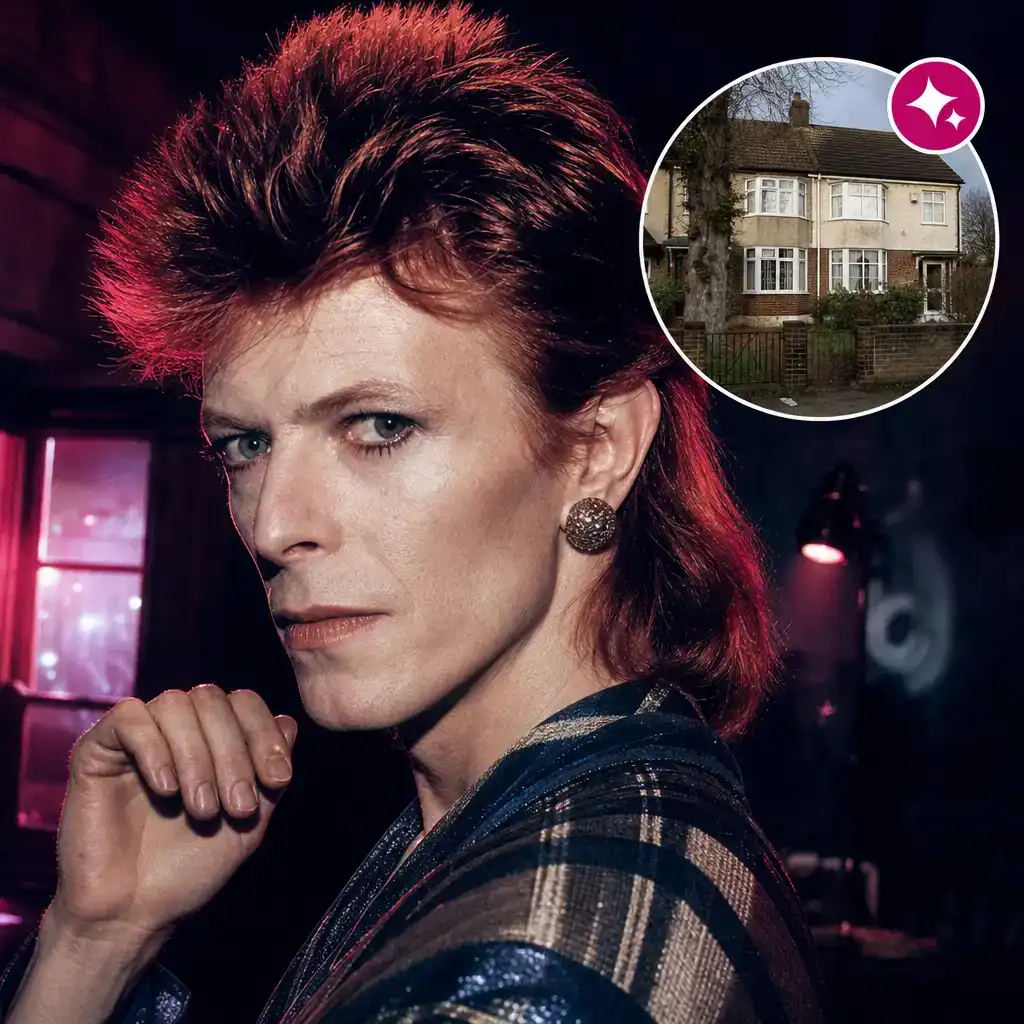
The modest semi-detached house in Bromley where David Bowie spent his teenage years is being turned into a public heritage site, giving visitors access to the small bedroom where one of pop’s most restless imaginations first took shape.
4 Plaistow Grove does not look like the birthplace of a global cultural force. It looks, inconveniently for anyone hoping for gothic drama, like a normal suburban home. But David Robert Jones, later known everywhere as Bowie, lived there from the age of eight to 20, between 1955 and 1967, sharing the house with his parents, John and Peggy.
Why 4 Plaistow Grove Matters
Bowie wrote early songs in a bedroom measuring just 9ft by 10ft. He later described that room as his “entire world,” filled with books, music and a record player. It was the private space that helped feed the ideas behind his early work, including the creative path that led to his breakthrough hit, Space Oddity.
The Heritage of London Trust has bought the house and plans to restore it to its early-1960s look. The aim is not to polish it into a shrine, but to show the ordinary setting that produced something very much not ordinary.
Dr Nicola Stacey, director of the Heritage of London Trust, is leading the project, with Geoffrey Marsh, co-curator of the David Bowie Is exhibition, curating it. Bowie’s lifelong friend George Underwood is also supporting the work.
What It Felt Like To Step Inside
Dr Stacey said receiving the keys to the property was a powerful moment.
“It was incredibly exciting when I got the keys for the first time,” she said.
“There is something absolutely extraordinary about standing in the house. Even though a lot of it structurally hasn’t changed a huge amount, there is something very powerful about opening his bedroom door, just standing there looking out of the window where he spent so much of his time.
“That is where he formed the David Bowie that was let loose on the world. It wasn’t the easiest house to live in for him. His family dynamics were a little bit complex and it wasn’t a house that was bursting with creativity and warmth, except in this space.”
That contrast is central to the project. Visitors will see a straightforward picture of 1960s domestic life, then step into the room where Bowie’s imagination began to expand beyond the limits of the house.
“What we want is for people to get a sense of 1960s domestic life, then go into his bedroom where there is a burst of vision and excitement, and, even on this tiny scale, a sense of creative genius really starting in this space,” Dr Stacey said.
How The House Will Be Used
The restoration is due to finish in late 2027. Once open, the home will not simply be a preserved time capsule. The trust also plans to host creative and skills workshops for young people, linking the site to Bowie’s legacy of “free creative experimentation.”
Dr Stacey said the team has already been working with local schools to explore which parts of Bowie’s life resonate with students and how those stories can be told through the house.
“We’re giving people the opportunity to see a house in Bromley exactly how it was in the 1960s,” she said. “It wasn’t a grand house by any stretch. There was a lavatory outside, the bath was a tin bath, all those things children now gasp with astonishment at when you tell them.
“But that’s the place where he came from. His music is so varied and captures generation after generation constantly.”
The idea is quietly effective: show young people that creative lives do not always start in glamorous rooms with perfect lighting and expensive equipment. Sometimes they start in a small bedroom in Bromley, which is either comforting or a serious challenge to everyone’s excuses.
Bowie’s South London Story
Bowie’s south London years stretched well beyond Plaistow Grove. He was born in Brixton in 1947 and lived at 40 Stansfield Road before the Jones family moved to Bromley.
He later lived in nearby Beckenham, where he co-founded the Beckenham Arts Lab at the Three Tuns pub on the high street. The building is now a Zizzi restaurant, because history does enjoy testing people’s composure. Outside the former pub, the pavement carries an etching of the famous thunderbolt from Bowie’s Aladdin Sane cover.
Other local milestones followed:
- In March 1970, Bowie married his first wife, Angie, at Bromley Registry Office in Beckenham Lane.
- In 1971, he worked on The Rise and Fall of Ziggy Stardust and the Spiders from Mars at Underhill Studios in Greenwich.
- His years across Brixton, Bromley, Beckenham and Greenwich helped shape the artist who would become one of the most influential musicians of the 20th century.
Bowie died in 2016, but the geography of his early life remains unusually visible, especially for fans who want to understand where the mythology began before it became mythology.
Why Bromley Is Paying Attention
For Dr Stacey, the house is not just a Bowie site. It is a south London story with global reach.
“It’s a brilliant south London story,” she said. “He’s of such huge global significance and the idea of being able to bring people to south east London, and show them that this is where it all came from, is inspiring for everyone.”
The trust has already heard from people with memories of Bowie before the world knew what to do with him.
“We’ve had an amazing amount of people contact us to say they knocked on his door when they were teenagers and got his autograph,” Dr Stacey said. “People are so proud of living near the house and excited about what this will do for Bromley.
“We’ve had contact from people who saw him crossing the street in incredibly outrageous clothes in the 60s. He was always just different and some longed to look like him, to just be as cool as him.
“It’s great the house is going to come back to life. It’s been sitting there quietly waiting for this opportunity.”
For fans, the appeal is obvious. For Bromley, the project offers something more grounded: a chance to claim its place in a cultural story that eventually travelled far beyond one small room.