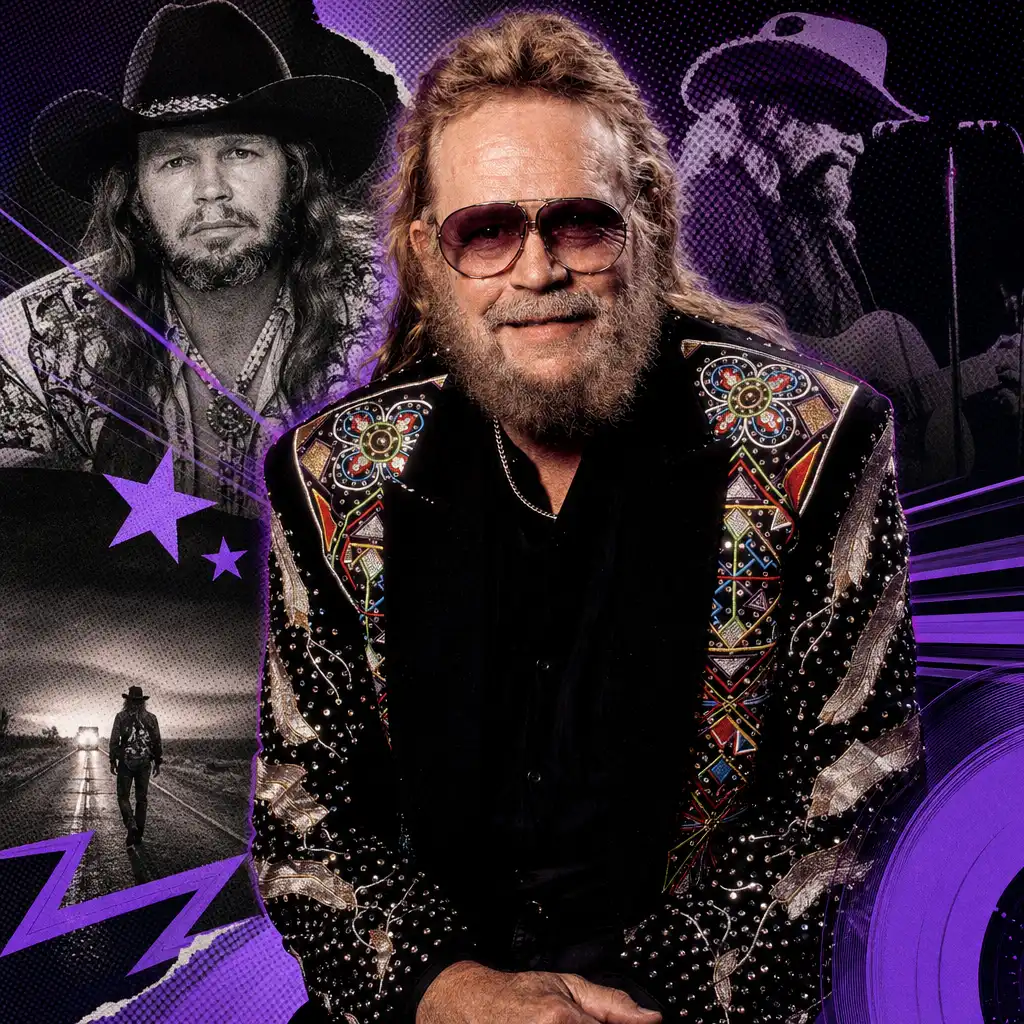
David Allan Coe built a country career out of rough edges, hard miles and songs that sounded as if they had arrived with dents already in them. The outlaw country figure behind “You Never Even Called Me by My Name,” “The Ride” and the Johnny Paycheck anthem “Take This Job and Shove It” has died at 86.
Coe died in an intensive care unit at around 5 p.m. on Wednesday, his representative confirmed to Rolling Stone. A cause of death has not been confirmed.
“David is a musical treasure,” the representative said. “Even in his years of declining health, David appreciated all of the fans.”
His wife, Kimberly Hastings Coe, also paid tribute in a statement to Rolling Stone, calling him “one of the best singers, songwriters, and performers of our time [and] never to be forgotten.”
“My husband, my friend, my confidant and my life for many years,” she said. “I’ll never forget him and I don’t want anyone else to ever forget him either.”
A hard-lived figure in outlaw country
Coe was one of the central names in outlaw country, the movement that pushed against Nashville polish in the 1970s with rougher production, sharper writing and artists whose public images did not need much studio assistance. His voice carried the grain of that world: defiant, wounded, sometimes funny, often impossible to sand down.
Born in Akron, Ohio, on Sept. 6, 1939, Coe spent much of his youth in reformatories and prisons, including time at the Ohio State Penitentiary. His criminal record included charges such as grand theft auto and possession of burglary tools.
He also carried a prison legend with him for decades. Coe long claimed he had killed a man in prison in 1963, saying he beat him with a mop bucket after a confrontation in a shower. Later research suggested that story was more mythmaking than fact, even as his time behind bars was well documented. With Coe, the biography and the performance often stood uncomfortably close together.
After leaving prison in 1967, he headed to Nashville in the kind of entrance that would sound invented if it had not been repeated by those close to him. His son, Tyler Mahan Coe, told GQ in 2021 that his father arrived in a hearse, parked outside the Ryman Auditorium and performed on the street before Grand Ole Opry shows, wearing a mask and a rhinestone suit while trying to force his way into the business.
Subtle, it was not. Effective, eventually, it was.
From street performer to country hitmaker
Coe’s early hustle led to a deal with Plantation Records. He released his blues-rooted debut album, Penitentiary Blues, in 1970, followed by Requiem for a Harlequin in 1973.
The commercial turn came through songwriting. In 1973, Tanya Tucker scored a country chart hit with Coe’s “Would You Lay With Me (In a Field of Stone),” a song that helped move him from curiosity to serious Nashville writer.
He then signed with Columbia Records and released The Mysterious Rhinestone Cowboy in 1974, his first fully country-facing album. In 1975, Once Upon a Rhyme gave him his first country Top 10 single with “You Never Even Called Me by My Name,” a wry, self-aware country standard that became one of his signature songs.
In 1976, Coe released Longhaired Redneck, with the title track openly leaning into the outlaw-country identity. A year later, one of his biggest songs became a defining working-class hit when Johnny Paycheck recorded “Take This Job and Shove It.” The single reached No. 1 in 1977 and became a durable anthem for anyone who had ever looked at a time clock with contempt.
Coe’s run did not end with the 1970s. In 1983, he released “The Ride,” a ghostly piece of country storytelling built around the legend of Hank Williams. In 1984, “Mona Lisa Lost Her Smile” became his highest-charting single, peaking at No. 2.
Across nearly six decades, Coe released 42 studio albums, a catalogue that mixed traditional country, blues, outlaw posturing and moments of unusually direct songwriting.
Health struggles in later years
Coe had faced serious health setbacks in the final stretch of his life.
In 2013, at age 73, he survived a severe crash in Florida when a semi-truck broadsided his Suburban at an intersection after he ran a red light at about 1:30 a.m., according to the Ocala Star Banner. Emergency crews spent two hours cutting him from the wreckage. He suffered broken ribs, bruised kidneys and required 48 stitches in his head.
In 2021, at 81, Coe was hospitalized for a month after testing positive for COVID.
The man behind the reputation
Outside music, Coe often lived in a way that reinforced his outlaw image. He was a former member of an Outlaws Motorcycle Club chapter in Louisville, Kentucky. In a 2003 interview, he said he joined after cousins who were already members brought him into that world.
He was married six times. His final marriage, to Kimberly Hastings Coe, took place in 2010 at the Little White Wedding Chapel. Country star Toby Keith attended and served as an official witness, according to The Boot.
Coe is survived by his wife Kimberly, his son Tyler Mahan Coe and his daughter Tanya Coe.
His legacy is not tidy, and it probably never could be. But country music rarely moves forward through tidy figures. Coe’s best songs remain part of the genre’s unrulier bloodstream: funny, bleak, combative and built to last longer than the mythology around them.