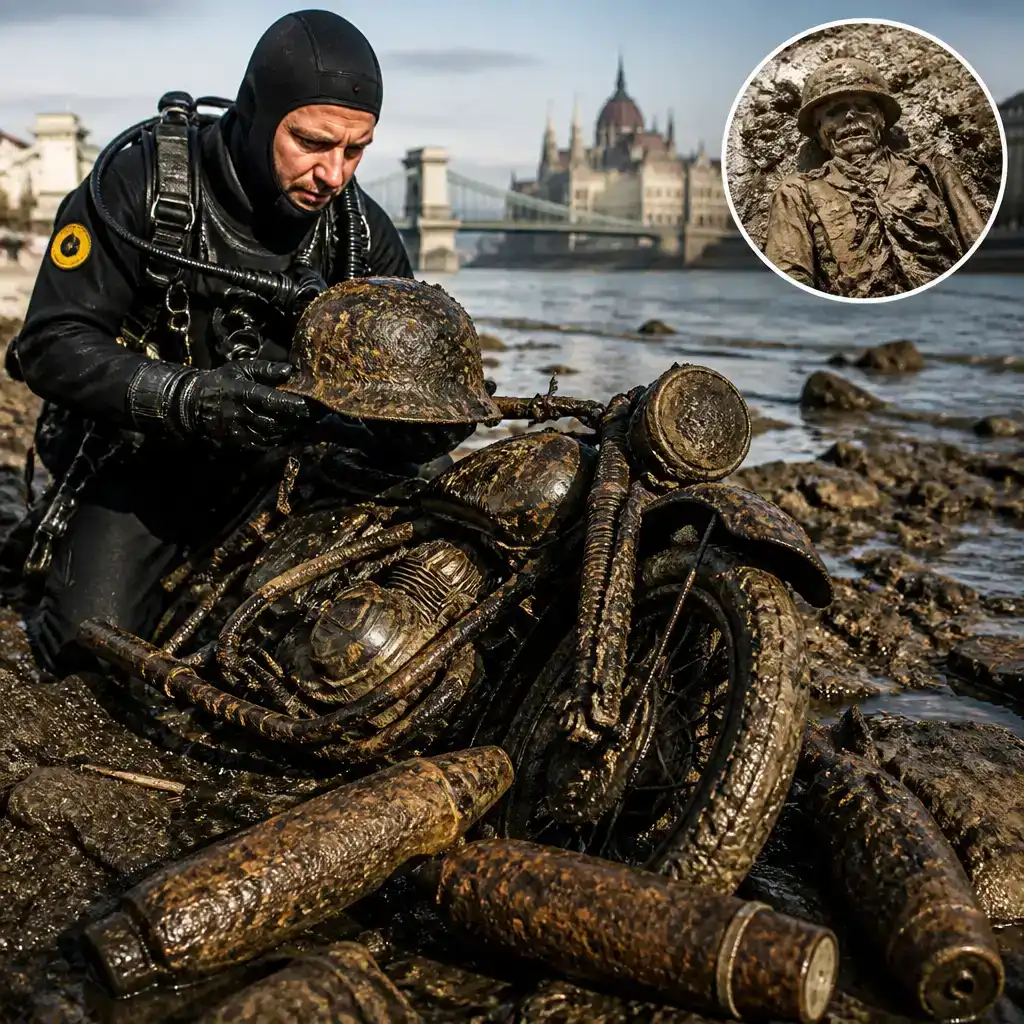
- Two military identification tags
- A wedding ring
- A Kuban Shield, a German combat badge
- Anti-tank mines and ammunition
Hungarian military outlet Honvédelem later reported that investigators opened the motorcycle’s side box and continued cataloguing its contents. Hungarian reports also described an MG42 machine gun among the recovered weapons.
Early local accounts referred to the bones of one German soldier, about 10 mines and extensive ammunition. The commission and later international reports said two soldiers had been found. Authorities have not publicly explained that discrepancy.
Harbour sludge mixed with oil appears to have protected several objects from severe deterioration. It is not exactly a conservation method museums would recommend, but it kept the tags and motorcycle in unusually good condition after roughly eight decades underwater.
Why identifying the soldiers will take time
One tag reportedly belonged to a Wehrmacht soldier and the other to a member of the Waffen-SS. The Waffen-SS was declared a criminal organisation at the Nuremberg Trials because of its role in war crimes.
German military identification tags were designed to split in two after a soldier’s death. One half remained with the body, while the other went to military authorities responsible for recording casualties and notifying relatives. In this case, the commission believes the men’s families may never have received confirmation of what happened.
“Now begins a puzzle, in which we will try to determine the identity of the two dead,” commission official Arne Schrader told Bild.
Finding the names attached to the tag numbers may be relatively quick. Proving that those names belong to the recovered bodies is harder. Tags could have been moved, exchanged or separated from their owners during fighting, burial or decades in the river. The same uncertainty applies to the Kuban Shield.
Bone analysis will therefore be central to the investigation, alongside military records and other archival evidence. The commission cautioned that identifying the original tag holders is only the first stage, with no guarantee that all the evidence will align neatly. History rarely provides complete paperwork, especially after spending 80 years under a river.
Budapest’s archives may provide crucial evidence
The German War Graves Commission conducts searches, recoveries and burials on behalf of the German government. Its work across Eastern Europe remains substantial: more than one million war dead are still missing, and its recovery service finds more than 15,000 people each year.
Hungary’s Defence Ministry estimates that about 53,000 German troops were killed or remain missing in the country. Budapest saw fierce combat between the Soviet Red Army and German forces during the final months of the Second World War, leaving bodies, weapons and vehicles scattered across the city and surrounding region.
Previous cases show how municipal records can resolve mysteries that physical evidence cannot. In 2020, the commission identified 160 war dead in Budapest after researcher Gabor Kohlrusz discovered a city list containing 60 names and 100 identification-tag numbers.
That precedent offers some hope for the latest investigation, although each case depends on what records survived and whether the objects can be connected reliably to the remains.
Once the work is complete, the soldiers are expected to be buried at the German-Hungarian war cemetery in Budaörs, outside Budapest. The cemetery records 17,502 dead and is Hungary’s largest shared burial ground for German and Hungarian war casualties.
Exposed weapons create a separate emergency
The human remains have drawn international attention, but the exposed explosives present the more immediate danger. Discovery of the anti-tank mines prompted authorities to close part of the riverbank temporarily while a bomb disposal unit worked at the site.
Another apparent munition exposed by the low river disappeared before police arrived, HVG reported on August 10. The incident suggested that someone had entered the riverbed and removed it, turning a historical discovery into a public-safety problem with impressive efficiency.
Authorities routinely warn people not to touch suspected military objects. Old explosives may be corroded, unstable and difficult to identify, while low water gives civilians easier access to areas that are normally submerged.
The Danube has revealed other wartime remains during periods of drought, including sections of German wrecks and munitions between Budapest and Serbia. Near Prahovo in Serbia, falling water has exposed broken sections of vessels sunk during the Second World War.
Such discoveries create simultaneous demands for bomb disposal teams, archaeologists, military historians, forensic specialists and archives. The river may uncover the objects in minutes. Establishing what they are, who they belonged to and whether they might still explode takes rather longer.
What happens next?
Investigators must complete the recovery, examine the bones, trace the identification numbers and compare the results with German military records. They will also need to determine whether the wedding ring, badge and other personal effects were carried by either soldier.
Families searching for missing relatives can consult the German War Graves Commission’s database, although the organisation has stressed that the outcome of this case remains uncertain.
The find has generated considerable interest in online groups dedicated to tracing relatives who served in the two world wars. Some users welcomed the possibility that families might finally learn where missing relatives died and that the remains could receive a formal burial.
That prospect gives the recovery significance beyond the unusual sight of a wartime motorcycle emerging from central Budapest. The drought has exposed both unresolved deaths and live risks. One may eventually provide answers to families; the other requires everyone nearby to resist the urge to collect a souvenir.