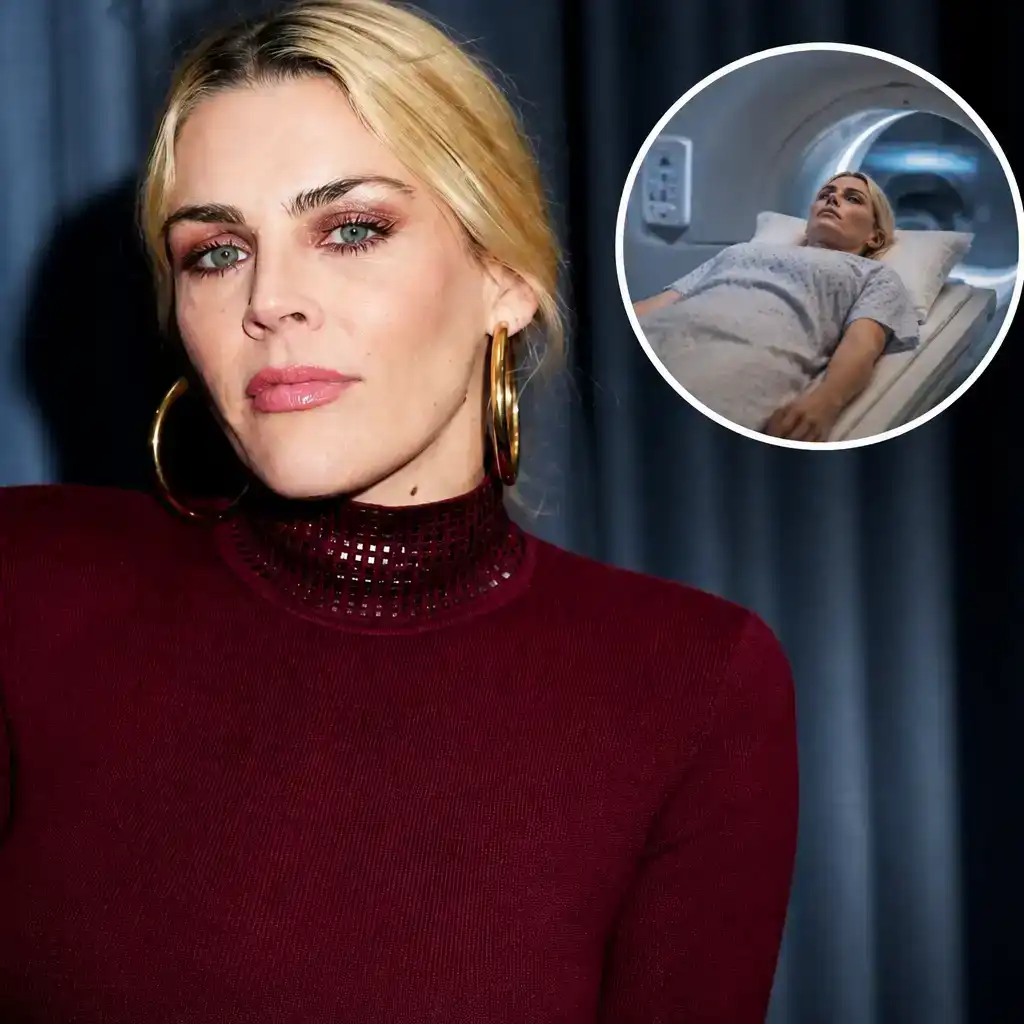
Busy Philipps’s brain tumour diagnosis began with a scan she nearly postponed and led to two operations within a matter of weeks. The 47-year-old actor, known for Dawson’s Creek, Freaks and Geeks and Cougar Town, has now revealed that doctors found a rare grade 2 oligodendroglioma despite her having no symptoms.
“I’m grateful that I’m alive,” Philipps told People, describing the past six months as “the weirdest” of her life. She has returned to work and currently requires neither chemotherapy nor radiotherapy, according to later reports, but remains under medical surveillance.
How did doctors discover the tumour?
Philipps underwent a Prenuvo full-body MRI on February 12 after a blizzard in New York City forced her to delay the original appointment. She had no apparent warning signs before the scan.
The timing was particularly difficult. Her appointment came one day after the death of her former Dawson’s Creek co-star James Van Der Beek from colon cancer. Philipps had called him “one in a billion” and said she was “profoundly heartbroken.”
Her former husband, screenwriter Marc Silverstein, encouraged her not to cancel again. He suggested going ahead with the scan might be “the best thing you could do for your friend.” It proved to be unusually consequential advice.
Philipps recalled a doctor telling her: “This is a real tumour, and it’s inside your brain. And Busy, it’s got to come out.” She said she began hyperventilating while trying to process the news.
Doctors diagnosed a grade 2 oligodendroglioma, a relatively rare, slow-growing tumour most commonly found in adults between 30 and 50.
What happened during the first operation?
On March 2, Philipps underwent a five-hour operation to remove the 2.6-centimeter mass. Reports said surgeons achieved a complete removal.
The procedure came shortly before she was due to begin filming the legal drama Cupertino. Before surgery, however, she had to explain the diagnosis to her daughters, Birdie, 18, and Cricket, 13, whom she shares with Silverstein.
Birdie was “really, really scared and overwhelmed with emotion,” according to Philipps. She tried to reassure her eldest daughter with a blunt promise: “Birdie, you’re just not in the movie where your mom dies your senior year of high school. That’s just not the movie that you’re in. I promise you.”
Cricket responded more directly, asking whether her mother would be fine. Philipps told her she would. Cricket accepted the answer, which may qualify as the most efficient family meeting in recent memory.
After the operation, Philipps expected to recover and return her attention to work. That plan held until April.
Why did Busy Philipps need a second surgery?
During a dermatology appointment, Philipps’s doctor noticed that the incision from the brain surgery did not look right. Rather than touching it, the dermatologist photographed the area and told Philipps to send the image to her surgical team immediately.
The surgeons agreed there was cause for concern. Doctors subsequently found a staphylococcal infection in the incision, requiring another procedure known as debridement to remove infected tissue.
“The second surgery really threw me,” Philipps said. “I just felt like I was back to square one, and I was really, really upset.”
She has since recovered and returned to work. Doctors have told her there is a strong chance the tumour may not recur, and she does not currently need chemotherapy or radiotherapy. Still, complete surgical removal does not automatically mean the matter is permanently finished. Grade 2 oligodendrogliomas can return or progress, making continued scans and specialist follow-up important.
Philipps said the experience also gave new meaning to something she had repeated for roughly two years: “My brain feels broken.” Her doctor reminded her of those comments after the diagnosis.
“I wasn’t consciously aware that anything was really wrong, but there was something that was misfiring,” Philipps said. “My brain does not feel broken anymore.”
What is a grade 2 oligodendroglioma?
The National Cancer Institute describes oligodendroglioma as a tumour that forms in glial cells, which support nerve cells in the brain and spinal cord. A confirmed diagnosis requires an IDH mutation and the deletion of chromosome regions known as 1p and 19q.
Some reports have called Philipps’s tumour malignant or cancerous. The institute uses more specific language for grade 2 disease, describing it as low-grade, slow-growing and locally invasive. Grade 3 tumours are faster-growing and explicitly classified as malignant.
Around 14,950 people in the United States were living with oligodendroglioma in 2019, and approximately 1,185 cases are diagnosed there each year. The overall five-year relative survival rate is 79.5 percent, though an individual prognosis depends on factors including:
- The tumour’s grade and genetic profile
- The patient’s age and general health
- Where the mass formed in the brain
- How completely surgeons could remove it
- Whether it later recurs or progresses
Those figures provide context, not a personal forecast. Philipps’s doctors have the rather more useful advantage of seeing her scans and pathology results.
Should healthy people get full-body MRI scans?
Philipps’s case raises a wider question about commercial full-body MRI screening. Her scan found a potentially serious tumour before she had symptoms, an outcome that understandably makes early screening look compelling.
Medical guidance remains less enthusiastic. The American College of Radiology says there is not enough evidence to recommend total-body MRI screening for asymptomatic people with an average level of risk. Philipps’s experience shows that such scans can uncover significant disease, but one high-profile case does not settle the broader debate over routine screening.
For Philipps, the discovery led to treatment before the tumour announced itself in a more dramatic fashion. She has called herself “the luckiest girl in the world,” while also acknowledging the fear, complications and disruption that followed.
The actor first became widely known as Kim Kelly in Freaks and Geeks before playing Audrey Liddell in Dawson’s Creek alongside Katie Holmes, Michelle Williams and Joshua Jackson. She later appeared with Courteney Cox in Cougar Town and played Karen Googlestein in White Chicks.
For anyone affected by a cancer diagnosis in the United Kingdom, Macmillan Cancer Support provides information and assistance through its helpline on 0808 808 00 00, available daily from 8 a.m. to 8 p.m.