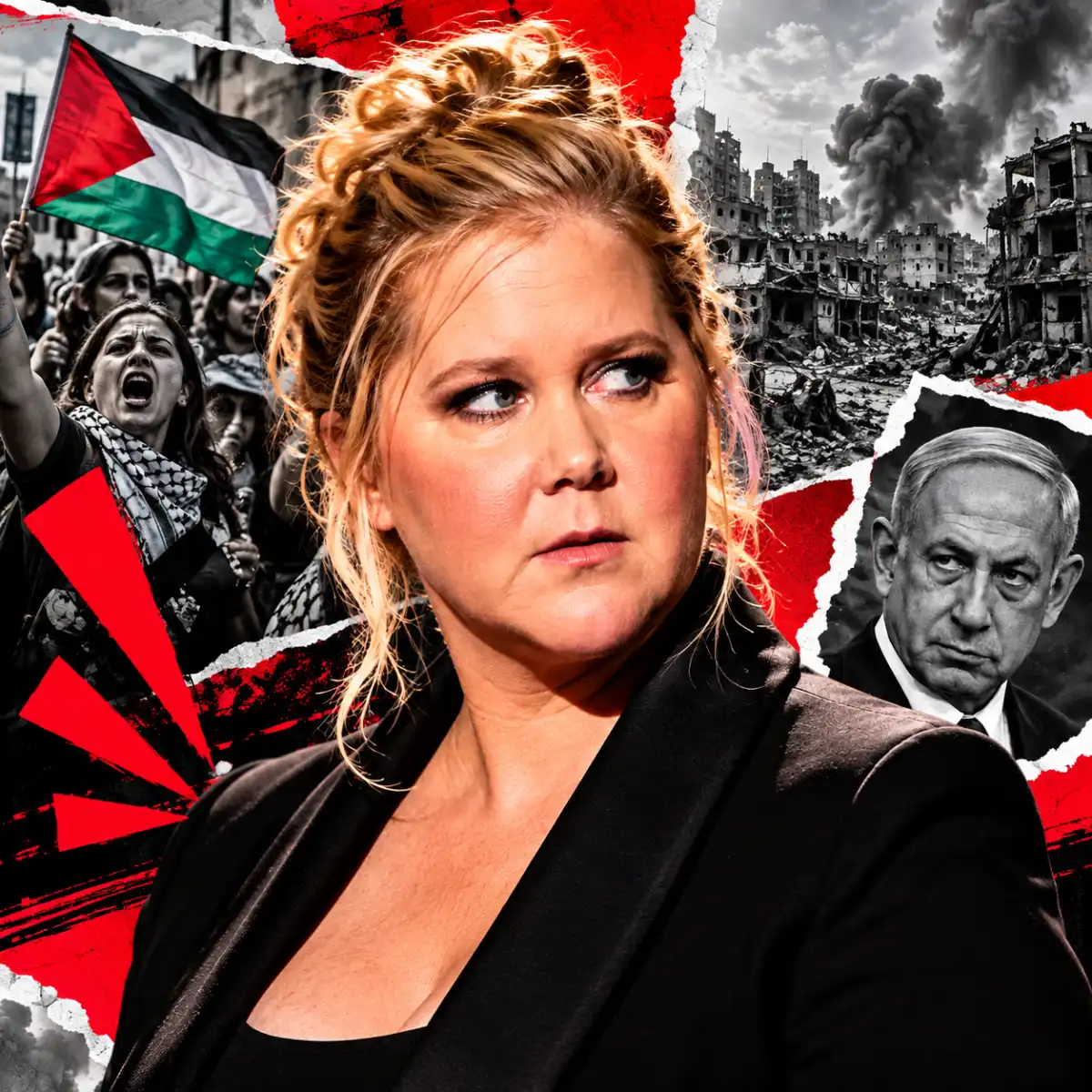
Amy Schumer has addressed the fierce criticism surrounding her social media posts about the Israel-Hamas conflict, condemning the humanitarian crisis in Gaza and distancing herself from Israeli Prime Minister Benjamin Netanyahu's actions.
In a recent interview with Variety, the comedian and actress revealed that the backlash has followed her beyond social media, with strangers confronting her in public and even shouting at her while she works on set.
Schumer, known for films including Trainwreck and I Feel Pretty, says these encounters have become so frequent that they no longer surprise her. Her latest comments also make clear that she does not support the Israeli government's conduct in Gaza.
Amy Schumer condemns Netanyahu's actions and the crisis in Gaza
Speaking to Variety, Schumer offered a direct response to questions about her position on the conflict, explicitly rejecting the actions of Israel's political leadership.
"I don't agree with anything that Netanyahu is doing, and neither do the Israelis I know. Of course, what's going on in Gaza is sickening, horrifying and unacceptable."
The statement draws an important distinction between Schumer's views on the conflict and support for the decisions of Israel's government.
It also addresses a central issue in the criticism surrounding her public commentary: whether her social media activity should be interpreted as an endorsement of Israeli government policy.
Schumer's latest remarks leave little ambiguity about her stated opposition to Netanyahu's actions. They do not, however, provide a detailed explanation of her previous posts or address every criticism directed at her.
Public confrontations have become part of Schumer's daily life
The controversy has not remained confined to online arguments.
According to Schumer's account in the Variety interview, members of the public regularly confront her about her position on the Israel-Hamas conflict. Some have even shouted at her while she was working on set.
The actress indicated that such encounters happen multiple times a day, describing a level of public scrutiny that has become familiar rather than shocking.
For a comedian accustomed to public attention, being recognised is hardly unusual. Being confronted repeatedly over an international conflict is a considerably different experience.
Her account illustrates how intensely audiences can respond when prominent entertainers publicly discuss politically divisive issues.
It also reveals how the consequences of online commentary can extend into everyday professional and personal interactions, even when a celebrity is not actively discussing the subject.
Why Schumer's latest comments matter
Schumer's remarks arrive against the backdrop of criticism over her social media statements about the Israel-Hamas conflict.
The available account of the interview does not establish which specific posts prompted individual confrontations, nor does it identify the arguments made by those challenging her in person.
That distinction matters. Public anger toward a celebrity's statements does not necessarily reveal the precise beliefs that celebrity holds, just as a subsequent clarification does not automatically resolve every objection to their earlier comments.
Schumer has now explicitly condemned the humanitarian situation in Gaza while rejecting Netanyahu's actions. Those statements deserve to be considered on their own terms rather than treated as interchangeable with every position taken by the Israeli government.
At the same time, her latest comments do not erase the wider debate surrounding her previous public statements.
The difference between criticism and confrontation
In my view, the most revealing aspect of Schumer's interview is the contrast between what she says she believes and the hostility she describes encountering. Criticism of a public figure's political statements is legitimate, particularly when those statements concern a humanitarian catastrophe. But repeatedly shouting at someone in public is unlikely to produce the careful discussion such a serious subject deserves.
That does not mean Schumer's earlier posts should escape scrutiny. It means her actual words, including her explicit condemnation of events in Gaza, should remain central to any fair assessment.
There is also a broader question about how much responsibility celebrities assume when they enter political debates online.
Schumer's experience suggests that public commentary can create expectations that extend well beyond the original statements. Audiences may demand further explanations, clarifications or accountability long after a post has disappeared from their feeds.
Those demands can be reasonable. The difficulty comes when disagreement turns into personal confrontation rather than engagement with what someone has actually said.
Schumer's clarification leaves a wider debate unresolved
Schumer has made her current position on Netanyahu and the humanitarian crisis in Gaza explicit. What remains unresolved is how critics will interpret those remarks alongside her earlier social media activity.
The Variety interview offers a clearer picture of her stated views, but it does not establish whether the clarification has changed the minds of those who have confronted her.
For now, the actress describes a reality in which her comments about the conflict continue to shape encounters with strangers, including during her working day.
Her latest statement may help define what she believes. It cannot guarantee that everyone who recognises her in public will be willing to listen.