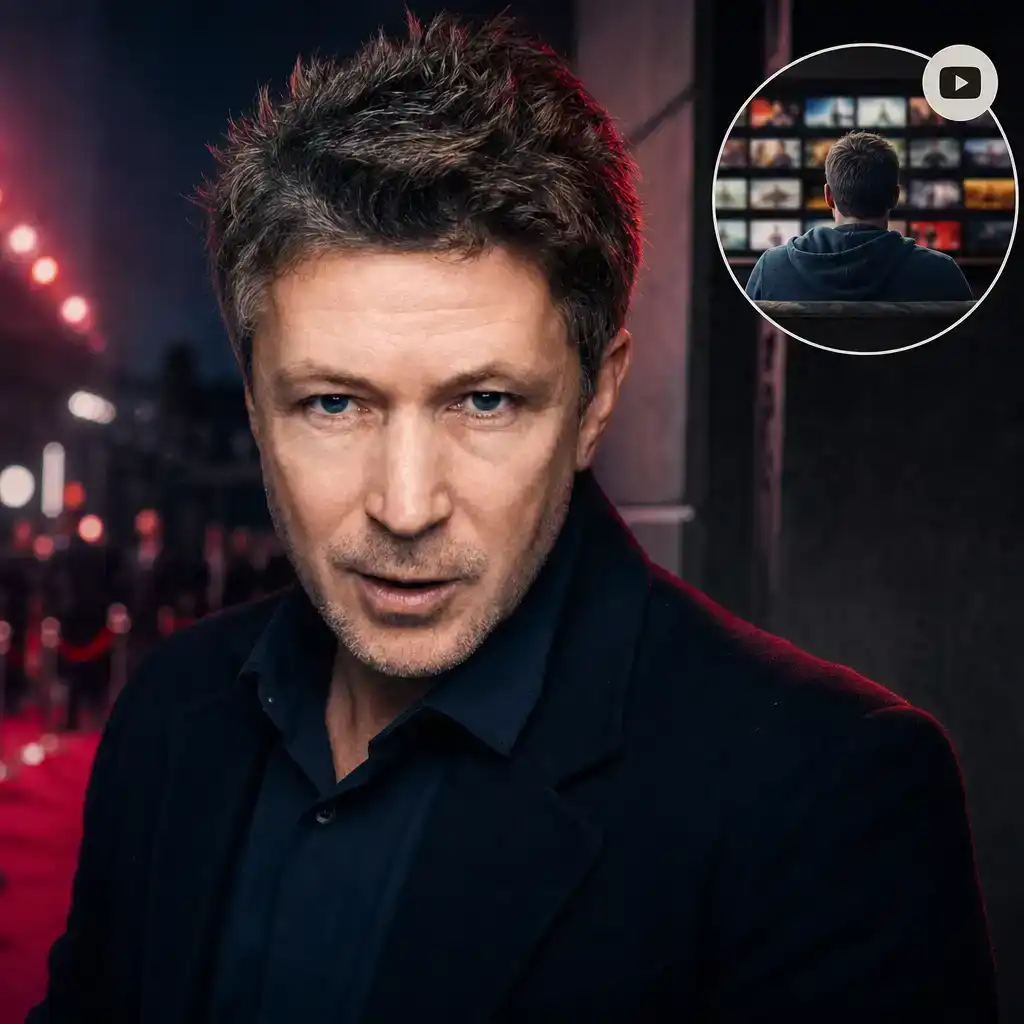
Aidan Gillen has spent enough time inside prestige television to know when the room is getting crowded. Speaking at the Transilvania International Film Festival, the Irish actor looked back on what he called a freer era for British drama and offered a blunt view of today’s TV content overload: there is, in his words, “too much on TV.”
The “Game of Thrones,” “The Wire” and “Peaky Blinders” actor is serving on the international competition jury at the Romanian festival this week. He is also there with two new films: “Re-Creation,” the Ireland-set drama from David Merriman and Jim Sheridan that premiered at Tribeca in 2025, and “Gorky Resort,” Łukasz Połkowski’s historical drama about a young Polish lieutenant in a Soviet prisoner-of-war camp.
Why Gillen thinks modern TV feels crowded
During an hour-long masterclass before a full house, Gillen argued that TV is now so packed with programming that even strong shows seem built to keep viewers constantly stimulated.
“I just think there’s so much stuff. Even the TV stuff now is being designed to try and give you these little [dopamine] hits now and then,” he said. “Even the sophisticated, high-end TV stuff is also being dumbed down a little to try and keep people interested.”
Then came the simpler version, for anyone still checking the menu on six different streaming apps: “There’s too much on TV.”
Gillen was not dismissing the medium outright. He acknowledged that television is still producing “loads of really daring stuff,” and pointed to shows such as “Pluribus” as examples of “really sophisticated” storytelling. His point wasn’t that television is dead, but that abundance makes it harder for bold work to break through.
A self-taught actor who learned by doing
Gillen also used the masterclass to trace the beginning of his career, which did not follow the polished drama-school route often associated with British stage and screen actors.
“I’m not a trained actor. I didn’t go to drama school. I was very keen to get out of school as soon as I was able to,” he said. “I found the classroom environment extremely stifling.”
Instead, he built his education wherever he could find it. He joined a theater group at 14 and spent his teenage years working through VHS rentals from a local shop. His viewing habits were wide, and not especially curated in the modern algorithmic sense. He watched “everything from the arthouse European stuff to horror movies to Westerns to Merchant Ivory stuff.”
At 18, Gillen moved to London. He soon found work at the Bush Theatre, the small but influential venue he credits with teaching him the basics of the craft. For him, the training happened in rehearsal rooms, not lecture halls, which may explain why he still talks about acting as a practical job rather than a status object.
The British drama era he still misses
Gillen’s first major screen break came in “Safe,” Antonia Bird’s gritty 1993 BBC drama in which he starred opposite Kate Hardie as a young homeless man surviving on London’s streets. The film won the BAFTA for best single drama, and Gillen remembers that period as a remarkable moment for British television.
“You could make these quite out-there, daring dramas with no interference that would end up on television, and like 10 million people would see it. It was quite incredible,” he said.
That, he suggested, is what feels different now. In his view, British broadcasters once took bigger swings on serious drama and placed them in front of mass audiences without overexplaining or smoothing down the edges.
“They don’t really do that anymore. They stopped making that stuff and started making ‘Ballroom Dancing With the Stars,’” he said. “People used to watch that stuff. It wasn’t just, ‘Oh, this is highbrow art stuff.’ It was like, ‘This is fucking brilliant drama.’”
The line landed because it was not just nostalgia for old scheduling habits. Gillen was describing a time when difficult stories could still become shared viewing, before “challenging” became a category to be hidden three rows down a platform homepage.
From “Queer as Folk” to “Game of Thrones”
After “Safe,” Gillen starred in Russell T. Davies’ “Queer as Folk,” the groundbreaking series about queer life in 1990s Britain. The show became a defining piece of British television, both for its subject matter and for the directness with which it treated characters who had too often been pushed to the margins.
Gillen then crossed to the United States for one of his most widely admired roles: Tommy Carcetti, the ambitious and morally slippery Baltimore politician in HBO’s “The Wire.” It was a part that fit neatly into the kind of intelligent, layered TV drama he had been praising, even if the show’s audience grew more slowly than its reputation.
Soon after came the roles that made him globally recognizable. In “Game of Thrones,” he played Petyr “Littlefinger” Baelish, the calculating operator whose talent for manipulation made him one of the fantasy drama’s most memorable figures. In “Peaky Blinders,” he appeared as Aberama Gold, an assassin and bounty hunter with a taste for danger and a name that sounded as if it had been designed in a very dramatic room.
His new films bring him back to darker material
At Transilvania, Gillen also promoted projects closer to the serious, unsettling work he praised from earlier in his career.
“Re-Creation,” directed by David Merriman and Jim Sheridan, is based on the real-life murder case of French producer Sophie Toscan du Plantier. The drama is set in Ireland and premiered at the Tribeca Festival in 2025.
“Gorky Resort,” directed by Łukasz Połkowski, moves into historical territory. The film follows a young Polish lieutenant inside a Soviet prisoner-of-war camp, putting Gillen in another story shaped by political pressure, moral strain and survival.
The festival setting let Gillen connect those projects to the larger arc of his career. He has moved between intimate British drama, American prestige television, global fantasy and historical film, but his comments suggest that he is still drawn to material with some discomfort built into it.
What still makes acting worth it for him
For all his concerns about the state of television, Gillen stopped short of casting himself as a doomed traditionalist. He even admitted that his complaints about streaming might not be so different from older generations panicking over radio or television.
“TV was like that when I was a teenager. ‘TV is going to kill our kids.’ And I used to come home from school and go to bed…and watch like 10 hours of TV,” he said.
That early obsession, he suggested, is still part of what drives him.
“One of the reasons I wanted to become an actor is because…I always saw the world as a really amazing playground, a work of art, a living dream. I wanted to be part of that and part of painting that picture,” he said.
He also made clear that fame was never the prize.
“It was the doing of the thing. Not the finished product, not the hotel room, not going to a film festival and walking on the red carpet or being famous or any of that stuff. I was never interested, and I’m still not, in any of that,” he said. “It’s the actual working, going in and doing it on the day, that’s what excites me.”
The Transilvania International Film Festival runs from June 12 to 21.